

The short version
What a dry fruit counter actually needs
Most counters carry four to six raisin lines and no more, because raisins sit next to almonds, cashews, walnuts and pistachios competing for the same shelf. What they need is a premium line that carries gifting, a volume line that sells all year, and a value line for the customer who is buying on price.
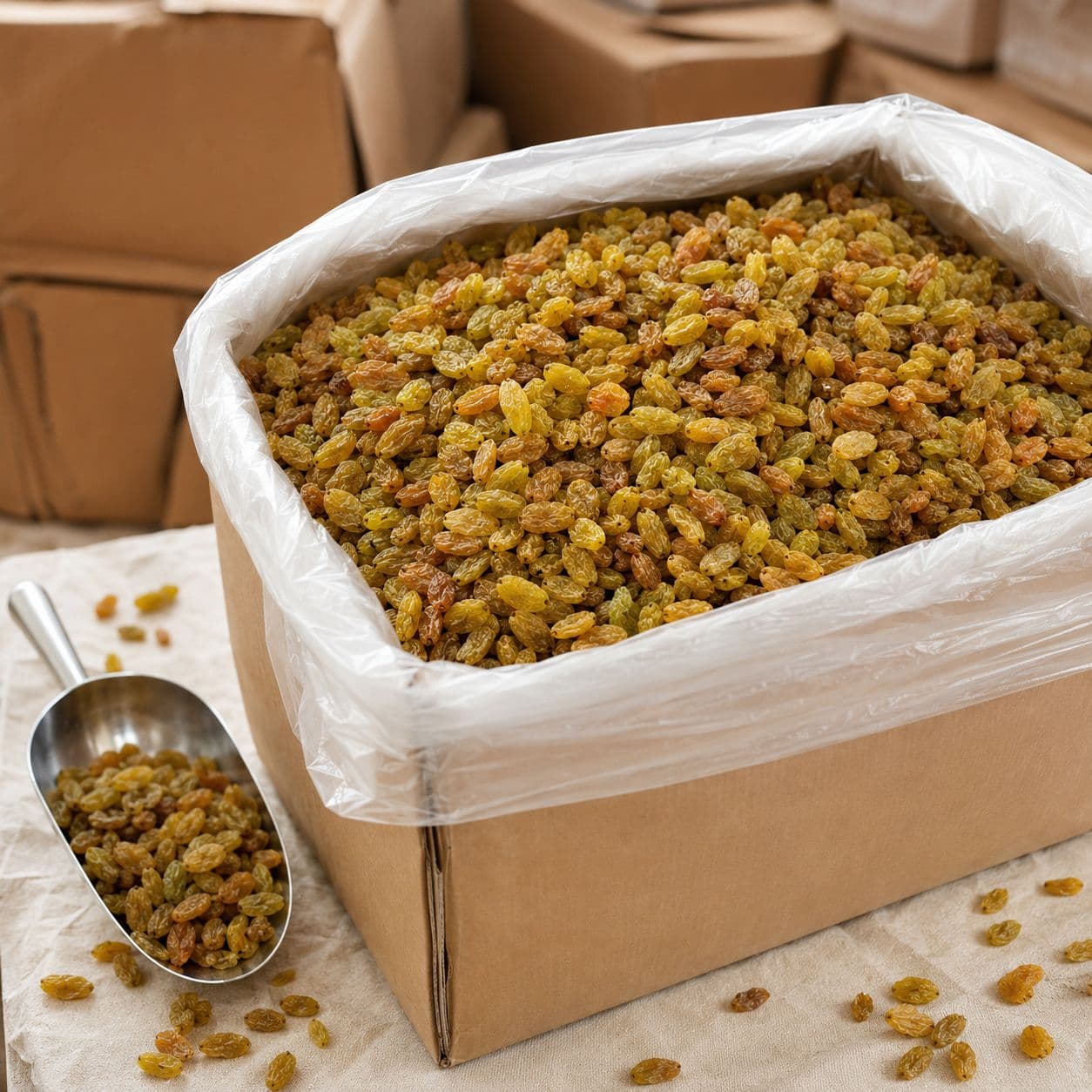
Nearly every counter also runs loose sale from an open carton alongside sealed pouches, at two different prices, and the loose line usually moves on a lower grade. There is nothing wrong with that as long as the grades are not mixed in the same tray.
Running three suppliers to fill one shelf is where distributors lose time and freight. The job of a raisin supplier for dry fruit wholesalers is to take that problem away, so we put black, green and golden across two or three grade bands on a single dispatch. The size and colour bands behind each are on the grade ladder we work to.
A working shelf plan for a dry fruit counter
The rate is your margin, so compare it properly
When you resell, a rate is not a cost line. It is the margin. Two habits protect it, and neither is complicated.
First, compare quotes inside the same grade. Grade names in this trade are conventions rather than a statutory standard, so one trader's grade A is another trader's premium and a third trader's B. A rate quoted without a size band, a colour description and a moisture figure next to it cannot be compared to anything. Ask those three lines of every supplier you are pricing against, this one included.
Second, get the number held long enough to be useful. Our quotes stand for 48 hours, which is enough time to price your counter, work your margin and confirm, without carrying market risk on stock you have not sold yet. Today's number comes from the current bulk rate.
Repacking economics
Most distributors repack, because that is where the margin sits. It is also where the margin quietly leaks, in three places that almost nobody measures.
Weight giveaway
Hand-filling 500g pouches on a table scale, your staff will overfill rather than risk a short pack, and they are right to. Five to ten grams a pouch sounds like nothing. Across a quintal repacked into 500g pouches it is a kilo or two given away before you have sold anything. Either price it in deliberately or put a checkweigher on the bench and stop guessing.
Moisture in an open carton
An open carton in a humid shop is a slow problem. Repack in short runs, close the liner between runs, and never leave a 25kg carton open across a monsoon week. Raisins take moisture out of the room and go tacky, and a tacky pouch on a shelf comes back as a return. Storage conditions and realistic shelf life are covered on storing cartons through a monsoon.
One lot per pouch run
Do not split a pouch run across two cartons from different lots. Your regular 500g customer notices a size change before your counter staff do, and they will say so at the till rather than to you. Batch marking on the carton is there so a run can be traced back to one lot and one packing date.
Private label and finished packs
Once monthly volume is steady, printed pouches or cartons in your own name become viable. It needs a volume commitment, artwork approval before the first run, and lead time scheduled around the packing line. We will not overstate that capacity: private-label runs sit in a queue behind existing work, so confirm the timeline before you promise dates to your own customers.
Distributors who are not ready for their own artwork sometimes take our sealed retail pouches instead and sell them as a finished line. Our own pack prices are published openly on what we charge a retail customer, so you can see exactly what a customer finds if they search before walking into your shop.
Format options, liners, batch marking and what a custom run involves are on carton and packing formats.
Four questions your counter staff will be asked
Get these straight once and print them on a card behind the counter. They come up every week, and a wrong answer costs you a sale or gets you a return.
Give them a hand check too
Squeeze a handful and open your palm. Good stock falls apart. Stock that holds as a lump has picked up moisture and will not sit well on a shelf. The rest of the checks, including what a spoiled lot smells like, are in a hand check anyone on your counter can run.
The distributor's year
Three peaks and one dead patch. Rakhi in August opens the gifting run, Diwali across October and November is the peak, and the wedding season carries November into February. March to June is quiet, and that is also exactly when the new crop lands and rates are at their softest.
The mismatch is the opportunity. Stock bought in April and held properly is stock you own at last season's rate when the Diwali indents come in. Stock bought in the second week of October is bought at everyone else's price, alongside every sweet unit and gift packer in the state.
Two constraints decide whether you can play it. Storage that will hold through a monsoon, and cash tied up for six months. If you have both, buy early. If you have neither, at least fix the grade and the supplier early so the only variable at reorder is the number. Season, crop and belt detail is on the Sangli and Tasgaon belt.
Freight, documents and payment
Freight per kilo falls quickly with consignment size, which is the practical argument for taking all three varieties from one desk rather than three. A mixed consignment of black, green and golden shares one lorry and one freight bill.
On credit, plainly
Payment terms are agreed at quotation, and first orders from a new account normally settle before dispatch. Credit is a relationship built over deliveries, not an opening offer. A supplier who extends it to a stranger on the first call has priced it into the rate somewhere, and you are paying for it whether you use it or not.
Choosing a raisin supplier for dry fruit wholesalers
Judge it on three things: whether the specification is put in writing, whether the grade holds across four consecutive deliveries, and whether the supplier tells you plainly when a grade is short rather than sending something close to it. Rate is the fourth thing, and it only becomes comparable once the first three are settled.
We send 250g of each grade you are considering, with a grade sheet giving size band, colour and moisture. Charged at cost plus courier and adjusted against your first order.
Put the samples on the counter rather than in the office. The people who will sell it should be the ones looking at it, and the useful question is whether it looks better or worse than what you stock today. That judgement decides your repeat sales far more reliably than a rate comparison does.
Send the varieties, the grades, an approximate monthly quantity and your destination city to the bulk desk and you will normally have a firm number back the same working day.
Frequently asked
Yes, that is a large part of what this desk does. Black, green and golden across premium and value grades, in 10kg, 20kg and 25kg cartons, with 5kg for counters repacking in short runs. Minimum order is 15kg and grades can be mixed to reach it.