

The short version
What golden raisins are, and what buyers call them
Golden raisins and yellow raisins are the same thing. Two names for one product, used interchangeably in the Indian trade, and we quote against the same grade sheet whichever word arrives in the enquiry. Some buyers also say amber, particularly bakery buyers describing what they want the finished crumb to look like.
The fruit is picked riper than the grapes that go into green lots, then dried under shade on a slower schedule so it stays plump instead of shrinking hard. Sulphur dioxide is used within permitted limits, and that is what holds the amber colour rather than letting the skin brown down towards black. This is standard practice for the variety across every producing region we know of, and we state it on the specification sheet rather than leaving it to be discovered.
The result is a raisin that is larger than black, softer than green, sweeter than both without the tart finish, and considerably more expensive to produce. It is the smallest of our three lines by volume and it is the one where supply runs out first.
If you are deciding between amber and black for a bake, the practical differences in colour, soak behaviour and cost are set out in the amber against black comparison.
Organic certification: we do not hold it
This needs saying plainly, because golden is the variety where the question comes up most and where the temptation to be vague is strongest.
We do not hold organic certification for any of our raisins, golden included. None of our lots are certified organic, none are sold as organic, and we will not describe them as natural or chemical free in a way designed to imply certification we do not have. Our golden lots carry sulphur dioxide within permitted limits, which on its own rules out most organic specifications.
If your buyer or your own label genuinely requires certified organic material, tell us at enquiry stage and we will tell you straight away that we cannot serve it. That is a better outcome for both of us than a consignment arriving against a claim nobody can document.
Grade ladder and specification
Golden has a shorter ladder than green because the volume is smaller and the buyers are more concentrated. Two bands are stocked through the year. A third appears in some seasons and not others, and we will not quote it when we cannot supply it consistently.
Golden raisin grades we quote and supply
Tolerances on the grade sheet
Golden is the variety where buyers care most about colour and least about length, which inverts the usual green conversation. What we measure and declare stays the same across all three lines.
One point worth flagging for bakery QA: golden eats softer than green at the same stated moisture, because the fruit went on the racks riper. Do not read that softness as a wet lot. Read the meter figure on the sheet.
Who buys golden raisins in bulk
Almost everything we move in golden goes to buyers who need the fruit to still look like fruit at the end of a process. That is the whole commercial case for paying more than black.
Bakeries and cake manufacturers
The core of the demand. Fruit loaves, tea cakes, muffins, buns and anything with a pale crumb where a black raisin sitting on the surface reads as burnt whether it is or not. Golden holds its amber through a 180C bake and stays visible without looking like a mistake.
Jumbo goes into premium and display lines. Grade A goes into daily production where the same behaviour is needed at a workable cost. Soak times, dusting and dosage per batch are covered in soak and dosage guidance for bakers, and supply terms for the trade are on bakery supply terms.
Rusk and biscuit units
Rusk buyers use golden dry, without soaking, because the second bake pulls moisture out and a pre soaked raisin turns leathery on the exposed face. Grade A is the usual specification. Biscuit and cookie units chop the fruit, which is exactly the case where jumbo is money wasted and grade A or commercial does the same job.
Gift hamper packers and premium retail
Jumbo, bought hardest between August and October, and judged almost entirely on colour uniformity and size because the product sits behind a window in a box. This trade competes for the same narrow band as premium select green does in the same weeks, which is why we ask hamper buyers to fix quantity by mid year.
Buyers who want to see the material on their own bench first usually take a sealed retail jumbo pouch before committing a carton.
Hotels, bakeries in hotels and institutional kitchens
Breakfast buffets, in house patisserie, muesli and dessert lines. Steady monthly consumption, 10kg and 20kg cartons, and usually grade A. These buyers care most about the same lot arriving each month, because a pastry chef who has calibrated a soak time does not want to recalibrate it in April.
Packing formats and minimum order
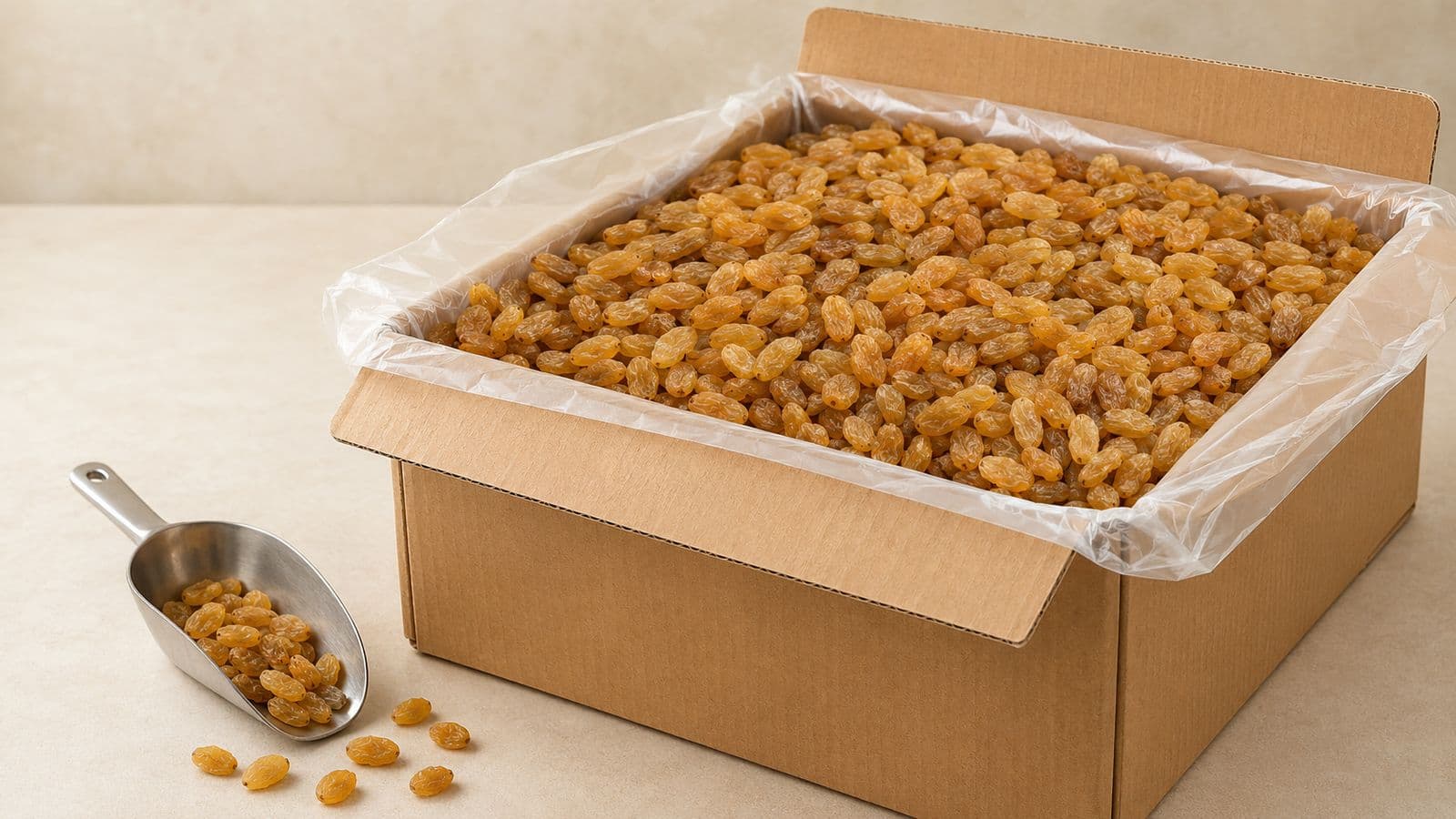
Golden ships in 5kg, 10kg and 20kg corrugated cartons with a food grade liner, closed before taping and batch marked on the outer. We do not usually pack golden in 25kg, because the buyers who take it in that quantity are rare and a 25kg carton of soft fruit compresses at the bottom if it sits stacked for months.
Carton formats for bulk golden
Minimum order and mixed loads
Minimum is 15kg and varieties can be mixed to reach it. A bakery taking 10kg golden jumbo and 5kg black for its dark lines on one dispatch is the most common first order we write.
Private label pouches and printed cartons open on repeat volume with artwork approval and lead time. Compare formats across varieties on the green carton ladder if you are placing one order across more than one line.
How golden raisins suppliers in India quote, and what moves the rate
We publish no fixed rate for golden. The market moves week to week, the jumbo band moves furthest, and a number quoted without a size band attached is not a number anybody can compare. Most serious golden raisins suppliers in India price jumbo and grade A separately for exactly that reason, and a single blended golden rate should make you ask which band is actually in the godown.
Quotations are dated, name the grade and the quantity, are stated ex-Tasgaon and hold for 48 hours. Freight is separate and quoted alongside the rate once the destination is known. Send us four lines and you will normally have a figure back the same working day.
Why golden costs more than black
Riper fruit at picking, a slower shade schedule, more rack time per kilo, tighter colour sorting and a smaller total production. Every one of those is a cost, and together they put golden above both other varieties at comparable grades.
Bakery buyers sometimes try to close that gap by putting black into a light bake and accepting the appearance. It works commercially in dark and spiced products. It does not work in a pale crumb, and we would rather say so than sell you a cheaper carton you return. For the current figure against your band, ask for the day's quoted rate.
Samples and the first order
Golden is the variety where a sample matters most, because colour is the whole specification and colour is exactly what a photograph or a phone screen misrepresents.
Seasonality and availability
Production runs February to April and then stops. Everything sold from May onward is drawn out of cold storage against a quantity that is already fixed, and golden is the smallest of the three lines, so it is the first to run tight.
Two demand peaks collide in the same window. Hamper packers want jumbo for Diwali and bakeries scale up for the Christmas and New Year season immediately after. From roughly September the jumbo band is the hardest material in our godown to allocate, and we start telling new enquiries honestly that grade A is what is realistically available.
The golden buying year
Where bulk golden buyers get caught out
These come through the desk every year, and most of them are decisions made at purchase rather than problems that developed in storage.
Storage at your end
Golden sits between the other two varieties in behaviour. It does not clump as hard as black, and it does not brown as visibly as green, but it does soften and dull if it is left warm. Cool, dark, off the floor, away from external walls, and used in strict batch order against the outer marking.
Realistic warehouse conditions and what shelf life actually looks like in an Indian godown are on carton storage and shelf life.
Freight, payment and paperwork
Rates are ex-Tasgaon with freight quoted separately once destination and quantity are known. Within Maharashtra, part load transport reaches most towns in two to four days. Pan India, consignments up to a few quintals normally move by courier and larger loads by transport, typically four to seven days.
Every dispatch carries a GST invoice showing HSN classification, variety, grade, quantity, rate and packing, and cartons are batch marked so a consignment traces back to a lot and its packing date. A grade sheet can travel with the consignment where your intake process needs one. Payment terms are agreed at quotation, and we do not extend open credit to a first time buyer.
New buyers setting up a supplier rather than reordering will find the full sequence, dispatch detail and sample process on how we set up a new bulk account.
Frequently asked
Yes. They are two trade names for the same product and we quote both against the same grade sheet. Some bakery buyers say amber, which is also the same fruit. What matters on the order is the size band, jumbo or grade A, rather than which of the three words your buyer uses.