

The short version
What long green seedless actually is
Same grape as black. Thompson seedless, off the same vineyards around Tasgaon, often off the same grower's plot in the same week. The difference is entirely in how it is dried.
Green fruit goes on the racks after a food grade dip that breaks the waxy bloom on the skin so moisture can leave evenly. The racks sit under shade net, out of direct sun, for roughly 12 to 16 days. Kept off the sun the skin never darkens, so the finished raisin stays pale green to light olive, long, firm and slightly tart. Rack time is longer than black and rack space is the limiting resource in the whole belt, which is a large part of why green carries a premium at every grade. The full sequence is written out in the shade drying process.
Green lots carry sulphur dioxide, used within permitted limits, and that is what holds the pale colour instead of letting it brown. We say so on every specification sheet. A buyer who wants an unsulphured product is asking for black, and we would rather point them there on the first call than have the conversation after a consignment lands.
All our green is seedless. It is graded on length first, colour uniformity second and moisture third, and those three numbers are what a quotation attaches to. Origin, season and how the yard actually works are on the Sangli belt page.
Grade ladder and specification
Green has the widest grade ladder of the three varieties, because length is measurable and buyers pay for it. The ladder below is what we quote and supply. It is measured on a representative draw from inside the lot, not on a handful skimmed off the top.
Length is where money changes hands. A four millimetre difference in the average piece is visible across a 500g pouch on a counter, and a repacker whose customers have got used to the long grade cannot quietly drop a band without hearing about it.
Green raisin grades we quote and supply
Tighter draws and what they cost you
Buyers packing premium gift lines sometimes ask for a tighter cut off the top of premium select, effectively the longest fruit in the lot. We can arrange it on prior notice for repeat volume, but it needs lead time and it does not come at premium select rates, because pulling a narrow band out of a lot leaves the rest of that lot harder to place.
Ask for it before harvest planning rather than in September. In October we will usually say no, and that is a capacity answer rather than a commercial one.
Tolerances on the grade sheet
These lines travel with every sample and every consignment. If you are running a supplier comparison, ask everybody to answer the same ones next to their rate. The format we use across all varieties sits on the specification we quote against.
Who buys bulk green kismis, and why
Green is bought for how it looks on a shelf and how it behaves in a pan. It survives a boil, stays whole and visible in a kheer or a pulao, and its slight tartness cuts a very sweet dish. Those two properties account for nearly all of the demand.
Dry fruit wholesalers and repackers
The single largest buyer group for premium select, taken in 10kg and 20kg cartons and repacked into 250g, 500g and 1kg pouches. What they need from a supplier is not the sharpest rate in any given week but the same length band every month, because a counter customer compares this month's pouch against last month's without being asked to.
Distributor specific terms, breadth across varieties on one dispatch and private label options are on what distributors order.
Retail chains and gift hamper packers
Premium select again, and this trade buys hardest between August and October for the festive window. Hamper packers care about length and colour uniformity above everything, because the product is being looked at through a window in a box rather than tasted before purchase.
The practical constraint is that everybody wants the same band in the same eight weeks. Buyers who fix grade and quantity in May get served. Buyers who ring in the second week of October get grade A and an honest explanation.
Food manufacturers and ready mix units
Grade A and grade B, bought against a written specification rather than a grade name, going into kheer and payasam mixes, instant desserts, breakfast cereals and cake and dessert premixes. These buyers care about moisture and defect tolerance more than length, because the fruit is being blended rather than displayed.
They also need the same lot behaviour across months, which for green means committing volume during the season rather than buying spot through the year.
Sweet units, caterers and hotels
Grade B mostly, in 20kg and 25kg cartons, where the raisin must stay whole in a rice or milk preparation but nobody is inspecting individual pieces. Sweet units generally split their order, taking green for anything that stays visible and black for anything that cooks down. The black ladder for that half of the order is on the black grade bands.
Packing formats and minimum order
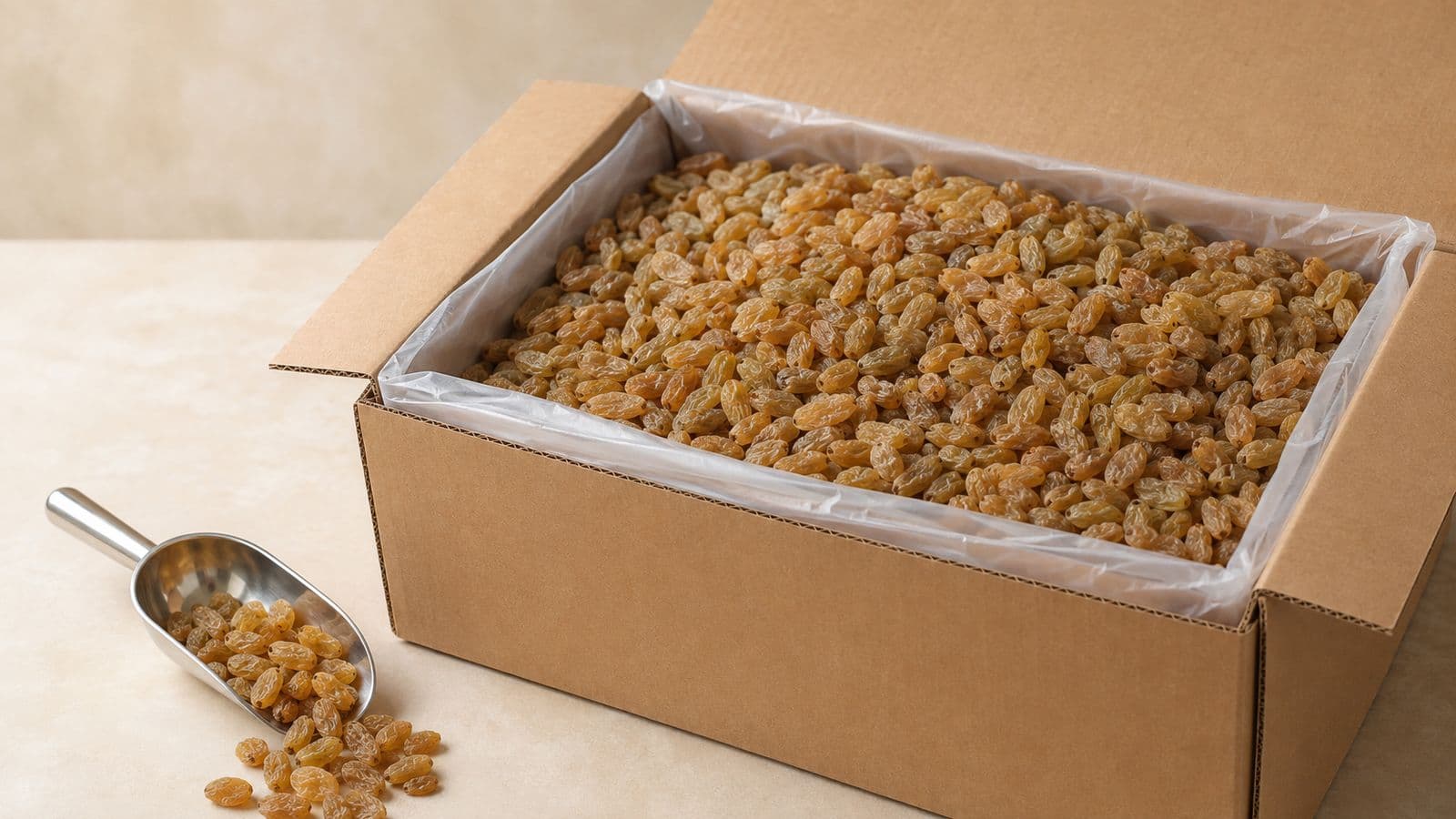
Standard packing is a corrugated carton with a food grade liner, closed before taping and batch marked on the outer so a consignment traces back to a lot and a packing date. Green moves mostly in 10kg and 20kg, with 5kg used by caterers and small repackers who cannot turn a larger carton over fast enough.
Carton formats for bulk green
Minimum order, mixed loads and private label
Minimum is 15kg and mixed varieties count towards it. A first order of 10kg premium select and 5kg grade A, so you can put both in front of your own customers, is a perfectly sensible way to start and we would rather sell that than talk somebody into a quintal they are not sure about.
Private label pouches and printed cartons open up on repeat volume, with artwork approval and lead time before the first run. If you would rather buy a sealed pouch and take it apart on your own bench before committing, our retail premium select pack is the same material out of the same lots.
Green raisins wholesale rates and quotation basis
We publish no price list for green raisins wholesale and there should not be one. The Tasgaon market moves week to week, premium select moves further than the rest of the ladder, and a rate quoted without a length band attached to it means nothing at all.
So we quote on the day, against a named grade and a named quantity, ex-Tasgaon, and hold that number for 48 hours. Freight is separate and comes with the quote once we know the destination. Four lines from you is enough to price it.
Why green sits above black
Shade drying occupies rack space longer, rejects more fruit for colour patchiness and produces a raisin that is graded on a visible dimension. All three push cost up. The gap is real and it is a production cost, not a quality verdict, and any supplier who explains it as green simply being the better raisin is selling rather than explaining.
Inside green, the spread from premium select down to grade B is wider than the gap between green and black at the same band. That is the single most useful fact on this page. For the current number against your grade, ask for the day's bulk rate.
Samples and the first order
Green is the variety buyers most often get wrong from a photograph, because a camera flattens both length and colour. Handle it before you commit.
Seasonality, and why premium select runs short first
All of a year's raisins are made between roughly February and April. Nothing is produced after that. From May the whole trade is drawing down a fixed quantity out of cold storage, so timing is a bigger lever on your landed cost than negotiation is.
Green has one specific vulnerability. Shade racks are finite and rack time is long, so the belt can only make so much green in a season regardless of how the grapes come in. Then weather does the rest. A wet week in March produces lots that dry unevenly and drift olive, and those lots do not disappear, they simply grade down. Total tonnage looks close to normal while the premium select band thins out badly. That is why the spread between premium select and grade B widens in a poor year even when the headline crop reads fine.
The green buying year
Where bulk green buyers get caught out
Every one of these has arrived at this desk as a complaint that traced back to a purchase decision made months earlier.
Browning is not a defect, it is a countdown
Green does not clump the way black does. What it does is drift, from pale green towards yellow and then brown, and it does it faster in warmth and light. The fruit is entirely usable. What has gone is the pale colour you paid the premium for.
So green wants the cool, dark, off the floor treatment more than black does, and it wants strict first in first out against the batch mark. A carton bought in May and opened in November against a carton bought in September is a comparison your own customers will make for you.
Freight, payment and paperwork
Quotes are ex-Tasgaon. Freight is separate and quoted with the rate once destination and quantity are known. Within Maharashtra, part load transport reaches most towns in two to four days. Pan India, up to a few quintals normally moves by courier and larger consignments by transport, typically four to seven days.
Every dispatch carries a GST invoice showing HSN classification, variety, grade, quantity, rate and packing. Cartons are batch marked so a consignment traces back to a lot and its packing date, and we can send a grade sheet with the consignment where your intake process wants one. Payment terms are agreed at quotation, and we do not open credit lines with a first time buyer.
If you are setting up as a new buyer rather than reordering, the whole sequence from enquiry to standing order is laid out on the wholesale hub, which is also where location and dispatch detail sits.
Frequently asked
Green raisins wholesale rates move with grade, quantity and the week. Premium select, grade A and grade B are three genuinely different products, and the spread across that ladder is wider than the gap between green and black. We quote the day's rate ex-Tasgaon against a named length band and hold it for 48 hours. Minimum order 15kg, freight separate.