

The short version
What we stock, and what we do not
Black raisins are Thompson seedless grapes dried in open sun. Ten to fourteen days on the trays through February, March and April, no shade net over them and no bleaching agent anywhere in the process. The skin runs from green through brown to something close to black, the flesh softens, and the sugar concentrates until the fruit tastes jammy rather than fresh. That is the whole product.
We buy lot by lot through the season from growers and traders around Tasgaon, Palus, Khanapur and Miraj, sort at our own bench and commit the balance to cold storage. We will not tell you every kilo came straight off a farmer's rack. Some of it moves through the market yard and some sits in cold storage before we take it. Either way it is squeezed, tasted, graded and written up the same way before it goes into a carton, and the region it comes out of is described on the belt we buy in.
Everything we sell as black is seedless. Seeded black raisins, the loose dark fruit sold by weight in parts of north India, are a different product on a different grape and we do not carry them. If your specification genuinely needs seeds, say so at enquiry stage and we will tell you straight that we cannot serve it rather than shipping something close and hoping. The seeded and seedless split sets out what is actually on the market.
Sulphur is the other question that lands on the first call. Black is not sulphured. Sulphur dioxide exists in this trade to hold a pale colour, and black is meant to darken, so there is nothing to hold. Green and golden lots do carry it within permitted limits. If your QA team runs one specification across all three varieties, that difference has to be written into it before anybody signs anything.
Grade ladder and specification
Grade names in this trade are convention, not statute. Two suppliers can both write grade A on a bill and ship visibly different fruit, and neither of them is lying. The ladder below is what we quote against, measured on a representative draw pulled from inside the lot rather than off the top layer of the carton.
Size on black is a smaller number than buyers expect if they have been handling green all year. Grade A black at 12-16 mm sits well under premium select green at 18-22 mm, because open sun shrinks the fruit further than a shaded rack does. A buyer switching from green to black for the first time almost always writes back asking whether the lot has been undersized. It has not. It is a different variety and it is supposed to look like that.
Black raisin grades we quote and supply
The tolerances we work to
These are the lines that travel on the grade sheet with every sample and every consignment. Ask any supplier you are comparing to answer the same ones, in writing, next to their rate.
Moisture is the line buyers skim and then regret. Black carries more free sugar at the surface than green does, so a lot packed wet will set solid in a Mumbai godown by the second week of July and somebody on your floor will be breaking cartons apart with a mallet. Tell us your band before we quote, not after the truck has left Tasgaon.
Who buys bulk black kismis, and why
Black is the workhorse of the three varieties. Cheapest per kilo, sweetest on the tongue, and the one that disappears into a cooked product without anybody noticing it went in. That combination decides almost all of the demand, and it is why black moves in larger single consignments than green or golden do.
How the same three parameters run across black, green and golden is set out on the ladder for all three varieties, which is worth reading if you are placing one order across more than one line.
Sweet and mithai manufacturers
Our largest black buyers by volume. Laddoo, panjiri, halwa, dry fruit barfi, ghee based sweets of every description. Grade A goes where the raisin sits visible on the finished piece. Grade B or commercial goes where it cooks down into the mixture and nobody will ever see an individual raisin again.
A unit running two quintals a month into a Diwali season will usually take grade B and put the saving into more fruit rather than better looking fruit. That is the correct call and we will say so rather than push the top band. Terms specific to that trade sit on what mithai units order.
Namkeen, chikki and snack units
Commercial grade, bought by the quintal, and size becomes close to irrelevant once the fruit is mixed into a bhujia or set into a chikki slab. What these buyers care about is that the lot is dry enough not to clump inside their own storage and free enough of stems that it does not slow the line.
Chikki makers in particular like black because the natural sugar binds without extra jaggery going in, and the colour vanishes into the slab anyway.
Dry fruit wholesalers and repackers
Grade A, taken in 10kg or 20kg cartons and repacked into 250g, 500g and 1kg pouches for counters. Consistency matters more here than anywhere else in the list, because a customer who bought a good pouch in June and a poor one in September blames the shop, not the lot.
Repackers who want to check the material before committing to a carton usually buy a sealed pouch of the same grade A lot first and take it apart on their own bench.
Caterers, hotels and institutional kitchens
Twenty and twenty five kilo cartons, ordered against a festival and wedding calendar rather than a steady monthly figure. Price sensitive, and usually happy on grade B once somebody has explained that the raisin is going into a pulao garnish where softness helps.
Packing formats and minimum order
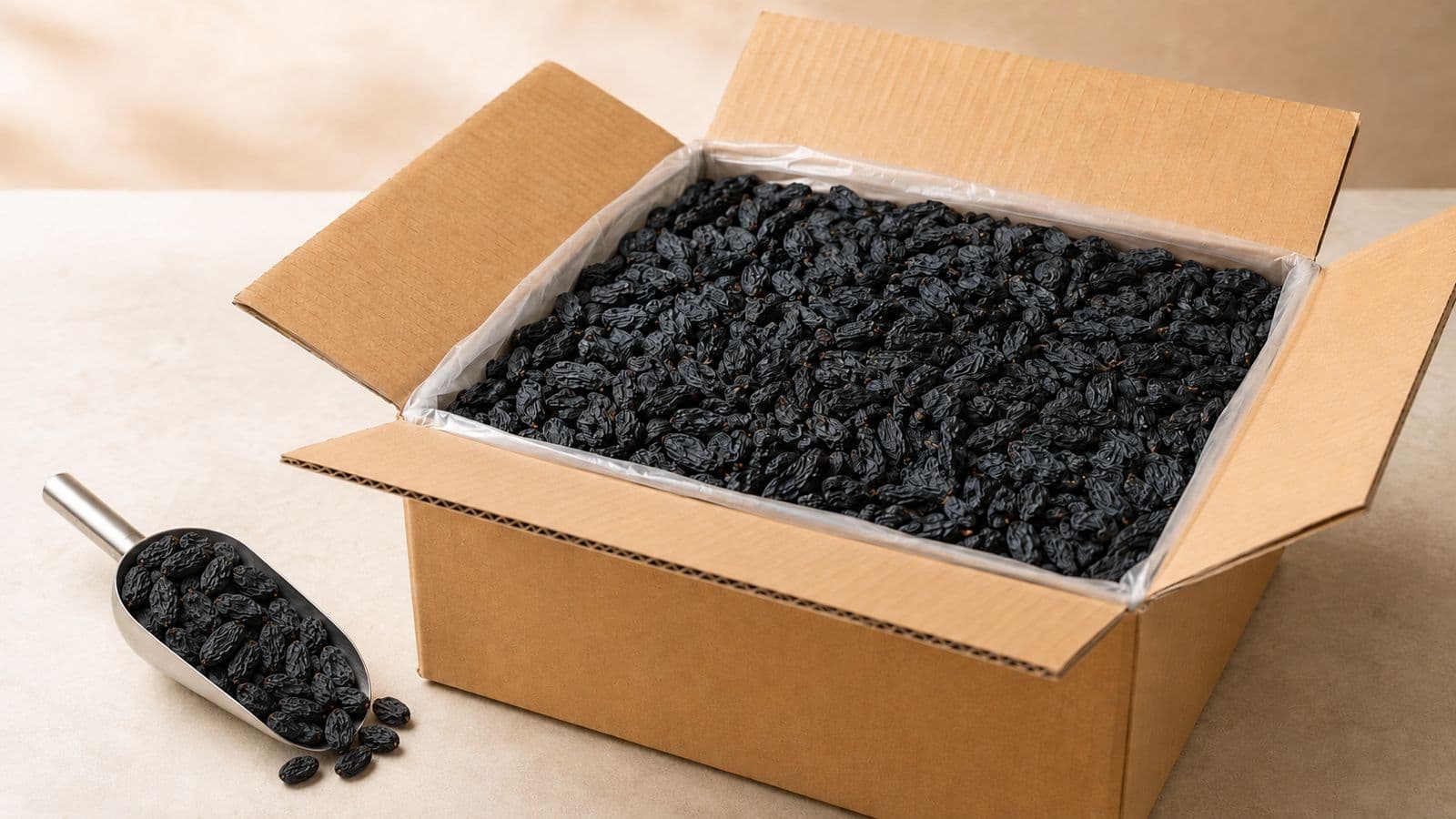
Standard packing is a corrugated carton with a food grade liner, closed before the carton is taped and batch marked on the outer so a consignment traces back to a lot and a packing date. Ten and twenty kilo are what most black moves in.
Carton formats for bulk black
Minimum order and mixed consignments
Minimum order is 15kg. That is not a policy invented to sound serious. Below fifteen kilos, freight, packing labour and paperwork cost more than the margin on the consignment, and you are genuinely better served buying sealed retail packs.
Mixed varieties count towards the minimum, so 10kg of black and 5kg of green on one dispatch is a valid order. Custom weights, printed cartons and private label pouches open up on repeat volume, with artwork approval and lead time before the first run, because those runs get scheduled around the packing line rather than dropped into it. Formats and what each one costs you in handling are on carton formats and private label.
Black raisins wholesale rates and how we quote
Most black raisins wholesale enquiries reach this desk as a bare rate question with no grade attached to it, and that is the one version of the question nobody can answer honestly. We do not publish a fixed rate for black and we would be careful with a supplier who does. The Tasgaon market moves week to week. A price list printed in June is fiction by August, and a list that names no grade was fiction on the day it was printed.
What you get instead is a dated quotation against a named grade and a named quantity, ex-Tasgaon, valid for 48 hours. Freight is quoted separately because it depends on where you are and how much you are taking. Send four things and you will normally have a number back the same working day.
What actually moves the number
Four things, in this order. Grade first, and by a wider margin than most buyers expect: the spread between grade A and commercial black is larger than the spread between black and green at the same grade. Season second, because all of a year's stock is made in one window. Crop year third. Quantity last, and it matters less than buyers hope below a few quintals.
If you want the current figure rather than the mechanics behind it, ask for the day's quoted rate and give us the four lines above.
Samples and the first order
No sensible buyer commits a quintal to a supplier they have never handled material from. The sample process exists so that the first carton is not the experiment.
When black lots are made, and when to buy
Every raisin sold in India in a given year is made between roughly February and April. There is no second harvest and no rolling supply. From May onward the entire trade is drawing down a fixed quantity out of cold storage, which is why timing matters more here than in most food ingredients a buyer deals with.
Black carries its own wrinkle. Because it dries in open sun it is exposed, and one unseasonal shower in the second week of March sends growers running to pull trays in. Fruit that goes back out afterwards carries patchy colour for the rest of its life. That does not shrink total tonnage by much. What it does is thin the grade A band specifically, so the gap between grade A and commercial widens for the whole rest of the year.
The black buying year as we see it from the yard
Where bulk black buyers get caught out
None of these are hypothetical. Every one of them has come through this desk in the last few seasons, usually as a complaint that turned out to be a purchasing decision made months earlier.
The one that costs real money
A trader can undercut anybody in Sangli by quoting commercial against somebody else's grade A and never mentioning which one he is holding. It is not fraud. It is a rate for a product, and the product was never named.
So ask for size, colour and moisture written next to the rate. If it comes back as a bare number per kilo, you have learned something useful about the supplier without spending anything.
Freight, payment and paperwork
Rates are ex-Tasgaon and freight is separate, quoted alongside the rate once we know the destination. Within Maharashtra, part load transport reaches most towns in two to four days. Pan India, consignments up to a few quintals usually move by courier and anything larger by transport, typically four to seven days depending on where you are.
Every dispatch carries a GST invoice showing HSN classification, variety, grade, quantity, rate and packing, and cartons are batch marked. Payment terms are agreed at quotation. We do not run open credit with a first time buyer, and we would rather say that at the start than negotiate it after the lot is packed and sitting on the bench.
Raisins travel better than most buyers assume. Heat in a truck is not the problem. Moisture is, which is why the liner is closed before the carton is taped and why we ask you to keep stock off a bare floor at your end. The full procurement sequence, from first enquiry through to a standing reorder, sits on our bulk supply desk.
Frequently asked
Black raisins wholesale rates depend on grade, quantity and the week you are asking. Grade A, grade B and commercial black are three different products and the spread between them is wide, so a single per kilo figure would mislead you more than it helped. We quote the day's rate ex-Tasgaon against a named grade and hold it for 48 hours. Minimum order 15kg, freight extra.