

The short version
The formats we actually pack
These four are stocked. Anything outside them is a custom run, which means line time and lead time, and we will say so rather than quietly agreeing and delivering late.
The choice is less about your total volume than about how fast one carton empties on your floor. A carton that sits half open for six weeks in a Konkan monsoon is a worse buy at any rate than a smaller carton finished in ten days. MOQ, sample terms and dispatch sit alongside format in the same conversation, and they are all set out at the wholesale desk.
Stocked bulk raisin packing formats
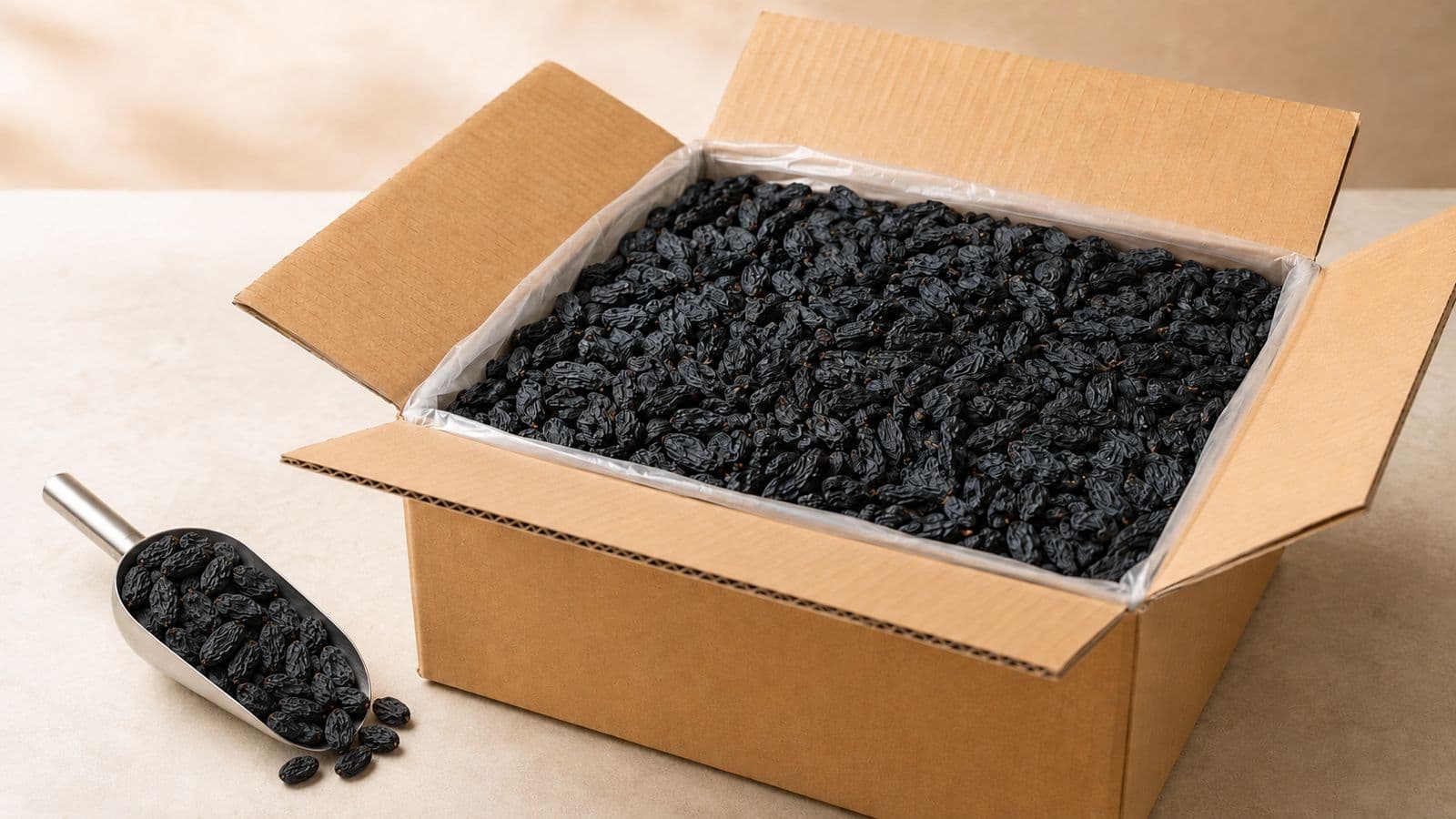
Inside the packaging: liner, carton and fill
The carton is a box. It stops the stack collapsing and it takes the abuse of a transport lorry. It does almost nothing about moisture, which is the only thing that actually harms raisins in transit and storage.
The liner is the part that matters.
Food grade liner
Every carton we send is lined with food grade material, filled, and closed at the neck before the flaps go down. That closure is the moisture barrier for the whole journey. If it is folded loosely so somebody can look inside quickly at your intake bay, it has stopped being a barrier from that moment on.
Tell your goods inward team to reclose the liner properly after sampling, or better, to sample from one nominated carton and leave the rest sealed. We have had lots come back to us as complaints where the fault was six cartons opened for inspection on a wet August morning and never reclosed.
Carton construction and stacking
Cartons are corrugated kraft, taped and marked. They stack, and they will hold a reasonable column, but a raisin carton is not a rice sack and it does not want a forklift pallet dropped on top of it. Damage we see on arrival is almost always crushing from the bottom of a mixed load rather than anything that happened at our end.
Where the consignment shares a lorry with heavy goods, say so at booking. It changes how the transporter loads and it is a free improvement.
Weight and fill
Cartons are filled to a nominal net weight and weighed at the packing bench. Weigh one on arrival against the invoice as part of your intake check. If a carton reads short, tell us the same day with the batch mark, because that number ties back to a specific bench and a specific hour.
Batch marking and what is printed on the outer
Every outer carries a batch mark, the variety, the grade and the net weight. The batch mark is the useful one. It ties the carton back to the lot it was drawn from and the date it was packed, which is the whole basis on which a complaint can be investigated rather than argued about.
For buyers running a formal goods inward process, this is also what makes first in first out enforceable. A godown storing four deliveries of green grade A with no dates on the cartons is a godown that will eventually put the oldest stock at the back of the stack and leave it there.
If your QA process needs specific marking on the outer, an internal item code, a customer PO number, a particular description format, tell us at quotation stage. Adding it after the third dispatch means your records show two different marking conventions for the same product, and somebody in your accounts team will spend an afternoon on that. The documentation set ingredient buyers in food processing usually want goes further than this, and it is easier to agree at the first order.
Bulk cartons against retail pouches
These are two different products with two different cost structures, and buyers occasionally compare them and conclude something odd about our pricing.
A retail pouch is nitrogen flushed, sealed, printed, dated and priced to sit on a shelf. It carries the cost of the film, the print, the flush, the small run and the handling. A bulk carton carries a liner and a stencil. Per kilogram they are not comparable, and they should not be.
If you are buying under 15kg, the sealed packs on our retail price list are genuinely the better buy. Above 15kg, cartons are the right format and the rate comes off the day's wholesale quotation.
Bulk packing against retail packing
Custom packing and private label
For repeat buyers we pack to a custom weight or into your own printed cartons or pouches. This is a real service and it is also a scheduling problem, so we are direct about what it needs: a volume commitment, artwork approved before the first run, and a lead time agreed in advance.
The usual path is a distributor who starts on 10kg cartons, settles on one or two grades over four or five months, and then wants their own name on a 500g pouch for their counters. That is the right moment for it. Doing it on the second order, before the grade has proved itself in your market, means printing film for a specification you may still change.
Buyers repacking for retail shelves should read what distributors usually order alongside this, because grade breadth and packing decisions tend to get made in the same conversation.
How your packaging choice changes landed cost
Three things move with format. Rate per kilogram, which falls as the carton gets bigger. Freight, which is charged on weight or volume depending on the transporter and generally favours denser, larger units. And wastage, which moves the other way.
Wastage is the one buyers underestimate. A 25kg carton opened by a small bakery gets worked through over two months, and by the last five kilos the fruit has been exposed to air, humidity and however many people reached into it. The rate saving on that carton was smaller than what the last five kilos cost you in texture.
Our advice, and it costs us a little margin to give it: buy the largest carton your floor can genuinely finish in three to four weeks, not the largest carton you can carry. Storage conditions once it is open matter as much as the format, and those are set out in holding bulk stock through an Indian year.
What goes wrong in packing and transit
Clumped cartons on arrival are nearly always a liner or a transit problem, not a grading problem. A properly dried lot that left the bench at spec does not clump inside a closed liner in four days on a lorry. If it arrives clumped, something got wet or something was open.
Crushed cartons come from loading. Short weight comes from the bench and is rare but not impossible. Wrong grade in the right carton is the one that hurts, because it is only found in production, and it is why the grade goes on the outer as well as on the invoice.
Tell us on the day, with photographs and the batch mark. The full intake check we recommend is part of the bulk buying workflow, and the parameters you are checking against are on the specification sheet we quote to.
Frequently asked
Corrugated kraft cartons in 5kg, 10kg, 20kg and 25kg, each with a food grade liner closed at the neck before the flaps go down. Outers carry variety, grade, net weight and a batch mark traceable to the lot and packing date.