

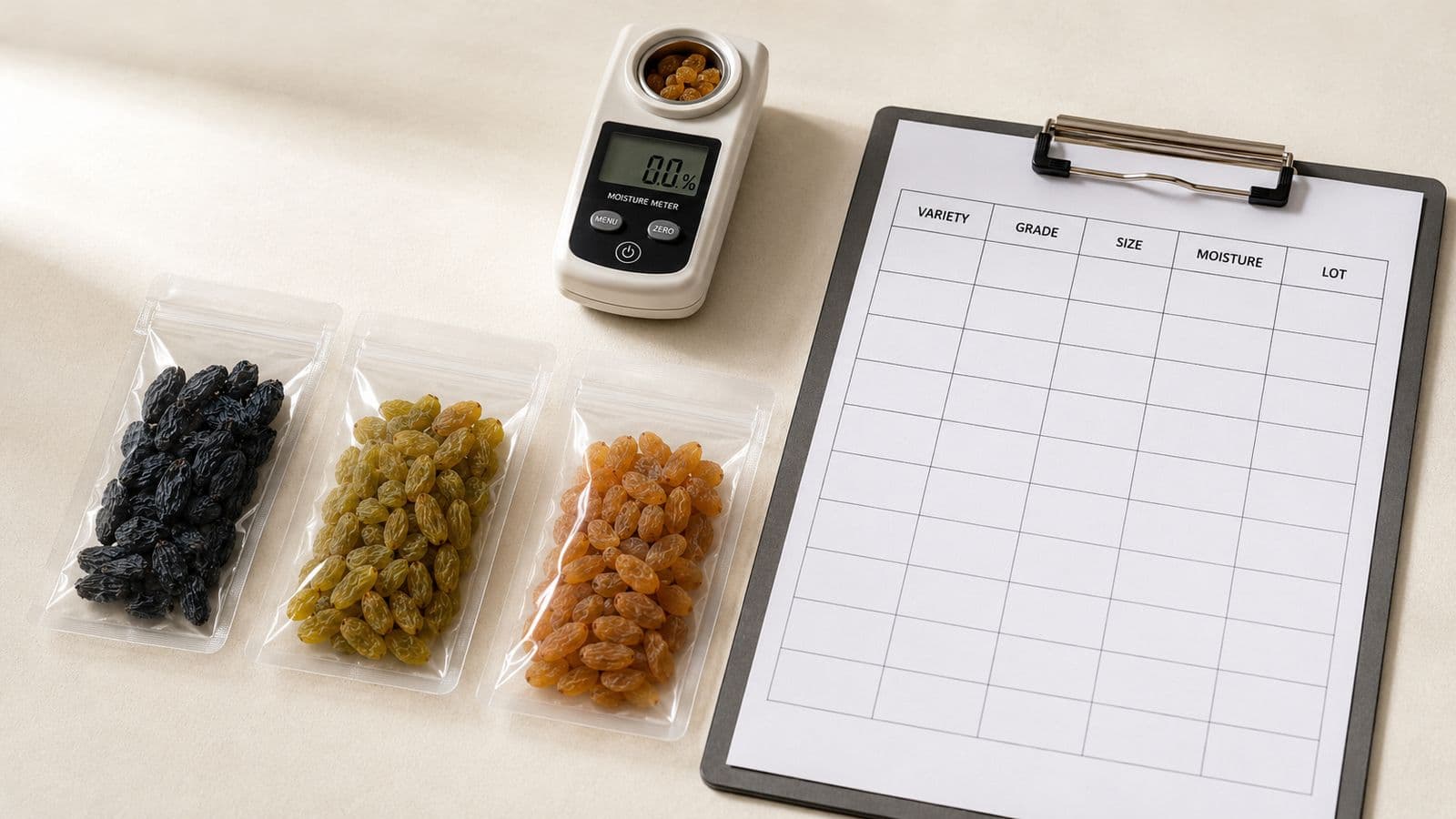
The short version
Grade names are trade conventions, not a standard
There is no single rulebook that every trader in the Sangli belt is bound to when he writes a grade on a carton. The names grew out of how lots were physically sorted and sold, and they still work that way. Two godowns a kilometre apart in Tasgaon can both mark grade A and mean material that sits a full size band apart. Most of the time that is not dishonesty. It is the absence of a common measure.
Export contracts behave differently, because the overseas buyer writes the specification and the specification travels with the money. Domestic bulk trade mostly runs on a grade name plus a sample, and the sample is quietly doing all the work. That holds up fine until the third consignment lands and nobody wrote anything down.
So treat every grade name below as shorthand. It is useful shorthand, the vocabulary the whole belt speaks, and you will not get a sensible conversation started without it. But the numbers behind the name are what you are actually buying, and turning those numbers into a contract is the specification side of the same conversation.
Raisin size is the leg that leads the grade
Size comes first because it is the first sort that physically happens to a lot, and because it is the one thing a buyer can verify standing at a counter with no equipment at all. What size means changes by variety, which is where most confusion starts.
In green raisins, size means length, measured tip to tip on a dried berry. In black and golden it means body. A long flat black raisin is a worse berry than a shorter plump one, and no millimetre band on its own will tell you that.
Measuring green by length
Draw twenty pieces from the middle of a carton, not off the top layer, and line them against a steel rule. Ignore the two longest and the two shortest. Where the middle sixteen sit is your band. Premium select green runs 18-22 mm. Grade A sits at 15-18 mm. Grade B comes in at 12-15 mm and reads visibly shorter in the hand once you have seen the other two.
Nobody in the market yard does this with callipers. A rule and twenty berries settles most arguments inside a minute, and if you want to see what a tight premium band looks like without placing a bulk enquiry, a pouch of our long green kismis is the cheapest reference sample you will ever buy.
Black and golden are judged on body
Grade A black runs roughly 12-16 mm and should feel plump between finger and thumb. Flat pieces mean the grape went onto the racks under-filled, and they eat dry however good the colour looks. Grade B black at 10-13 mm is smaller and more mixed, which is fine where the fruit is going to be cooked into something.
Golden jumbo runs 16-20 mm and is the one line where buyers routinely reject on size alone, because a bakery paying jumbo rates wants the fruit visible in a slice. Golden grade A at 13-16 mm does the same job in daily production at a better rate.
Sieve fractions and what falls through
Lots pass over sizing sieves before hand sorting, and what falls through is not waste. It becomes the next grade down, or it goes to processing buyers who are grinding, cooking or coating the fruit anyway. Perfectly good material, sold honestly, at the rate it deserves.
The thing to watch is a grade quoted well under the market for that name. Ask if what you are being offered is a sieved fraction. There is nothing wrong with buying one. There is a great deal wrong with paying grade A money for it.
Colour uniformity and moisture, the other two legs
Colour is judged across the whole handful and never piece by piece. Even pale green for green, deep brown-black for black, warm amber for golden. A few darker berries in a green lot are normal and honest, because grapes do not dry at identical rates on a rack. What downgrades a lot is broad patching, a chalky dullness, or a handful that plainly looks like two lots poured together.
Moisture is the leg you cannot see, and it is the one that decides what the lot does after it leaves us. Green is dried to around 15 percent, black a shade under that, golden around 15 percent as well. Two or three points over and the material looks right on the day, tastes right on the day, and mats into a block in week eight. What that means for a godown through an Indian monsoon is set out in bulk storage and shelf life.
A lot that is uniform on all three legs is a premium lot. Uniform on size but patchy in colour grades down. Uniform on both but three points wet is not a grade problem at all, it is a rejection waiting to happen.
The full raisin grade ladder across black, green and golden
These are the grades we actually stock, sort and quote. We do not list grades we cannot supply consistently through a year, because a name on a website that turns into a substitution at dispatch is worse than no name at all.
Read the ladder vertically inside a variety, not horizontally across varieties. Grade A green and grade A black are not the same tier of material. They are the second rung of two different ladders.
Raisin grades in India as we quote them, by variety
Grade words you will hear that we do not put on a quote
Half the grading vocabulary in circulation describes a process, a house preference or a sales pitch rather than a tier of material. None of it is illegitimate. It just cannot be compared between two suppliers, which is the only thing a grade is for.
Common trade terms and what to ask for instead
Why grade moves the rate more than variety does
Buyers new to bulk usually assume the big price decision is green against black. It is not. Inside green alone, premium select to grade B is a wider spread than green to black at the same tier. Grade is where the money sits.
The spread also breathes with the season. A wet stretch during the February to April drying window damages the top of the crop first, because premium material is exactly the material that has to come off the racks even in colour and unbroken. Total tonnage can look normal that year while premium select is genuinely scarce, and the ladder stretches. In a clean drying season it compresses again.
This is why a rate is only comparable when a grade is stapled to it. Send us variety, grade, monthly quantity and destination and we will quote the day's number for that exact tier from the bulk rate desk, ex-Tasgaon, held for 48 hours.
Matching a grade to what you are making
Start from the finished product and work backwards. The most expensive grade is rarely the right grade, and buying premium select for a halwa line is money spent on a quality nobody will ever see.
Application to grade, as we usually recommend it
Where the trade guidance sits
Oven behaviour, soak times and dosage by product are covered on our bakery supply page. For mithai production, including how to hold one grade through a festive run, see what sweet units order.
What a grade does not tell you
A grade describes the material as it was sorted. It says nothing about four other facts that decide whether the consignment is right for you, and each of those needs its own line on the order.
How we set a grade on an incoming lot
We buy lot by lot rather than committing the year's requirement in one go at the start of the season, so every lot gets assessed on the way in. Samples come from three points in the consignment, never from the top of the stack. Size goes over a sieve and then against a rule. Colour is read against material we have retained from earlier lots of the same grade, under daylight, on white paper.
Then the squeeze test, which we still trust more than any single instrument reading. Close the hand, press two seconds, open it. Good material falls apart on its own. A fistful that keeps the shape of your hand is over specification whatever the meter says, and we go back and check the meter.
We do reject lots. Not often, but a bad drying week does it. When rain lands mid-week across the belt, a whole stretch of output comes out dull, soft and uneven, and the honest thing is to say the premium tier is not available that month rather than pass off the next rung down under the same name.
Putting a grade on a purchase order
One line does most of the work: variety, grade name, size band in millimetres, moisture ceiling. For example, green raisins, premium select, 18-22 mm, moisture not above 15 percent. Everything else on the order is commercial rather than technical.
Minimum order is 15kg. Rates are quoted ex-Tasgaon with freight separate, and a quote holds for 48 hours because the market moves. If this is a first order, ask for a 250g sample of the exact grade with a grade sheet before you commit anything, charged at cost and adjusted against the invoice. Packing formats, freight, documentation and the rest of what a first order involves sit on the wholesale desk.
Frequently asked
In working trade practice: premium select, grade A and grade B for green; grade A, grade B and commercial for black; jumbo and grade A for golden. The names are conventions built on size band, colour uniformity and moisture rather than a statutory standard, so always ask for the millimetre band alongside the name.