

The short version
What actually spoils bulk raisins
Raisins come off the racks at roughly 15% moisture. Everything about storing them is about not letting that number climb back up.
They will do it happily, because dried fruit is hygroscopic and it will pull water out of the air until it reaches a rough equilibrium with the room it is sitting in. In a Sangli February that room is dry and nothing happens for months. In a Kolhapur July it is not, and a carton with a loose liner will gain enough moisture in three weeks to soften the sugar on the skin and mat the whole lot together.
Heat is the second lever and it is misunderstood. A warm godown does not add water. What it does is drive moisture in and out of the fruit in daily cycles as the shed warms and cools, and each cycle leaves the surface a little stickier than it was. Stock in a tin roofed shed with no ventilation ages faster than the same stock in a cooler room at the same humidity, and the difference shows up as texture rather than as anything you can see.
The third thing, rarely mentioned and worth mentioning, is odour. Raisins take on smells from whatever shares their space. Do not store cartons next to detergent, paint, masala stock or diesel. We have had a lot rejected by a bakery for exactly that reason, and there is no way to fix it once it has happened.
The realistic shelf life of raisins in bulk
The honest number depends entirely on where the cartons are standing, so a single figure is not useful. What follows is what we see coming back to us from buyers across Maharashtra, Karnataka and Tamil Nadu, measured from the packing date on the batch mark rather than from your delivery date.
Note that shelf life here means holding grade, not safety. A raisin that has drifted in texture is still perfectly edible, it has simply stopped being the grade you paid for. For a dry fruit counter selling on appearance, that is the same thing as spoilage. For a sweet unit cooking the fruit into halwa, it is not.
Realistic holding time for bulk cartons from the packing date
Godown layout for bulk raisin storage
Most of the difference between a six month godown and a nine month godown is layout rather than equipment, and layout is nearly free.
Get the cartons off the floor. A concrete floor sweats through the monsoon whatever you do to it, and the bottom carton in a floor stack takes all of it. Wooden or plastic pallets, or even battens, solve most of the problem for the cost of an afternoon.
Then get them off the walls. External walls, particularly west facing ones and anything under an uninsulated metal roof, run warmer and wetter than the middle of the room. Leave a hand's width all round. It also lets you walk the stack and actually see what is happening to the bottom cartons, which nobody does when the stack is flush to the wall.
Ventilation beats sealing in an ordinary Indian godown. A shed that can breathe when the outside air is drier than the inside air will hold better than one shut tight in June. If you have a hygrometer, use it: open the shutters when outside humidity is lower, shut them when it is higher. That single habit is worth more than most of the equipment people buy.
Cold storage, and when it pays
Cold storage is not an optional refinement in this trade. It is the mechanism by which raisins exist in October at all.
All of India's raisins are made between February and April. From May onward the entire market is trading stock, and the large majority of that stock is sitting in cold stores across Sangli district waiting to be drawn down. That is why a lot bought in October can arrive looking like it came off the racks in April, and why the ones that do not have usually been sitting in somebody's ambient godown instead.
At your end the sum is straightforward. Cold storage costs money per tonne per month. Set that against the grade you lose in an ambient godown across a monsoon and against what you would pay buying spot in the festive window instead of committing early in the season. For a buyer running a few quintals a month with predictable consumption, committing stock in April and holding it chilled is usually the cheaper year. For a buyer taking 15kg every six weeks it is obviously not, and you should buy little and often instead.
The seasonal arithmetic behind that decision is set out in how raisin rates move through the year. If you do not have chilled space of your own, a hired chamber in your own city is worth pricing before you assume it is out of reach. Season long holding arrangements are something our bulk desk will talk through directly rather than by email.
Moisture control in practice
Four habits do nearly all the work, and none of them need capital.
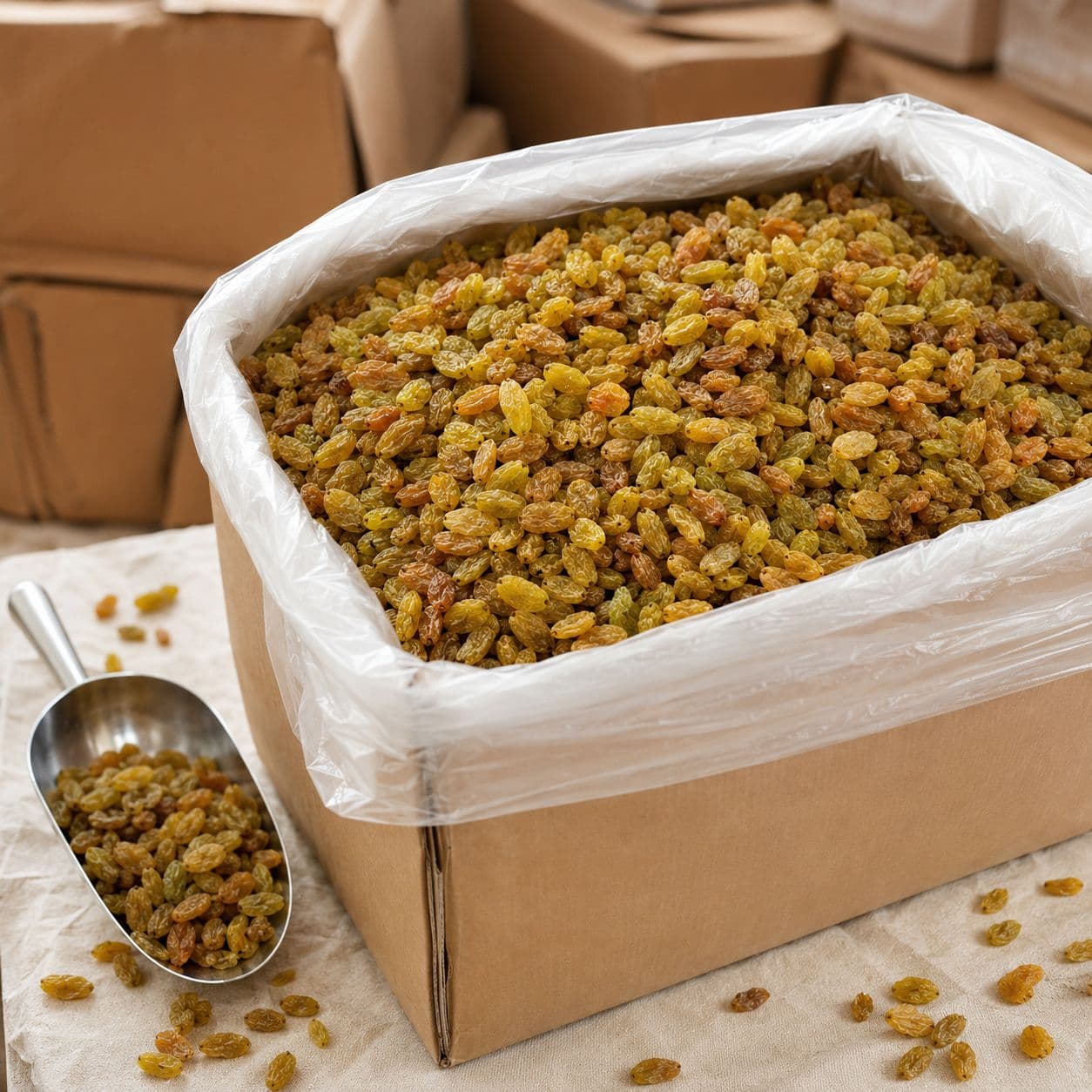
Keep the liner closed. Cartons come with a food grade liner closed at the neck, and it is the barrier all the way from our bench to your intake bay. Once your intake team has opened a carton to sample it, that carton is on a different clock from the sealed ones around it. Sample one nominated carton, reclose it properly, and leave the rest alone. The packing detail behind that is on how we pack bulk cartons.
Decant working stock. Once a carton is in production, move the day's or the week's quantity into a lidded food grade bin and close the carton again. An open 25kg carton on a production floor in July is a dehumidifier running in reverse.
Do not chase humidity with air conditioning alone. A cooled room that is not dehumidified can end up condensing moisture on cold cartons when the door opens on a wet afternoon. If you are cooling, cool the whole room and keep it stable rather than switching it on for eight hours a day.
And never, ever wash or wet raisins to loosen a clumped carton. It restarts the entire problem from the inside, and this time you cannot dry it back out.
Clumping, sugar bloom and what is a real defect
Three things look alarming on a bulk carton and only one of them is actually a problem.
Clumping is moisture. The natural sugar on the skin softens and the pieces glue to each other. A clumped carton can usually be broken up by hand or given an hour in a chilled room and used normally, and the material is not spoiled. What it costs you is texture, permanently, and a lot that has been through the cycle four or five times will eat duller than it should even after it separates. If cartons arrive clumped, that is a packing or transit failure and you should tell us the same day rather than working around it silently.
Sugar bloom is the white crystalline dusting you sometimes see on green and golden lots. It is crystallised natural sugar coming out of the fruit, it is not mould, and it is not a defect. It is more common in stock that has been chilled. Wholesale buyers occasionally reject perfectly good lots for it, which is why we mention it on every grade sheet. The visual difference is covered in how to inspect a lot before you accept it.
Mould is the real one. It is raised and fuzzy rather than flat and crystalline, it runs grey green, and the carton smells sour or fermented before you get close enough to look. That is a rejection, not a tolerance, and the tolerances we do work to are written out on our specification sheet.
Rotation and batch discipline
Use in strict first in first out order against the batch mark on the carton, not against where the carton happens to be standing in the stack.
This sounds obvious and it is the single most commonly broken rule in every godown we have visited. The new delivery goes in the front because that is where the lorry stopped, the old cartons migrate to the back wall, and eight months later somebody finds four cartons of grade A green from last season behind the pallet. Nobody decided that. It just happened.
The second half of the discipline is not mixing lots inside a production run. Two cartons from different lots can both be perfectly in specification and still behave slightly differently in a soak or an oven. Finish one lot before opening the next, and where a run has to span two lots, run the changeover at a batch boundary you can trace afterwards. Consistent raw material makes inconsistent finished product more often through mixing than through grading. How we hold lot continuity for supply into a food processing line is built around exactly that problem.
If you are also advising your own retail customers on keeping a pouch loose at home, the household version of all this is on storing raisins in a domestic kitchen.
The monsoon checklist
June to September is when stock is lost, and it is lost quietly. Nothing dramatic happens in week one. By week six the bottom of the stack has changed.
Coastal buyers should assume monsoon conditions for longer at both ends. Mumbai, Mangalore, Kochi and Chennai should be running monsoon discipline from May into October. Inland and dry belt godowns get away with four to six weeks of it. Either way, smaller and more frequent dispatches through the wet months usually cost less than the grade you lose holding a buffer, and the current bulk rate is quoted per dispatch in any case.
Frequently asked
About nine to twelve months from the packing date in cool, dry, controlled storage, and realistically six to nine in an ordinary Indian godown that goes through a monsoon. In a tin roofed shed with no ventilation, treat three to six months as the working figure and rotate hard.