

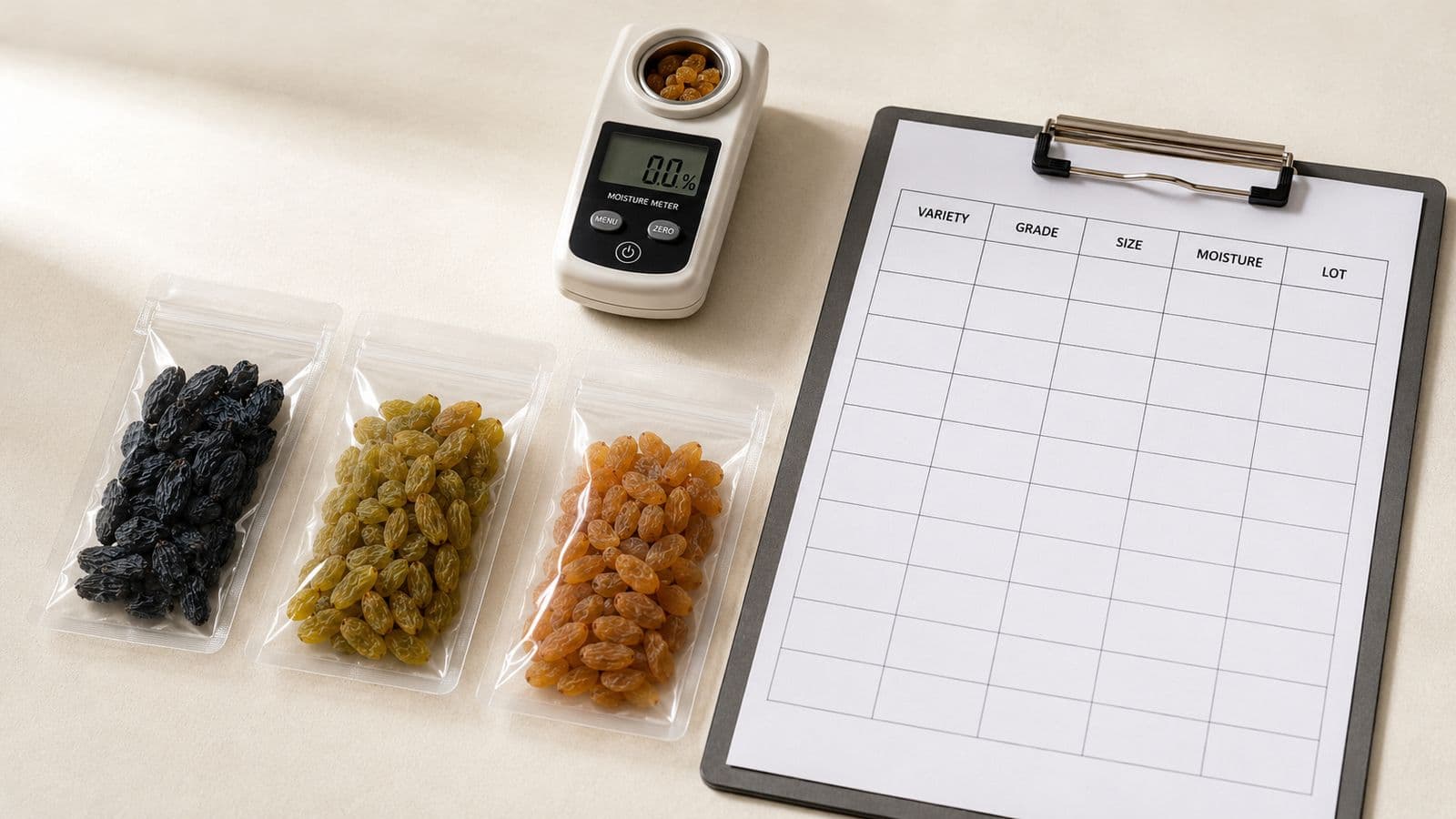
The best quality raisins in India are judged on five things you can see and feel: uniform size, even colour across the handful, dryness that lets a squeezed fistful fall apart on its own, no seeds or stem fragments, and a named grade with a packing date on the pack. Brand names tell you nothing these checks do not. One handful settles it in under a minute.
The short version
What separates the best quality raisins in India from the rest
Quality here is three things stacked on each other, and most buyers only ask about one. There is the grade the lot was sorted into. There is the season and the drying week it came out of. And there is what happened to it in storage between then and the pouch in your hand. A premium select lot that sat through a monsoon in a warm godown will lose a blind test to an ordinary grade A lot that came out of cold storage last week.
Most people looking for the best quality kismis are looking for a brand name to trust. There is not one. Quality is a lot: a defined batch, sorted to a named grade, dried in a good stretch of weather, held cold, packed recently. Everything below is a way of testing those four facts on material you can actually touch.
Grade itself is set on three measurements, and everyone in the Tasgaon market yard will use all three inside the first minute of a conversation: length or berry size, colour uniformity, and moisture. The full grade ladder we quote against sets out what each name covers.
Nine checks on a single handful
Tip a fistful onto white paper or a pale plate. Colour reads wrong against steel and against a dark kitchen counter, and colour is half of what you are judging. Take the sample from the middle of the pack or the middle of the carton, never off the top. The top layer is the part that gets arranged.
Run these in order. After the second time you do it, the whole sequence takes about forty seconds.
What each grade should actually look like
Grade names are not standardised across every trader in the belt, which is why the size band matters more than the word printed on the carton. Two suppliers can both write grade A and mean different material. Ask for the band in millimetres and the moisture ceiling, and the ambiguity disappears.
Grade moves the price further than the choice of variety does, which surprises people who have just finished reading up on the raisin types sold in India. A premium select green lot and a commercial green lot sit further apart on rate than green sits from black at the same grade.
Typical grade ladder in the Sangli-Tasgaon trade
Why moisture decides everything after the sale
Green raisins are dried down to roughly 15% moisture and black a little below that. Two or three points over the ceiling and the lot looks fine on the day, tastes fine on the day, and then goes wrong in the eighth week. Clumping first. Then a sugar syrup at the base of the pouch. Then, if the godown is warm, fermentation.
This is why moisture sits as a line item on every bulk specification sheet and why cold storage matters so much in this belt. It is also why the squeeze test is worth more than any amount of packaging copy.
At home the same logic applies in reverse. A good lot bought in March can be spoiled by a bad jar in July, and the fixes are simple enough: airtight container, out of the sun, refrigerated once opened during the humid months. We have set out what to do with an open pack through the monsoon in our storage guide.
What a defect actually looks like
Most buyers can tell something is wrong but not what, which usually ends in either accepting a bad lot or rejecting a perfectly good one. This table is roughly what our own reject sheet looks like when we go through a sample.
Common defects and whether they justify a rejection
Sugar bloom versus mould
This is the question we get more than any other, usually with a photograph attached, and nine times out of ten the answer is that the pack is fine. Raisins carry a lot of natural sugar. When a pack moves from a cool storeroom into a warm kitchen, or from a courier van into an air-conditioned office, some of that sugar migrates to the surface and crystallises there.
Sugar bloom is dry. Rub a piece between finger and thumb and the crystals feel gritty and come away. Drop one in warm water and the white disappears in a few seconds. There is no smell.
Mould behaves nothing like that. It stands proud of the skin, it is fuzzy rather than crystalline, it is usually grey-green or blue-green rather than white, it does not dissolve, and the pack smells sour or musty when you open it. Mould in raisins is almost always a moisture story, which means it traces back either to a lot that was dried short or to a pack that got damp after it left us.
If you find genuine mould in one of our packs, do not pick the pieces out and use the rest. Photograph it and send it to us within three days and we replace or refund the pack. If you want to understand why moisture varies between one lot and the next, that comes down to the drying week, and the drying process on the racks explains where it can go wrong.
The eight things a grade quote should state
For household buying, the checks above are enough. For a bakery, a sweet manufacturer or a dry fruit wholesaler placing repeat orders, quality has to be written down before the first carton moves, otherwise every consignment becomes an argument.
A quote that does not carry these eight lines cannot be compared with a competing quote, no matter how attractive the number at the bottom looks.
How we put that in writing
Our bulk quotes name the grade, the size band and the moisture ceiling, and they hold for 48 hours because the market moves on the day. The minimum order is 15kg. What each specification line means, and what tolerance we work to, is laid out on the specification sheet behind every bulk quote.
Checking a retail pack in a shop
In a shop you cannot squeeze a handful, so you are working with less. Hold the pouch up to a light and look through the window if it has one. Tilt it. Good material shifts and slides. A pack that moves as one solid block has taken on moisture, and it will not recover.
Then read the label properly. Grade named or not. Packing date printed or not. Net weight. Additive declaration. If the pack lists none of these, it does not matter how good the printing is.
The last check is arithmetic. Divide the price by the weight and compare per kilo, because a 250g pouch that looks cheap on the shelf is often the most expensive way to buy. Our own bands run from ₹229 for a 250g pack of black up to ₹999 for a kilo of golden, and the per kilo working is set out on the retail price page. If you want to see what a premium select lot looks like in the pouch, the green kismis packs are the clearest example of even colour and a tight size band.
Ask for a sample before a bulk order
No serious buyer commits a season's requirement on a photograph. Ask for a 250g sample from the actual lot being offered, not from a display tin, and run every check on this page against it. We charge samples at cost and adjust that cost against your first order.
Two things to insist on. First, that the sample is drawn from the lot you will be invoiced for, with the lot reference written on it. Second, that the lot is held or reserved while you assess it, because a good lot can be gone in a week during the festive run-up.
Keep a retained portion of every sample you approve. When a later consignment drifts, a retained sample turns a disagreement into a two minute comparison. Bulk enquiries, grades and sample requests all go through the bulk enquiry desk.
What we check before a lot gets packed
We buy lot by lot rather than committing to one large purchase at the start of the season, which means every lot gets assessed on the way in. Size band on a sieve. Colour against material we have retained from earlier lots. Moisture. The squeeze test, which we still trust more than any single instrument reading, done on samples drawn from three different points in the consignment.
We reject lots. Not often, but it happens, most commonly after a wet stretch during drying when a whole week's output across the belt comes out dull and soft. In those weeks the supply of high quality raisins narrows, the spread between grades widens, and anyone offering you premium select at commercial rates that month is offering you something else.
Lots are kept separate rather than blended, retail pouches are packed in short runs so stock does not sit for months in our own godown, and every pouch carries its packing date. If a pack arrives that fails any check on this page, photograph it, send it within three days, and we replace it or refund it. That is the whole policy.
Frequently asked
There is no single best brand. The best lots are uniform in size, even in colour, dry enough that a squeezed handful falls apart, free of seeds and stem fragments, and sold with a named grade and a packing date. Premium select green, grade A black and jumbo golden are the top retail grades in the Sangli belt.
Premium select green, grade A black and jumbo golden, packed in short runs with the packing date on every pouch.
See our graded retail packs