

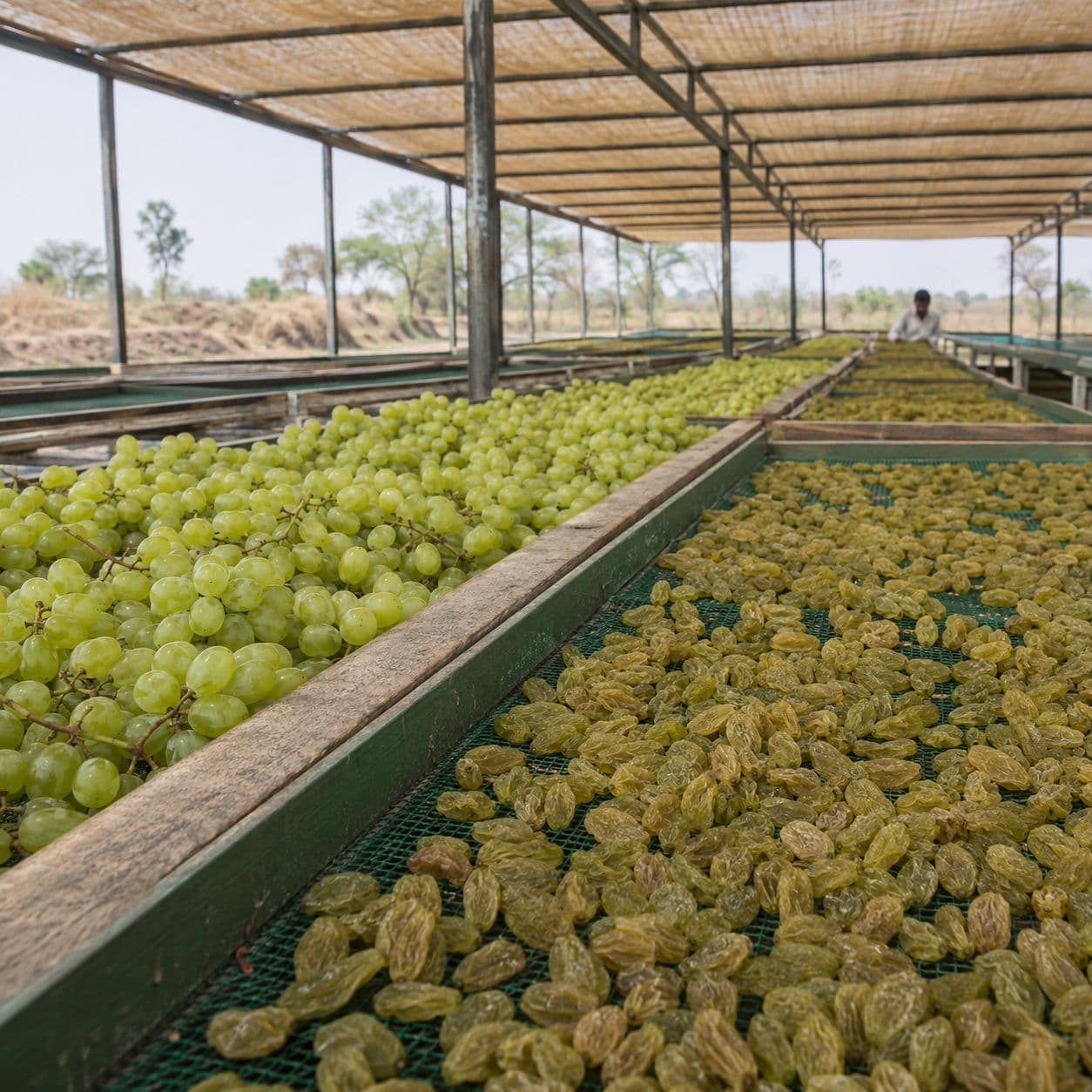
Raisins are made by drying seedless grapes until roughly 15% moisture is left. Nothing is cooked and nothing is added. In the Sangli-Tasgaon belt the season runs February to April: grapes are picked, dipped in a food grade solution so moisture leaves evenly, dried 12 to 18 days on racks under shade nets or in open sun, then stripped, cleaned, hand sorted, graded and moved into cold storage.
The short version
What actually happens when raisins are made
A raisin is a grape with about four fifths of its water taken out. That is the whole of it. No sugar goes in, no colour goes in, nothing is boiled or baked. The sweetness people notice in a good black raisin is the grape's own sugar left behind once the water has gone, concentrated into a berry a quarter of its original weight.
Roughly four kilos of fresh fruit yield a kilo of finished raisins, and that ratio is the reason rates move with the grape crop every season rather than with anything happening downstream. A grower deciding in January whether to sell fruit fresh as table grapes or send it to the drying sheds is making the decision that sets the following year's supply.
So when people ask how raisins are made, the honest answer is that the grape does most of the work and the drying shed does the rest. Green, black and golden all start as the same Thompson seedless fruit grown in the same belt. The differences that show up on a plate, and that we describe across the raisin types made here, are made almost entirely in the two to three weeks between picking and grading.
The harvest window, February to April
Grapes destined for raisins are left on the vine longer than table grapes. More sugar in the berry means more body in the raisin and a better yield per tonne of fruit, so growers push the fruit as far as the weather allows. Cutting starts in February and runs into April, and the exact date on any one plot depends on how the season pruned out.
Bunches are cut in the cooler part of the day and moved to the drying shed the same day. Fruit that sits overnight in a heap starts to sweat, and sweated fruit dries unevenly. On a good morning in Tasgaon you will see tempos moving cut bunches within a couple of hours of the knife.
There is no second window. Unlike a crop that can be replanted or harvested twice, the raisin year has one shot at it, and a run of unseasonal rain in March takes quality out of the market that cannot be replaced until the following February. Why this belt in particular carries the crop is set out in our note on where India's raisins come from.
The dip, and why it decides the colour
A grape is built to hold its water in. The skin carries a waxy bloom that slows evaporation, which is excellent for the grape and a problem for anyone trying to dry it. Left alone, a bunch takes far too long, dries from the outside in, and comes out dark and shrivelled with a hard skin and a wet centre.
So the cut bunches are dipped. The solution used across this belt is a food grade mix of potassium carbonate and an edible oil emulsion, which breaks up that waxy layer so water can leave the berry evenly and quickly. The bunches go in for a short immersion, come out dripping, and go straight onto the racks.
This one step, more than the drying method itself, separates a clean, evenly pale green raisin from a mottled one. A weak or old dipping solution shows up eight days later as a rack of fruit drying at three different speeds.
Green and golden lots also carry sulphur dioxide (E220), a permitted preservative that holds the light colour through drying and storage. It is used within permitted limits and declared on the pack. Black raisins are sun dried and normally carry none, which is one of the practical differences between black kismis and the shade dried grades.
Shade drying and sun drying
Green and golden raisins are dried under cover. The dipped bunches go onto tiered racks inside net houses, structures of pipe and shade net that cut direct sunlight while letting air move through freely. Air movement is the whole point. Shade drying is slower than sun drying, and that slowness is what preserves the pale colour and the firm, springy bite.
Black raisins take the opposite route. The same fruit is spread out in open sun, where ultraviolet light and heat darken the skin and drive the moisture off faster. The sugar concentrates harder and the berry ends up softer and sweeter. This is the genuine article behind the phrase sun dried raisins, and it is a processing choice rather than a marketing one.
Golden lots are the fussiest of the three. They come off riper fruit, run on a slower shade schedule, and are held back from drying too hard so the berry stays plump and amber rather than collapsing. That is a large part of why golden carries a premium over the other two on the grade ladder we quote against.
Drying method by variety, as it runs in the Sangli-Tasgaon belt
Day by day on the racks
A drying shed is not a machine you switch on and walk away from. Somebody is in there every day, and the work changes as the batch loses water. This is roughly how a green lot runs in a normal March.
What a bad week does to a season
Unseasonal rain during March is the thing everyone in this belt watches for. Rain on open sun drying floors is the worst of it, because black raisin lots have no cover at all, but even in net houses a few humid, still days push the moisture in the air up and the drying rate down.
A batch caught that way comes out dull, soft, and uneven, with more split skins and sugar weeping from the damaged berries. Some of it can be salvaged into lower grades. Some of it ferments and is finished. What a buyer sees three months later is a narrower supply of premium select and a wider spread between the top and bottom grades, which is one of the reasons a rate quoted without a grade name tells you nothing.
We reject lots in weeks like that. It is not dramatic and it is not frequent, but it is the part of the job that decides whether the pouch on your shelf holds up. What we look for when a sample comes across the bench is set out in our checklist for judging a lot.
Stripping, cleaning, sorting and grading
What comes off the racks is not a raisin as you know it. It is a dried bunch, stems and all, mixed with dust from the shed. Four operations turn that into a graded lot, and the last of them is still done by hand. This is the half of the production process nobody photographs, and it is where a good drying week is either protected or wasted.
From vine to pouch: the full timeline
Stripping and machine cleaning
Dried bunches go through a destemmer, a rotating drum that knocks the berries free of the stalk without crushing them. The loose material then passes through an aspirator, which blows off dust, leaf fragments and light stem pieces, and over vibrating sieves that separate the berries into size bands. The sieve stage is what produces a lot that reads as one size in the hand instead of three.
Hand sorting
No machine catches everything. Sorting halls in Tasgaon run long tables of workers, mostly women, who pull out the hard caps where the berry met the stalk, the scorched pieces, the split and weeping berries and any stem that slipped past the aspirator. It is slow and it is the difference between a lot a bakery will re-order and a lot that gets complained about because stem fragments showed up in a sliced loaf.
The tolerance for stem fragments is a real specification line, not a courtesy. One or two in a kilo is accepted across the trade. A visible scatter means the sorting was cut short to make a delivery date.
Grading
Sorted material is then graded on three measurements together: length or berry size, colour uniformity, and moisture. Premium select, grade A, grade B, jumbo. Each grade is bagged, weighed and priced separately, and lots are kept separate rather than blended, because blending two lots to make a tonnage is exactly how a consistent supply turns inconsistent.
Grading is not paperwork. Within a single variety, the grade decides more of the final rate than the choice of variety does, and it is the number a serious buyer asks about first.
Cold storage, and the other eleven months
By May the season is over. Every raisin that will exist that year already exists, and the question stops being production and becomes storage. Graded lots move into cold stores, usually held a few degrees above freezing at around 2 to 5 degrees Celsius, which keeps moisture from migrating, stops the surface sugar softening, and holds the colour of green and golden lots that would otherwise dull over a hot Maharashtra summer.
Without it, a lot bought in March would not be worth eating by October. This is why cold storage capacity matters as much as drying capacity in this belt, and why the festive season, which is the busiest selling period of the year, is supplied entirely out of store rather than off the racks.
It also explains a question we get a lot: raisins bought in November are not eleven months stale. They were made in March and held at a controlled temperature the whole time. What actually ages a raisin badly is a warm godown, not the calendar. More on the season, the market yard and how stock moves through the year sits on our Sangli sourcing page.
Packing, dates and what reaches you
Bulk lots are packed into 15kg cartons with a food grade liner, which is also our minimum order, and they go out against a rate quoted on the day. Retail pouches we pack in short runs, drawing from lots we have already assessed, so material is not sitting in our own godown for months waiting for a label.
Every pouch carries its packing date. That is deliberate and slightly unusual in this trade. Packing date plus a named grade are the two facts that genuinely differ between one supplier and another, and a pack that states neither is asking you to buy on faith.
We do not claim every kilo passes from a farmer's hand to ours with nothing in between. Some lots we buy directly off the racks in the season. Others come through cold stores we have dealt with for years. Both are honest routes and we would rather describe the sourcing model accurately than dress it up. Bulk buyers who want grades, packing options and current rates can start at our bulk raisin supply page, where lots are quoted by grade and the rate holds for 48 hours.
What the process should change about how you buy
Knowing how kismis is made changes the questions you ask at the counter. Once you know that green and black are the same grape dried two ways, the argument about which is more natural goes away. Both are established routes for the same fruit, made within a few kilometres of each other, and the choice is about what you are cooking rather than about purity.
Once you know the season is one short window, the packing date on a pouch stops being decoration. And once you know that grading happens on a bench in a sorting hall rather than in a laboratory, you understand why the grade name on its own is not enough and why the size band and moisture ceiling matter.
The shade dried route is what puts the firm bite in green kismis, and the open sun route is what makes black the sweeter, softer raisin. Neither is better. They are two different tools, and most kitchens end up keeping both.
Frequently asked
Seedless grapes are harvested at peak sugar, dipped in a food grade solution that opens the waxy skin so moisture leaves evenly, then dried for 10 to 18 days, under shade nets for green and golden raisins and in open sun for black. They are then stripped from the stems, machine cleaned, hand sorted, graded on size, colour and moisture, and moved into cold storage.
Black, green and golden lots packed in short runs from current season stock, with the packing date on every pouch.
See this season's packs