

The short version
Specify numbers, not grade names
A grade name is a trade convention. It works as shorthand between two traders standing in a market yard and it is not good enough to write into a purchase specification, because the same words cover materially different fruit at different suppliers.
Send us the parameters your QA works to and we will say plainly whether we can hold them consistently, which is a different question from whether we can hit them once. Agreeing to a specification we cannot hold across a full year, and then quietly substituting in November, is how supply relationships in this trade actually end.
The format below travels on our quotations and on the grade sheet that goes with every sample. The longer version, including defect and foreign matter language and how sample inspection runs, is on the specification format we quote against.
Lines we state on every quotation
What raisins do to a processing line
Raisins are an awkward ingredient on automated equipment for one reason. They are sticky, they compress under their own weight, and their behaviour changes with two points of moisture.
Bridging in a dosing hopper
A lot a couple of points wetter than the last one compacts in the hopper and bridges over the outlet. The volumetric doser keeps cycling, the actual dose drops, and nobody finds out until the pack check an hour later. If your line doses by volume rather than by weight, moisture consistency is not a quality preference. It is a yield figure.
Oiled or unoiled
Processors running feeders often want a light food-grade oil coat to keep the pieces free flowing. Say so at enquiry, because it changes the material and it changes your ingredient declaration. If we cannot do it reliably at your volume we will tell you rather than take the order and improvise on the packing bench.
Stems through a chopper or extruder
A stem fragment is harder than the fruit around it. It passes a metal detector without a flicker, and it will mark a roller or foul a die. Sieving and hand sorting catch most of them, and the tolerance belongs in the specification rather than in an argument after a stoppage.
Dicing and chopping
If you dice in house, a firmer and drier lot cuts cleanly while a soft, wet one smears the blade and balls up. Green cuts better than black for this reason, which is worth knowing before the variety is chosen on flavour alone. Bulk green supply and its grade bands are on bulk green raisin lots.
What we measure, and what we do not
We measure moisture as routine and state it on the grade sheet. As an ingredient supplier we are a sourcing desk with a sorting bench and a packing line, not a laboratory, and drawing that line clearly is better for both sides than implying capability we do not have.
If your QA works to water activity rather than moisture, or wants microbiological, pesticide residue or heavy metal results per lot, that is third party lab work. We will arrange it against a named lot on request, with cost and lead time on the buyer, and send the report through as it arrives rather than a summary of it.
What we will not do is put a number on a document we did not measure. Over five years of supply that is worth considerably more to a manufacturer than a rupee on any single quotation.
Documentation and vendor onboarding
Manufacturers ask for a consistent document set, and the sensible time to settle it is at quotation rather than at the first goods-in check with a lorry waiting at the gate.
Classification
Raisins are dried grapes under HSN heading 0806, and dried grapes sit under 0806 20. That is what appears on our invoices, with a plain goods description beside it. The detail, together with the honest caveat that you should verify current rates with your own advisor, is on HSN classification and invoicing.
Securing a year of supply from one crop
The fact a manufacturer has to plan around is that raisins are made once a year. The drying window runs February to April. Everything traded after that comes out of cold storage, and the total quantity available for the year is effectively fixed by May.
Continuity is therefore an inventory position rather than a service promise. A unit consuming two tonnes of bulk raisins a month across a year is asking somebody to have committed twenty four tonnes into storage before the monsoon. That decision gets taken in April, not in October when the requisition lands on a desk.
Buyers with predictable consumption should be talking about a season arrangement: agreed grade, agreed annual quantity, drawn down monthly, priced at each release rather than fixed for twelve months. Buyers who spot-buy through the festive window pay twice, once on the rate and once on whichever grade is still available. The cycle behind all of it is set out on the annual supply cycle.
Packing and goods-in
Standard packing for bulk raisins for food processing is 20kg and 25kg cartons with a food-grade liner, batch marked per lot. Smaller formats cost more per kilo and are rarely worth it once you have an intake bay and a decant procedure that works.
Tell us at quotation stage if your intake needs carton dimensions, gross and net weights, or palletised delivery. Those are easy to plan and awkward to retrofit after the first consignment has already been booked on a lorry.
If goods-in draws a sample per consignment, draw from more than one carton and from the middle of the carton rather than the top layer, which is the layer that has been handled. Liner options, marking and the full stocked format list are on the carton formats we run.
What we will not claim
Short section, and probably the most useful one on this page for a procurement team.
Why that list is here
None of it makes us the right supplier for every manufacturer, and it is not meant to. It does mean the specification you sign is the specification that arrives, which is the only thing worth optimising for on an ingredient that goes into a pack carrying your name.
Setting up a first supply of bulk raisins for food processing
Five steps, and the third one is where most decisions actually get made.
Getting a number
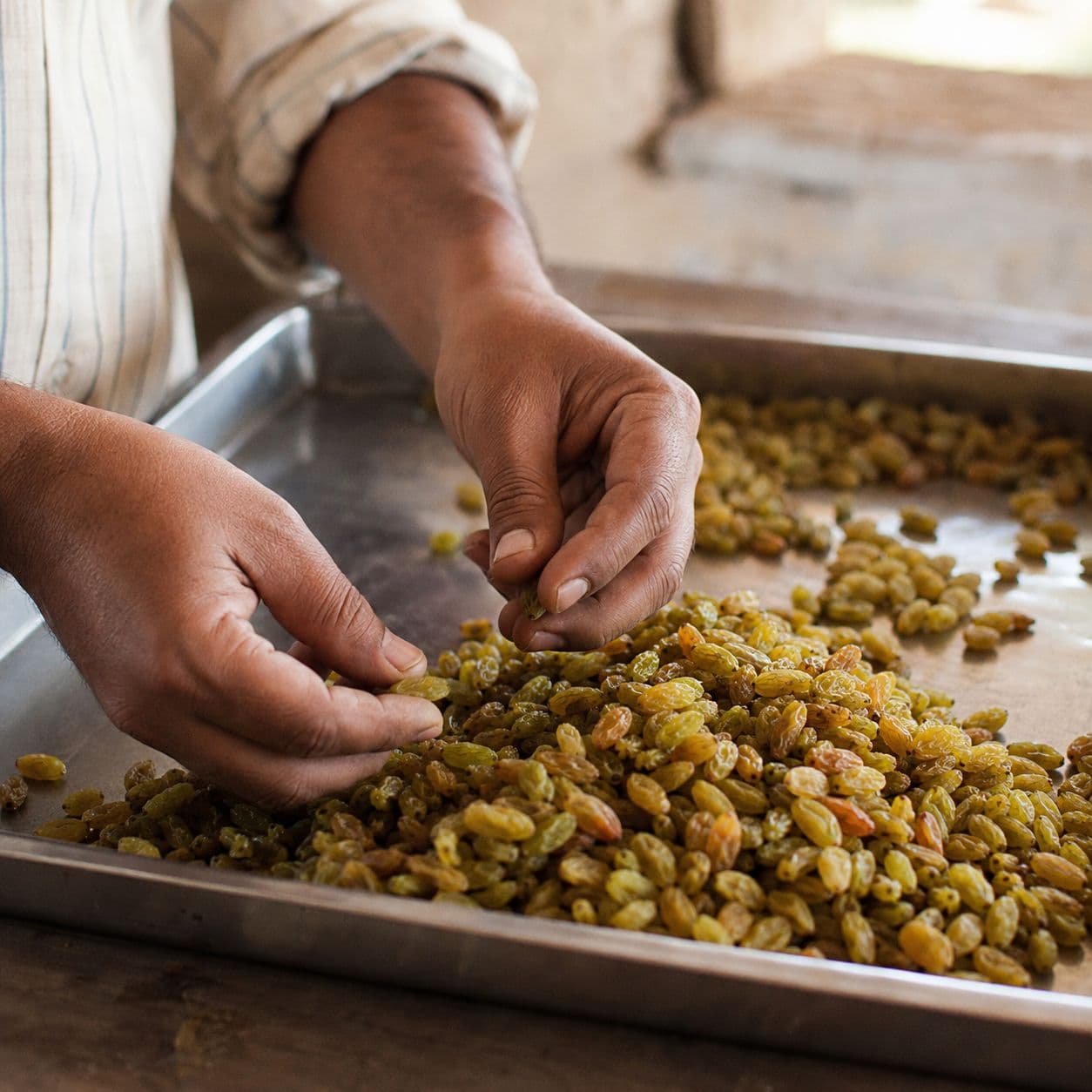
Minimum order is 15kg, which is enough for a trial run on most lines. Send the specification and quantity to the B2B desk, or go straight to a dated quotation if the grade is already fixed. How the lots are made in the first place, from grape to carton, is described in how the lots are dried.
Frequently asked
Yes. We quote against a written specification rather than a grade name, pack in 20kg and 25kg cartons with food-grade liners, batch mark every carton and hold the same lot specification across dispatches. Minimum order is 15kg, which covers a trial run on most lines.