

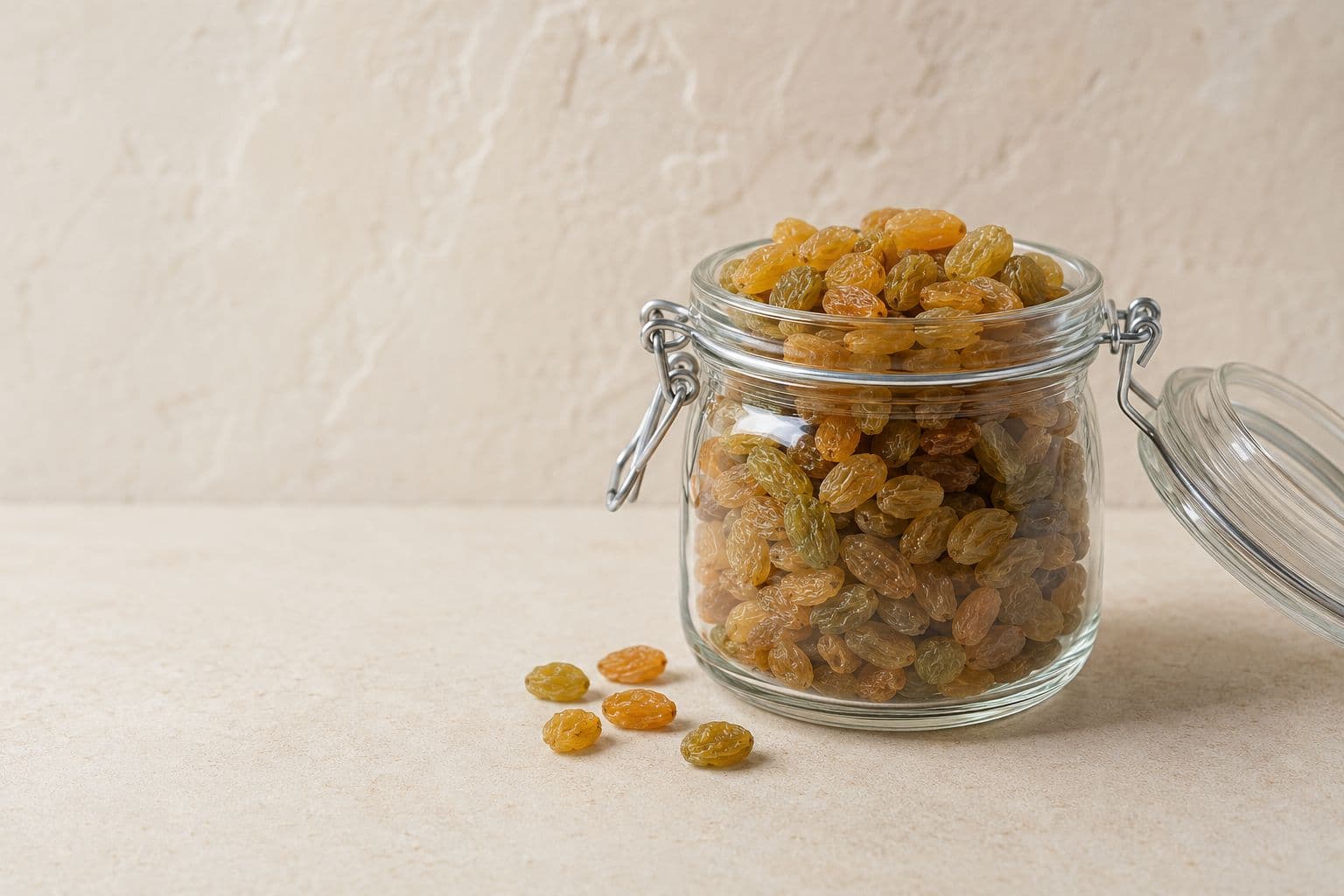
How to store raisins comes down to two habits: keep them airtight and keep them cool. A sealed pouch holds for about nine months from its packing date. Once opened, use within three months, kept in an airtight jar away from the stove and sunlight, and moved to the fridge from June to September. Clumping is humidity softening the natural surface sugar, not spoilage.
The short version
The two rules that decide how to store raisins
Airtight, and cool. Everything else on this page is a footnote to those two words.
Raisins have already been dried down to roughly 15% moisture on the racks, which is the whole point of the exercise. Storage is about not letting that number climb back up. Air carries water, and in a Sangli July it carries a great deal of it. An open bowl of raisins on a kitchen counter in August will be tacky by evening and matted by the next morning, and nothing was wrong with the raisins.
Heat is the second lever. It does not add moisture on its own, but it drives moisture in and out of the fruit in cycles, and each cycle leaves the surface stickier than it was. A shelf directly above the gas range is the worst place in most Indian kitchens to keep dry fruit, and it is where a lot of people keep it.
Why raisins clump and go sticky
Raisins carry their own sugar on the outside of the skin. That is not a coating anybody applied, it is sugar that migrated out of the fruit during drying and set on the surface. In dry air it stays hard and the pieces slide over one another. In humid air it softens, turns tacky, and the pieces glue themselves together.
This is the single most common complaint we get, usually in the third week of June, usually about a pack bought in April that was perfectly fine in April. It is a storage effect, not a quality defect, and it happens to good lots and bad lots alike. The good lots simply take longer to get there.
It is still worth preventing rather than fixing. Each soften and harden cycle costs a little texture, so a pack that has been through the cycle five times eats duller than one that has not, even after you separate it again. If a pack is going soft on you repeatedly, the container is losing air or the shelf is too warm.
What to keep them in
A steel dabba with a proper gasket lid is the best container in most Indian kitchens, and the cheapest. Glass jars with a clamp and a rubber seal are as good and let you see the stock. A screw top glass bottle is fine. A plastic container with a snap lid is acceptable if the lid actually snaps rather than sits.
Our own retail pouches are resealable and nitrogen flushed, and they work well on their own if you genuinely press the seal shut every time. Most people do not. The seal on a pouch that has been opened forty times is not the seal it left the packing bench with, and after the first month a jar beats it.
What does not work: a loose polythene bag with a knot in it, an open bowl on the counter, the original carton, or a pouch folded over and held with a clip. All four are air exchangers.
Where to keep them, month by month
Indian storage advice that ignores the calendar is useless, because a kitchen in Nagpur in April and the same kitchen in July are two different environments. Rough guidance we give at the counter, based on what actually comes back to us as complaints.
Coastal kitchens should assume monsoon conditions for longer at both ends. If you are in Mumbai, Mangalore, Kochi or Chennai, start refrigerating in May and keep going into October. Inland and dry belt kitchens can run a cupboard shelf most of the year and only move to the fridge for the four wettest weeks.
Where to keep an opened pack through the year
How to store raisins long term
If you buy a kilo at a time and go through it slowly, or you stock up before a festival season, the fridge is the right default and the freezer is the right answer past six months.
In the fridge, use an airtight jar and keep it away from anything strong smelling. Raisins pick up odours from an open bowl of leftovers with enthusiasm. Take out what you need and put the jar straight back. Repeatedly leaving a cold jar open on a warm counter causes condensation inside it, which is worse than leaving it in the cupboard would have been.
In the freezer, portion first. Split the kilo into three or four boxes so you are only ever thawing one of them. Fill each box close to the top, because trapped air is where the frost comes from. Frozen raisins go straight into a batter or a pot without thawing. For a snack bowl, give them twenty minutes on the counter and they come back to a normal bite.
Refrigerated raisins do not need to be brought to room temperature before cooking. Straight into the kheer, the halwa or the dough is fine. Almost every one of the everyday uses of raisins works fine with fruit taken cold out of the fridge.
Shelf life of raisins
A sealed, nitrogen flushed retail pouch is good for nine months from the packing date printed on the pack. That is the shelf life we print on every pouch we send out, and it assumes normal domestic storage rather than a shop window in May.
Once opened, the number that matters is texture rather than safety. Stored properly, an opened pack eats at its best for about three months. Beyond that it will still be perfectly usable, it just drifts, and which direction it drifts in depends on where you live. Dry belt kitchens get progressively harder raisins. Coastal kitchens get progressively stickier ones. Both cook fine. Neither is what you want in a snack bowl.
Packing date is the number to look for on any pack you buy, ours or anyone else's. A pack with no packing date printed on it is asking you to guess, and by the time you can tell from the texture, you have already paid. That check and the rest of them are set out in how to inspect a lot before you buy it.
Realistic shelf life by situation
White crystals are sugar, not mould
Every few weeks somebody sends us a photograph of a white dusting on a raisin and asks whether the pack has gone off. Nine times out of ten it has not. That is sugar bloom, crystallised natural sugar drawn to the surface after a temperature change, and it turns up most often when a pack moves from a cool storeroom into a warm kitchen or out of a courier van into an air conditioned office.
Sugar bloom is dry and flat against the skin. Rub a piece between finger and thumb and the crystals come away gritty. Drop one in warm water and the white vanishes in seconds. No smell.
Mould looks and behaves nothing like that. It stands up off the skin, it is fuzzy rather than crystalline, it runs grey green or blue green rather than white, it does not dissolve, and the pack smells sour or musty the moment you open it. Fermentation is the third failure, and it does not need anything visible at all: a sharp vinegar smell and a sticky solid mass is enough.
If one of our packs ever arrives fuzzy, wet or sour smelling, do not pick out the bad pieces and use the rest. Photograph it, send it to us within three days, and we replace or refund the pack.
The three varieties do not behave the same
Black raisins clump first. Sun drying pushes more sugar to the surface, so black is the variety that mats together in a humid kitchen while green sitting next to it is still loose. That is not a fault in the lot. It is what sun dried fruit does, and it is the reason we tell customers buying grade A black packs in the monsoon to refrigerate from day one.
Green raisins go the other way. They are firmer and drier to begin with, so their failure mode over months is hardening rather than sticking. A green pack left too long in a dry Pune winter turns leathery, and warm water for ten minutes brings it back well enough for cooking.
Golden sits in between and has one extra sensitivity: light. Amber colour fades in sunlight faster than black or green shows any change at all. A jar of golden on a windowsill will look dull inside a month. Keep it in the cupboard. Those differences trace directly back to how each one was dried, which is covered in the variety guide.
Storing bulk quantities
A kitchen jar and a godown are different problems. Cartons stack, and a stack traps heat in the middle where nobody can feel it. Bulk cartons should sit on pallets rather than the floor, a hand span clear of external walls, out of direct sun, and rotated so the oldest packing date leaves first.
Cold storage is standard practice across the Sangli belt for holding stock through the season, and it is why a lot bought in March can still be sold as current season material months later. Anyone buying 15kg and upwards should ask how the lot has been held before it was quoted, because a carryover lot held warm and a current season lot held cold do not eat the same. The operational detail for bulk buyers is on bulk storage and shelf life.
Bakeries have a specific version of this problem, since moisture drift in stored fruit changes bake behaviour on a line that was calibrated to something else. That interaction is covered in the baking guide.
Fixing a pack that has already gone wrong
Clumped and sticky: one hour in the fridge, then break the block apart with your hands. Move it into a proper airtight jar and keep it cold. Do not add rice, do not add silica sachets from a shoe box, and do not wash it.
Hard and leathery: ten minutes in warm water, drain, pat dry. Use them in cooking or baking the same day. They will not come back to snacking texture and pretending otherwise wastes the effort.
Faded golden: nothing to be done about the colour. Use them in a dark bake or a mithai filling where the colour is not doing any work, and buy the next lot in a smaller pack.
Fuzzy, wet or sour: throw the pack away. There is no salvage step here and no amount of picking through it makes the rest safe.
Frequently asked
About nine months from the packing date in a sealed, nitrogen flushed pouch. Once opened and kept airtight, they are at their best for around three months. After that they stay usable but drift, going harder in dry regions and stickier in humid ones. Always buy a pack with the packing date printed on it.
Nitrogen flushed resealable pouches in 250g, 500g and 1kg, with the packing date printed on every pack.
Buy a freshly packed batch