

The short version
One crop a year, and why that changes everything
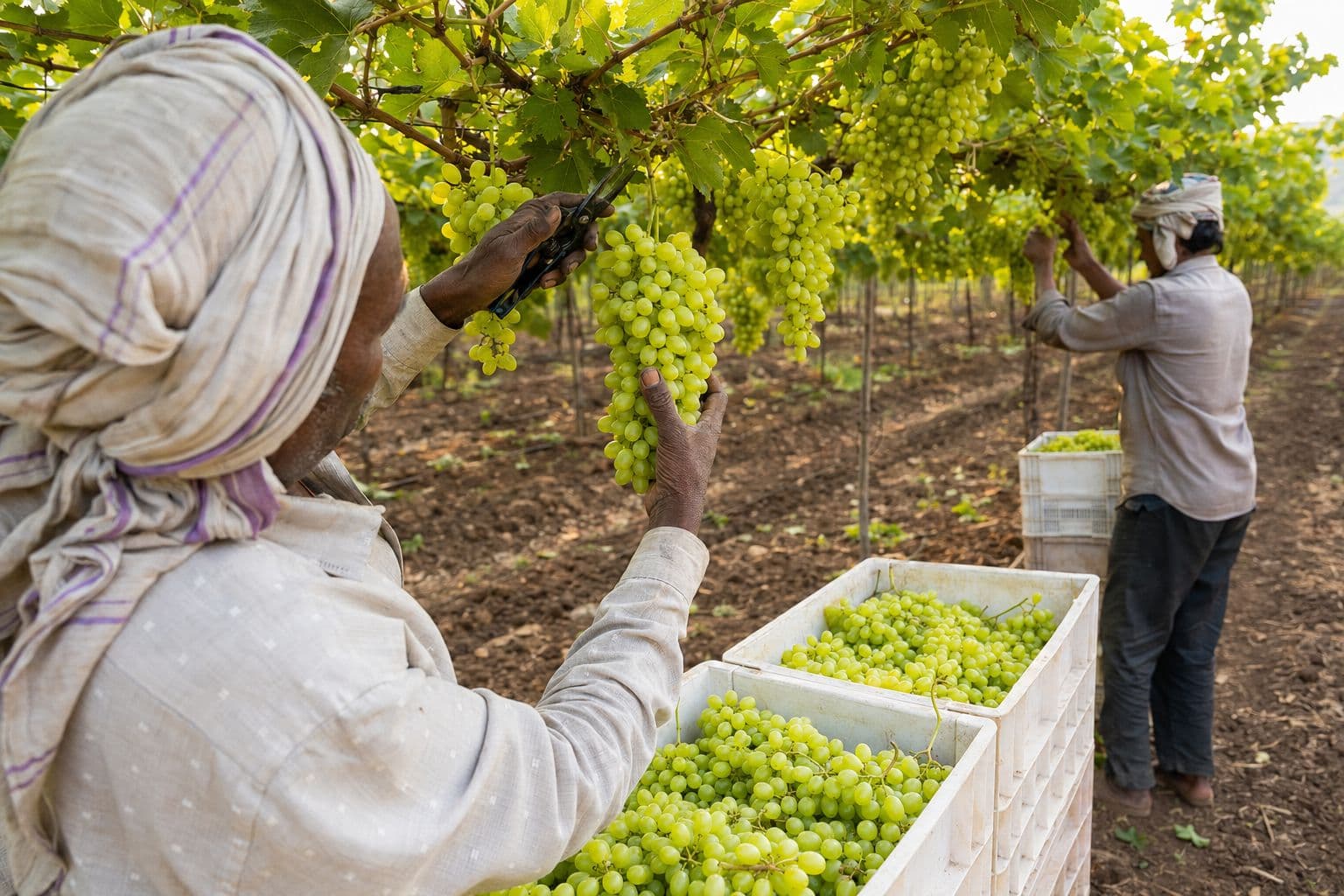
Most food commodities have a rolling supply. Something is being harvested somewhere most of the year, so a price shock in one region gets absorbed by another. Raisins in India do not work that way. The racks run from roughly February to April in the Sangli belt and a few weeks later in the Nashik side, and then they stop. Whatever exists on 30 April is what the country has to sell until the next season.
This means the kismis market price after April is not a supply and demand negotiation in the usual sense. It is a drawdown curve. Everyone in the trade can see roughly how much stock went into cold storage, everyone can see how fast it is moving, and the rate reflects how confident holders are about the months remaining.
It also means a buyer with godown space has a genuine structural advantage over one without. Not a clever trick, just arithmetic. Somebody has to pay to hold the stock between April and October, and that cost lands in the rate whichever way you buy.
Where the Indian raisin market actually sits
Sangli district is the centre of it, and within Sangli, Tasgaon taluka is where the trade concentrates. The large majority of India's raisins come out of Maharashtra, with Nashik as the other significant producing district. Which districts dry what, and why the map is narrower than the grape map, is set out in where India's raisin crop actually comes from. For exact tonnage, look at APEDA or state horticulture figures rather than anyone's estimate, including ours.
The physical market is simpler than people expect. Growers dry their own fruit or hand it to a drying unit. Lots come to the yard, get looked at, get sold. Traders and processors buy, sort, grade and either sell on or push the lot into cold storage. There is no exchange, no published settlement price, no futures contract. A rate is a rate because somebody paid it that morning.
That is why market rates you see quoted online are worth treating carefully. They are usually a single trade in a single grade on a single day, and reporting rarely says which grade. If you want the difference between the grade names attached to those rates, grade names and size bands sets out the ladder we buy against.
What happens between the vine and the rate
Roughly four kilos of grapes make one kilo of raisins, and the fruit sits on shade racks for twelve to sixteen days in the green and golden process. The grower's decision about whether to sell the bunch as table fruit or dry it is taken weeks before any of that, on the basis of what table grapes are fetching that month. A strong table grape season pulls fruit away from the racks and thins the raisin crop, and that decision has already been made by the time the market can react to it.
The full sequence, including what the dipping solution does to the skin and why shade drying takes as long as it does, is in what happens on the racks.
The market calendar, month by month
This is the shape of a normal year. Crop size, monsoon behaviour and the festive calendar shift the edges of it, but the direction holds more often than not.
Typical rate behaviour through the year in the Sangli belt
Why the kismis market price moves week to week
Inside that annual shape there is weekly noise, and buyers who watch it closely often misread what they are seeing. Four things drive most of it.
Arrivals. Even outside the season, lots come out of cold storage in batches, and a week with several holders releasing at once softens the market briefly. It usually recovers.
Festival dates. The Hindu calendar moves against the Gregorian one, so the demand peak shifts by two or three weeks year to year. A buyer comparing this October against last October is often comparing two different points on the same curve.
Quality supply within a grade. This is the one that catches people. Total stock can look comfortable while the specific band you need has gone thin, because premium material sells first and never comes back into the pool.
And from about November, the trade starts pricing what it thinks the coming February will bring. Reports of good flowering soften the December rate. Reports of unseasonal rain firm it. Neither is a fact yet, and both move money.
Why a bad drying season widens the grade spread
Unseasonal rain during the drying window is the single biggest risk in this trade, and it does not do what most buyers assume. It rarely destroys a crop outright. What it does is push a large share of the crop down a grade.
Wet racks dry unevenly. Colour drifts, a green lot browns in patches, a golden lot goes straw instead of amber, moisture runs high and the sorting yield collapses. Total tonnage can come out looking close to normal while the volume of material that will actually pass as premium select or jumbo has fallen sharply.
So the commercial grades stay roughly where they were and the premium grades run away upward. The spread between the top and the bottom of the ladder widens, sometimes considerably, and it stays wide until the next season. Anyone buying premium for gifting or retail repacking feels this hard. Anyone buying commercial grade for mithai units and processing barely notices.
The practical consequence: in a poor drying year, the buyer who can flex one grade down without hurting his finished product has a much better year than the buyer who cannot.
The September to November pull
Demand is not evenly spread across the year and never has been. Sweet manufacturers, dry fruit counters, gift packers and the wedding trade all load into the same ten to twelve weeks. Ramzan adds a second smaller pull depending on where it falls that year.
What makes the festive climb steep is that it collides with the thinnest part of the supply curve. Six months of drawdown have already happened. The premium bands, which is exactly what gifting and retail packing need, are the ones that ran short first.
Buyers who reach the market in the first week of October know they are buying at the worst point of the year. Many of them do it anyway, because working capital was needed elsewhere in April. That is a legitimate trade off, and it should be a decision rather than an accident.
Who is paying to hold the stock
Every kilo sold in September has been sitting in a cold store since April, and that is not free. Rent for five or six months, handling in and out, insurance, and a small weight loss along the way. Somebody carries that cost and it is inside the rate you pay.
The question worth asking is whether it should be you or us. A buyer with clean, cool godown space and predictable monthly consumption can take the material early, carry it himself and generally do better across a year. A buyer without that space is paying us to do it, which is a fair trade and usually the right one.
Do the maths honestly before you commit. Raisins held badly through a Maharashtra monsoon clump, soften and drift out of spec, and the saving disappears. Conditions, stacking and realistic shelf life are covered in holding stock in your own godown.
How a bulk buyer should time commitments
There is no single right answer here, because it depends on storage, cash and how much your finished product tolerates a grade change. What follows is what we actually see working across different buyer types in the belt.
Timing approaches by buyer type
Reading a market rate without being misled
A kismis market price gets quoted in trade groups, on aggregator sites and in casual conversation, and most of those numbers are missing the information that would make them useful. Before you treat one as a benchmark, check what it is actually describing.
This page, and the one you probably want next
Everything above is context. It will help you decide when to commit and which grade to commit to, and it will stop you misreading a rate somebody sends you on WhatsApp. What it will not do is tell you what your consignment costs, because that depends on your grade, your quantity and this week.
For that, ask for a dated quotation, which carries the quote structure, the basis, the validity window and the minimum order. If you are earlier in the process and still working out varieties, grades and how we source, start at our wholesale desk instead. The origin story, season and cold storage side of the belt sits on Sangli and Tasgaon sourcing.
One more thing worth saying plainly. We are a supplier with a position in this market, so read our directional comments with that in mind. Where we do not know something, such as what the coming crop will look like, we will say we do not know rather than dress a guess up as analysis. The live rate page is the one that commits us to a number.
Frequently asked
It changes weekly and it changes by grade, so a single national figure would be misleading. Rates are softest during the February to April season and climb hardest from September into the festive months. For an actual number against your variety, grade and quantity, use our live wholesale rate page, where quotes hold for 48 hours.