

The short version
What a raisin quality specification has to contain
Most bulk raisin disputes we see trace back to the same thing. The order said good quality bold size green raisins and nothing else, so at delivery there was nothing to hold either side to. A specification is not paperwork for its own sake. It is the only way a disagreement in month four can be settled in ten minutes instead of by whoever argues longer.
Nine lines cover it. Print the table below, fill in your own values, and send the same sheet to every supplier you are comparing. When three quotes come back against one sheet, the comparison is real. When three quotes come back against three descriptions, you are guessing.
The grade name at the top of the sheet is shorthand for the rest of it. What each name covers, and why the same word means different material in different godowns, is set out in the grade ladder we quote against.
Specification sheet, filled in for a premium select green lot. Copy the left two columns for your own order.
Size: setting a band you can actually hold a supplier to
Write size as a band, never as a single figure. Dried fruit does not come out of a season at one length, and a supplier who agrees to 20 mm flat is either going to over-sort at your cost or quietly ignore the line.
For green, the band is length in millimetres. For black and golden, length under-describes the berry, because plumpness matters more than reach. On those two we write the band and add a plumpness reference against a retained sample, which is less elegant and considerably more useful.
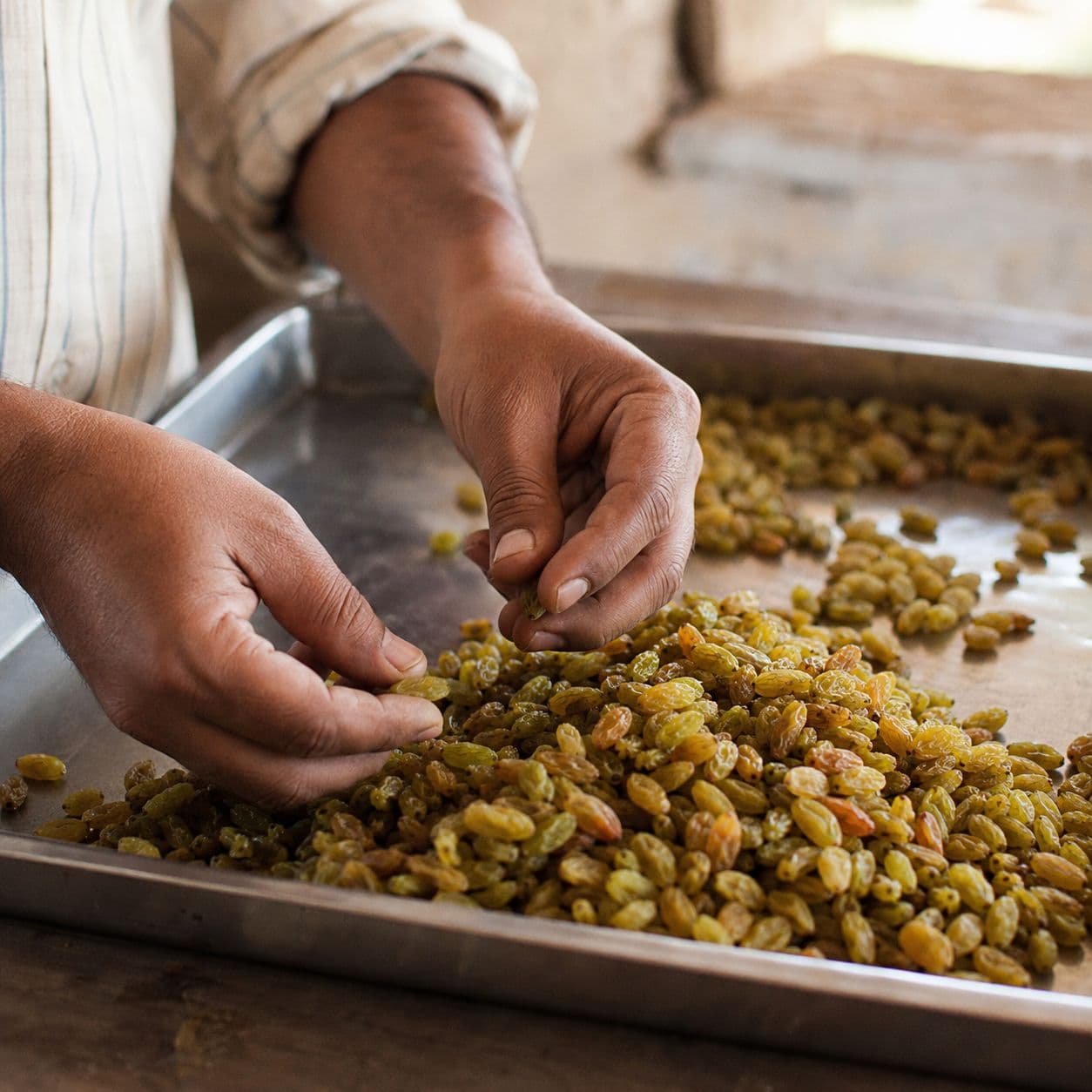
The check is the same everywhere. Twenty pieces drawn from the middle of a carton, laid against a rule, two longest and two shortest set aside. If the remaining sixteen sit inside the band, the line passes. If four or five of them sit a band low, you have a sieving problem and the lot is really the next grade down.
Moisture: the number that decides everything after dispatch
Moisture is the one parameter that looks harmless at intake and does all the damage later. Green raisins are dried to roughly 15 percent, black a shade under that, golden around 15 percent. Two or three points over the ceiling and the lot passes every visual check on the day, then clumps in week eight, weeps sugar into the base of the carton by week ten, and in a warm godown starts to ferment.
Write it as a ceiling, not a target. Not above 15 percent is enforceable. Approximately 15 percent is not.
Verify it twice. A meter reading gives you the number, and the squeeze test tells you whether to believe it. Close your hand around a fistful, press for two seconds, open it. Correctly dried material falls apart on its own. A fistful that holds the shape of your fist is over specification whatever the instrument says, and that is the point at which you go back and check the instrument.
One caution that saves a lot of bad feeling. Moisture can be picked up after dispatch as easily as before it. A consignment that leaves Tasgaon in spec and sits on a warehouse floor against an external wall through July is a storage problem, not a supply problem, and the conditions that separate the two are covered in how carton stock behaves in a godown.
Colour, and why the retained sample is the specification
Colour is the parameter nobody can write down properly. Even pale green means one thing to us and another to a QA officer who has only seen imported sultanas. Words will not close that gap.
So the retained sample does the work. When you approve a lot, keep half of the sample sealed, dated and labelled with the lot reference, and store it somewhere cool. That sealed pouch is your colour standard for the next year. Every later consignment gets tipped out next to it on white paper, under daylight, and the comparison takes thirty seconds.
Expect some drift between crop years. A season with a cooler drying window produces green that reads a shade paler; a hot dry season pushes it warmer. That is the fruit, not a substitution. What is not normal is a handful that looks like two lots poured together, with a clear population of outliers rather than a gentle spread.
Defects and realistic tolerances
Defects have to be counted, not eyeballed, or every intake becomes a negotiation about how bad is bad. The method we use and recommend is simple. Take a 200g draw from the middle of a carton, spread it on a tray, physically separate each defect category into its own pile, and weigh the piles. For stem fragments, which are light and would barely register by weight, count pieces per kilo instead.
The tolerances below are ours. They are what we work to and what we will put in writing, not a published national standard, and a different supplier may reasonably work to different ones. Write your own numbers into your order rather than inheriting anybody else's.
Working defect tolerances, by grade tier
What counts as foreign matter
Grit and sand, small stones, jute fibre off a sack, plastic strapping fragments, insect matter. Anything that did not come off the vine. This is the one line we do not express as a percentage, because a tolerance for stones is an invitation to supply stones.
Grit is the one buyers miss most often, because it does not show on a tray. It shows between the teeth. Bite three pieces from different parts of the draw. A faint crunch means the fruit dried on the ground or the cleaning line was rushed, and washing at your end does not properly fix it.
Rejection versus tolerance
This is the distinction that keeps a supply relationship workable. A tolerance means the defect is expected in small quantity, priced into the grade, and handled by noting it or by repricing the lot. A rejection means the material should not enter your production at all and no discount makes it acceptable.
Sugar bloom is neither. The fine white dry dusting on raisins that have moved from a cool store into a warm room is crystallised natural sugar. It rubs off, it dissolves in warm water in seconds, and it has no smell. Rejecting a good lot for bloom is the most common expensive mistake a new intake team makes, and the visual difference against mould is spelled out in our handful by handful quality check.
What to do with what you find
Sample inspection, step by step
No serious buyer commits a season's requirement against a photograph. Before a first order we send 250g of the exact grade with a grade sheet stating every line from the specification table, charged at cost plus courier and adjusted against your first bulk invoice, dispatched within two working days of confirmation. Samples are for wholesale enquiries with a genuine 15kg minimum behind them. If you want one pouch to look at, buy a sealed retail pack instead and skip the paperwork.
Here is how to run the inspection properly once it lands.
Checking the consignment when it arrives
Sample approval is not the end of it. The consignment is what you paid for, and it needs a draw plan of its own before anything goes into stock.
On a twenty carton consignment, open three cartons from three different layers of the stack, never three from the top. Draw from the middle of each opened carton. Check gross and net weight against the invoice on at least one carton. Run the squeeze test on each draw and compare all three against your retained sample side by side on the same sheet of paper.
If something is off, photograph it before anything is moved or repacked, and report it inside 48 hours. A carton photographed in place on the day it landed is evidence. The same carton described from memory three weeks later is a difference of opinion.
The commercial lines that sit under the specification
A specification tells the supplier what to send. These lines tell him how, when and on what terms, and they belong on the same document.
Minimum order is 15kg. Rates are quoted ex-Tasgaon with freight quoted separately, because freight depends on destination, quantity and whether the consignment moves by courier or by transport. A quote holds for 48 hours, which is enough to price your own counter or production run without carrying market risk, and no longer, because the market moves. Every dispatch carries a GST invoice with the HSN classification set out on our tax and invoicing page, and cartons are batch marked so any consignment can be traced back to a lot and a packing date.
Packing format belongs in the specification too, not in a follow up email. Carton size changes cost per kilo, handling at your end and damage in transit, and the trade offs are laid out in the bulk packing formats we run. Payment terms are agreed at quotation stage rather than assumed.
Commercial terms as we quote them
What actually goes wrong
Six failures account for nearly every raisin supply dispute we have been on either side of. None of them are exotic.
The buyer checklist
Print this, or copy it into your intake procedure. It is the whole page in one column.
Getting a quote against your sheet
Send us the filled sheet with your monthly quantity and destination city and you will normally have a firm number back the same working day, held for 48 hours, ex-Tasgaon. If any line on your sheet is something we cannot hold consistently through a year, we will say so at enquiry stage rather than agree and substitute later. Current rate mechanics are on the bulk rate desk, and everything else this desk handles sits on the wholesale hub.
Frequently asked
Nine lines: variety and seedless status, grade name, size band in millimetres, moisture ceiling, colour standard tied to a retained sample, defect tolerances by category, foreign matter stated as nil visible, additive declaration, and packing with batch marking and crop year. Anything written as an adjective rather than a number cannot be enforced at delivery.