

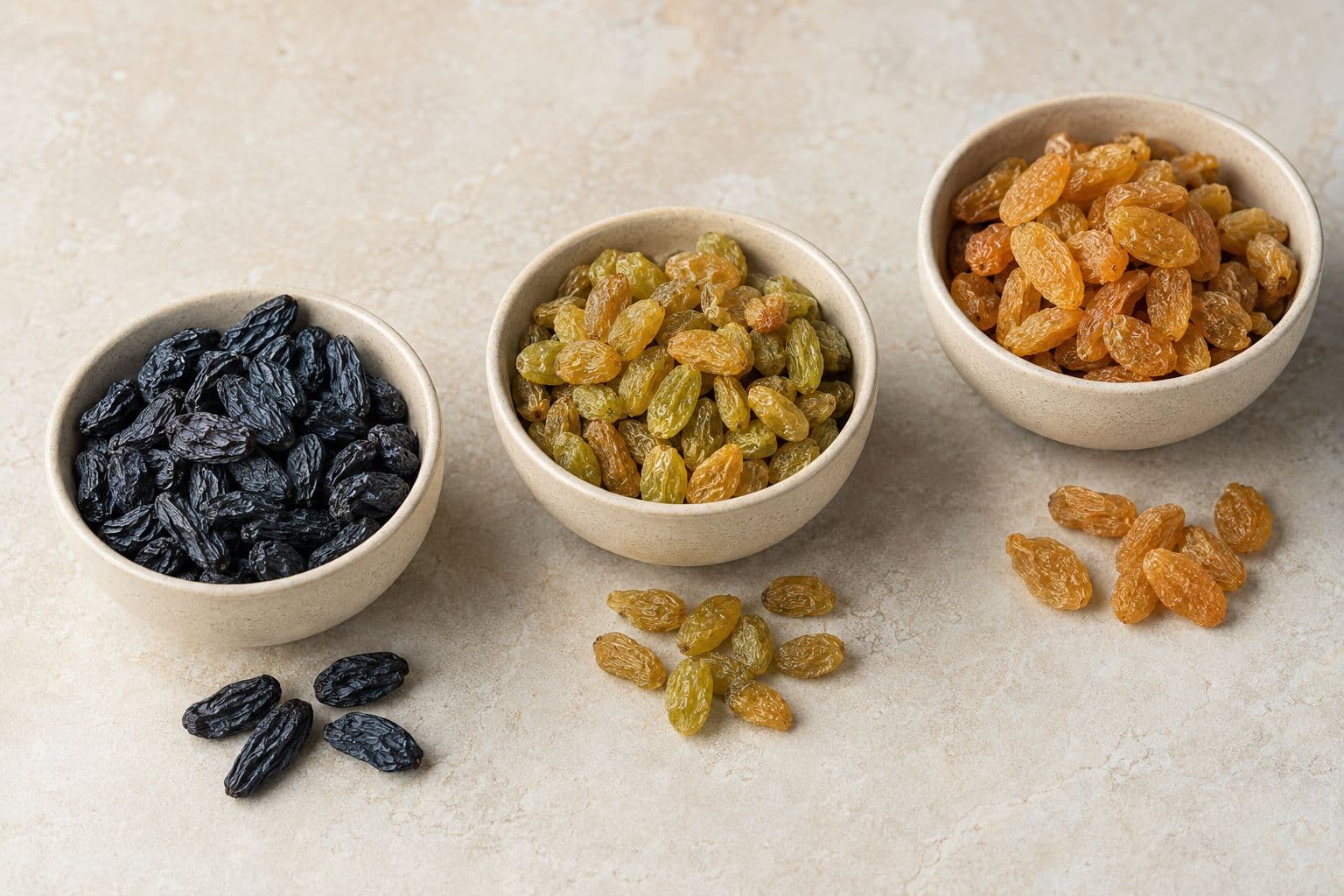
There are three everyday types of raisins in India: green, black and golden. All three are the same seedless Thompson grape, separated only by how they were dried. Green is firm and tart, black is soft and sweetest, golden is plump and mild. Seeded raisins and munakka come from different grapes and are sold separately. Sultanas and currants are the imported names for the same idea.
The short version
The three types you will actually find
Stand at any dry fruit counter in India and the raisin trays come in three colours. Pale green, deep brown-black, warm amber. That is the entire everyday range, and all three trays start life as the same fruit: the seedless Thompson grape grown across the Sangli and Tasgaon belt of western Maharashtra, where the large majority of India's raisins are made.
We buy all three from the same market yard, in the same February to April window, often off vineyards within a few kilometres of each other. They land on our sorting table looking like three different products. The vine did not decide that. The drying shed did. If you want the process itself, rack by rack, it is set out in how a grape becomes a raisin, and the region that does nearly all of it is covered in the Sangli and Tasgaon belt.
Green raisins, the long seedless kismis
This is what most Indian kitchens mean when they say kismis. Green raisins dry under shade nets for roughly 12 to 16 days, which holds the pale colour and leaves the flesh firm. A premium select lot measures 18-22 mm, springs back when you press it, and finishes tart before it finishes sweet.
That tartness is why it works in cooking. Drop green raisins into kheer or a sweet pulao in the last three or four minutes and they stay whole and visible instead of collapsing into the pot. They carry a small premium over black at the same grade, because shade drying occupies rack space for longer and gives less finished weight per tonne of grapes. Retail packs of green kismis run from ₹249 for 250g to ₹849 for a kilo.
Black raisins, the sun-dried sweet one
Black raisins go out in open sun for roughly 10 to 14 days. The skin darkens the way any cut fruit darkens in air, the sugar concentrates, and what comes off the racks is softer, rounder and the sweetest of the three. Grade A black runs 12-16 mm, shorter than green, and it gives way under the tooth rather than pushing back.
It is the snacking raisin. It is also what sweet units buy by the sack for laddoo, panjiri, halwa and chikki, because the sweetness carries through a preparation that already has sugar in it. Cheapest of the three as well, which is irrelevant on a 250g pack and matters a great deal at five quintals. Black raisins start at ₹229 for 250g.
Golden raisins, the plump amber grade
Golden raisins come from grapes left a little longer on the vine and dried slowly under shade, so they finish large, tender and warm amber. The jumbo grade sits at 16-20 mm. The flavour is mild and honeyed rather than concentrated, which is what a delicate bake wants.
Golden lots are normally sulphur treated during processing to hold that colour, declared as E220 on the pack. That is standard trade practice rather than a shortcut, and a supplier who will not tell you whether a golden lot is treated is telling you something else. Bakeries order golden because it still reads as gold fruit against a pale crumb after forty minutes in the oven. It is the dearest of the three at retail, from ₹289 for 250g. Packs and grades sit on golden or yellow raisins. Set beside the other two it splits cleanly: dark against amber is a sweetness and colour decision, while pale against amber is mostly about whether the fruit has to survive a boil.
Why one grape becomes three different raisins
The grape is not the variable. The drying is.
Sun drying is the older method and the cheaper one. Racks go out in the open, the fruit browns as it loses water, and roughly a fortnight later you have a black raisin. Shade drying uses nets plus a food grade dip that breaks the waxy bloom on the skin so moisture leaves evenly. Slower, dearer, and it keeps the fruit pale.
Ripeness at harvest is the second lever. Pick a little later, dry a little slower under net, and the fruit stays plump and turns amber instead of pale green. That is golden. Same belt, same kind of shed, a different call made by the farmer three weeks earlier.
All three finish near 15% moisture, and all three take roughly four kilos of grapes to make one kilo of raisins. A bad drying week, the kind where cloud sits over the belt for four days straight, thins the supply of premium grades and widens the price spread between grades for the rest of the season. That is trade reality and it shows up in the rate.
All types of raisins compared
The table below covers the full range you will meet in India, including the two products that are not raisins in the trade sense at all and the two names that only turn up on imported packs.
Read the price band as a retail band for the grades we pack. Bulk works differently and is quoted on the day, not printed.
The seven names sold as raisins in India, and what each one actually is.
Seeded raisins and seedless raisins
Seedless is not something done to the fruit. The Thompson grape has no developed seed to begin with, so every green, black and golden raisin coming off the Sangli racks is seedless from the start. Nothing is pitted, nothing is removed. That is why "seedless black raisins" and "black raisins" describe one product on an Indian shelf, and why the word on the label is reassurance rather than a grade.
Seeded raisins are dried from seed-bearing grape varieties altogether. Bigger, chewier, denser in flavour, and mostly bought for traditional preparations rather than eaten by the handful. If you bite one and find a seed, that is the variety behaving normally, not a fault in the lot.
Where it goes wrong is a pack marked seedless with seeds in it. That is a sorting failure and it should go back to the seller. We hold seedless lots only, in all three colours, and we will say we do not have something rather than substitute it. The longer version, including what people usually mean when they search for black raisins with seeds, is in seeded and seedless explained.
Munakka is a separate product, not a grade
Munakka sells from the same counters as kismis and gets described as big black kismis often enough that buyers pay raisin money for it, or munakka money for raisins. Both happen.
It is a different grape. Larger, darker, sticky rather than chewy, seed-bearing, and noticeably less sugary than a black raisin. It is normally soaked overnight in water or milk before use and the seeds are picked out by hand. Traditional and Ayurvedic preparations ask for it by name, and a recipe that specifies munakka will not behave the same way if you tip black raisins in instead. We are a raisin supplier and not a medical source, so we will describe what the fruit is and stop there.
We do not stock it. We do not put that word on anything we pack. If your requirement is genuinely munakka, buy it from someone who actually holds it and check the size when the carton opens. The two are set out properly in kismis and munakka side by side.
Sultanas, currants and the imported names
Three words that mean three separate things in a British or Australian recipe, and roughly one thing in an Indian shop.
Sultana is the name for a golden, seedless dried grape, usually treated to keep it light. It is close enough to Indian golden raisins that you can swap one for the other in a fruit cake and change nothing else. Currant, in the dried grape sense rather than the fresh blackcurrant sense, is a much smaller, darker, sharper fruit from a different variety, and it is not produced here in any quantity.
So a recipe listing sultanas wants golden. A recipe listing currants has no exact Indian equivalent, and the working substitute is small black raisins, chopped if the recipe wants them fine, used a little lighter by weight because they are sweeter. Bakery buyers reading a specification sheet that says sultana should ask for jumbo golden and check the grade rather than argue about the word. The full three way breakdown, including where currants genuinely differ, sits in raisins, sultanas and currants compared.
Grades move the price more than the type does
This is the part most buyers get wrong. The gap between a premium select green lot and a commercial green lot is usually wider than the gap between green and black at the same grade. So choose the type for the job, then choose the grade for the budget, then hold the supplier to the grade in writing.
Grade is decided by length, colour uniformity and moisture, plus how clean the lot is of stems, stones and shrivelled pieces. None of it is standardised nationally. One trader's grade A is another trader's premium, which is why a buyer who has been burned once asks for a grade sheet before a rate.
Grade names are trade conventions, not a national standard. Buy against a written spec, not a letter.
What each type costs
Retail first. These are our current pack prices, and they buy the grades named in the table.
Retail pack prices, updated 1 August 2026. Wholesale rates are quoted on the day.
Retail: buy the size that matches how you cook
The 1kg pack is the cheaper way to buy any of the three if raisins go into something in your kitchen most weeks. The 250g pack is the sensible way to try a variety you have never bought, because nobody should discover they dislike golden raisins one kilo at a time. All nine packs sit together on the current pack prices page, which we revise when the packing rate moves.
Bulk: why we do not print a number
A raisin rate moves with the season, the grade and the size of the lot sitting on the floor that week. A number printed in March is misleading by June, and a supplier who leaves it up is either not trading or not telling you the truth. So bulk rates are quoted on the day, hold for 48 hours, and start at a 15kg minimum. Samples are 250g, charged at cost, adjusted against your first order. Send the grade and the quantity to our wholesale desk and you get a real figure back the same day.
Which type should you buy
Answer one question before anything else. Does the raisin need to stay whole and visible, melt into the dish, or look good on a finished product?
Four ways buyers get caught
The same four mistakes come back to us every season, and all four are avoidable. Buyers pay for a colour when the grade was the thing that mattered. Buyers accept munakka as a large black raisin. Buyers compare two rates that refer to two different grades and conclude one supplier is cheap. Buyers store a good lot badly through a wet July and blame the raisin.
None of that needs expertise to avoid. Name the grade, ask what the lot actually is, look at the fruit before you commit to volume, and keep the pack sealed and cool once it is open.
What each type is called around India
A fair amount of the confusion in this category is naming rather than product. Names shift between the market yard and the shop shelf, and a shopkeeper is not usually trying to mislead you when he uses a different word from the one you searched.
In Sangli and Tasgaon nobody says raisins. They say bedana. Retail across north India says kismis or kishmish, and someone who says kismis without qualifying it usually means the long green kind. Black gets called kali kismis or kala kismis. Golden gets called yellow raisins about as often as golden, and since the two are one product, there is no reason to pay more for one word than the other.
Frequently asked
In Indian retail, three that matter: green, black and golden. All three come from the same seedless Thompson grape and differ only by drying method. Beyond those you will meet seeded raisins and munakka, which come from seed-bearing grapes and are sold as separate products, plus sultanas and currants, which are imported names rather than Indian varieties.
Black, green and golden in 250g, 500g and 1kg packs, graded and dispatched from Tasgaon.
Shop all three varieties