
The difference between kismis and munakka is the grape, not the grade. Kismis is the everyday seedless raisin, green, black or golden, eaten straight from the pack and cooked into sweets. Munakka is a larger seed-bearing dried grape, stickier and less sugary, traditionally soaked overnight before use. They are priced on separate markets and one will not stand in for the other.
The short version
What kismis is
Kismis, kishmish, kismish, whichever spelling your shop has painted on the tray, is the Indian name for dried seedless grapes. Say it in a Maharashtra kitchen and most people picture the long pale green one. Say it at a mithai counter and they mean whatever is in the tin that day. All of it comes from Thompson seedless and its local clones, and the large majority of it dries within a short drive of Tasgaon.
The three varieties on any Indian counter are all kismis. Shade-dried long green kismis, firm and slightly tart. Sun-dried black, soft and the sweetest of the three. Slow-dried golden, amber and plump. What separates them is a drying decision taken in February and March, which is a different subject and is laid out in the drying yard side of it and in where each dried grape sits in the Indian range.
Moisture lands around 15%. Dry enough that a squeezed handful falls apart in your palm, wet enough that it is still recognisably fruit.
What munakka is
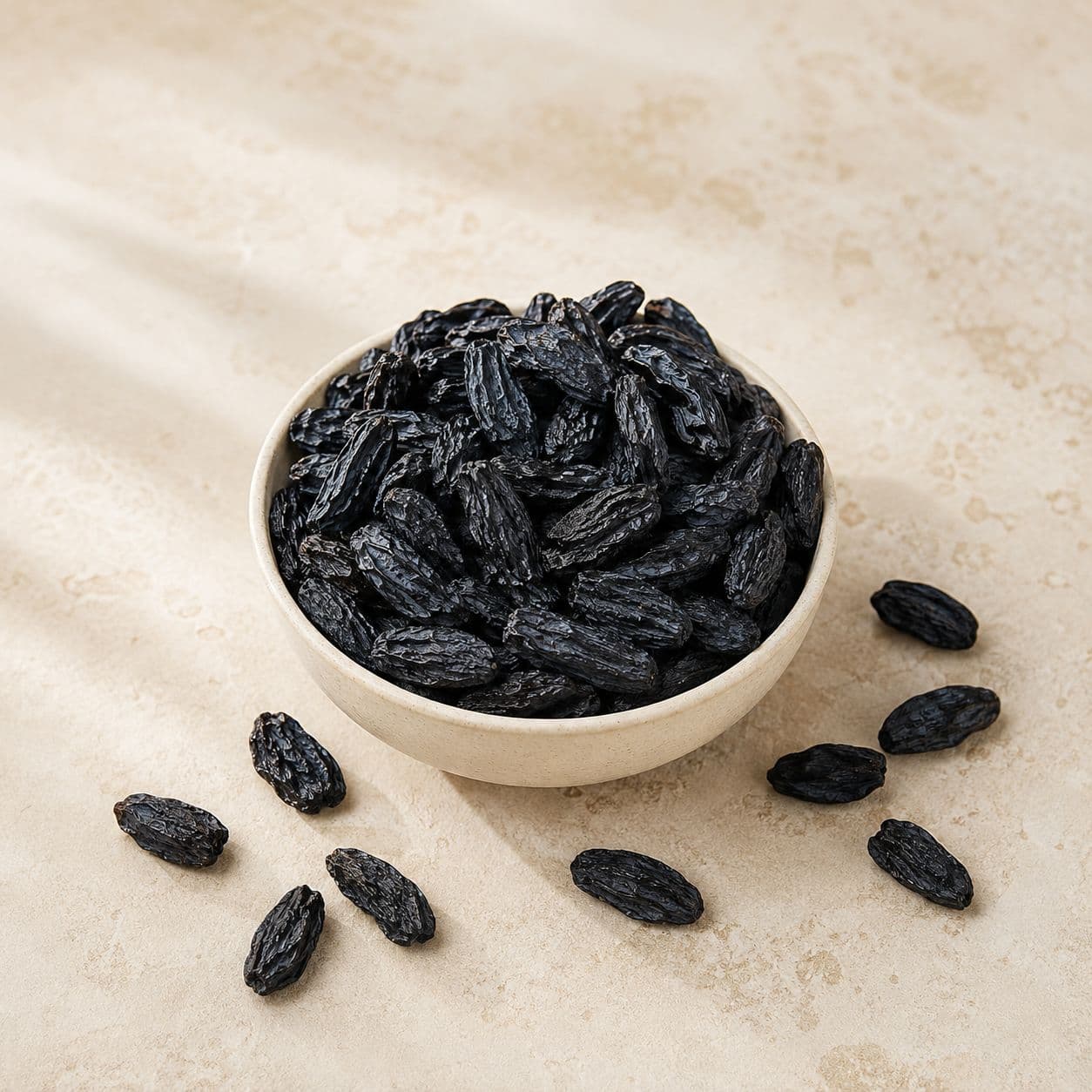
Munakka is a dried grape from seed-bearing varieties, and the seeds are part of the product rather than an accident. It is larger than any kismis grade we pack. Darker too, closer to a deep reddish brown than to black. Sticky in the hand. It carries more moisture than a raisin does, which is why a carton of it settles into a block instead of pouring loose the way a bag of kismis will.
The flavour is the real giveaway. Kismis reads as sweet first, then fruit. Munakka reads the other way round, with a tartness sitting behind the sweetness and less of that clean sugar hit, and it leaves the mouth feeling coated rather than clean. Anyone who grew up with a jar of it in the house can pick it out with their eyes shut.
We do not dry it, we do not buy it, and we do not see it come through the Tasgaon yard. What trades there is seedless raisin sold by grade, with buyers arguing over length and colour and moisture in a bag. Munakka reaches Indian counters through a different trade entirely, a good part of it through import channels, and it sits in a separate corner of the dry fruit shop for a reason.
Calling it a big raisin is where most of the trouble starts.
Munakka vs kismis, side by side
Put a handful of each on the same plate and the argument ends in about four seconds. Everything in the table below is something you would notice in that order, from the far side of a counter, without asking anyone a question.
Kismis and munakka compared
The row that decides everything else
It is the second one. Seeds or no seeds is not a detail on a spec sheet, it is the reason the two fruits are grown, dried, priced and cooked differently. Size follows from the variety. Stickiness follows from the moisture the variety carries. The soaking follows from the seeds.
Why nearly every kismis pack in India is seedless in the first place, and why nobody removes a seed from a raisin, is covered in the seeded and seedless question.
Why the two names get mixed up
Both are dried grapes. Both dark ones sit in trays a foot apart under the same glass. And "black kismis" gets used loosely at a counter for anything dark and wrinkled. Sealed packs make it worse, because you cannot feel stickiness through a laminate pouch, and a photograph on a listing will not tell you the size unless something is next to it for scale.
There is a pricing incentive too. Munakka usually costs more per kilo than ordinary kismis, so the confusion tends to run in one direction rather than both. A shop that sells you munakka as black kismis has done well out of the exchange. A shop that sells you kismis for a preparation that wanted munakka has cost you the dish and kept your money.
The fix is dull but it works. Look for the word seedless and, more usefully, a named grade. Premium select. Grade A. Jumbo. Munakka is never sold that way, because grade ladders in this country were built for the raisin trade. If a listing gives you a grade and a length in millimetres, you are looking at kismis whatever the photograph suggests.
What the name on the tray usually means
The soaking tradition, without the claims
Munakka is almost always soaked. A few pieces go into a cup of water at night, or into warm milk, and are left until morning. The seeds get pinched out, the flesh is eaten and sometimes the water is drunk. In plenty of houses this is a cold weather routine that starts somewhere around Diwali and stops when the season turns.
That practice carries a long list of traditional associations, and munakka appears by name in Ayurvedic and Unani preparations. We are a raisin supplier in Tasgaon. We can tell you what a fruit is, where it dried, what year it came off the vine and how it should feel in the hand. We are not the right people to tell you what it does for your body, and we are not going to pretend otherwise to sell a pouch.
Kismis gets soaked as well, for an entirely different reason. An hour in warm water plumps a raisin before it goes into a batter, and bakers do it as a matter of routine so the fruit does not pull moisture out of the crumb while the loaf bakes. That is a texture decision. The prep detail, including draining and dusting with flour so the fruit stays suspended, is in soaking and folding raisins into a bake.
Can you substitute one for the other
Not cleanly, in either direction.
Drop kismis into a preparation built around munakka and it disappears. Kismis is smaller, sweeter and softens within minutes of hitting hot liquid, so instead of dense fruit you get sugar in the pot. Go the other way and drop munakka into a kheer and you get large sticky pieces sitting up against the rice, a deeper flavour that fights the cardamom, and seeds that somebody at the table will find at the worst moment.
If a recipe names munakka, buy munakka. If it names kismis, or simply says raisins, then pick by drying method, because that is the choice that shows up on the plate.
Price, and what we will and will not quote
Our retail packs are kismis, so those are the only numbers we publish. Black is ₹229 for 250g, ₹429 for 500g and ₹799 for 1kg. Green is ₹249, ₹449 and ₹849. Golden is ₹289, ₹539 and ₹999. All of it, with the price per kilo worked out so the pack sizes are actually comparable, sits on what each pack size costs.
Munakka we do not price, because we do not stock it. If a supplier quotes you both off the same rate list, they are either trading both properly or guessing, and it is worth finding out which before an order goes in. Ask them what the munakka moisture is. The answer tells you a lot.
Bulk kismis works the same way as retail, only slower and with more paperwork. We quote seedless lots by grade, on the day, and a rate holds for 48 hours because Tasgaon moves and a stale number is worse than no number. Minimum is 15kg. Samples are 250g, charged at cost and adjusted against the first order. Bulk enquiries start there, with a grade named and a quantity attached.
What we actually stock
Seedless kismis, three varieties, packed in short runs so the stock on the shelf comes from the season you think it does. Black at grade A. Green at premium select. Golden at jumbo. Nothing we hold is munakka and nothing we label goes out worded so that it might be mistaken for it.
That is a limitation, not a boast. If you came looking for munakka we have sold you nothing today, and we would rather that than have you open a pouch next week and find the wrong fruit inside. Anyone who came for the dark snacking raisin should go straight to our black kismis packs, which is what most people searching this comparison actually wanted.
Everything else, the sorting, the grading, the moisture check on arrival, applies equally across all three. It is the same bench and the same set of arguments about what gets rejected.
Frequently asked
Kismis is a seedless raisin dried from Thompson seedless grapes. Munakka is dried from seed-bearing varieties, is visibly larger, stickier and less sugary, and carries seeds that are removed by hand. Kismis is eaten straight from the pack. Munakka is usually soaked overnight first. They trade on separate markets at separate rates.
Green, black and golden, graded and packed in short runs from the Tasgaon belt.
Shop seedless kismis