

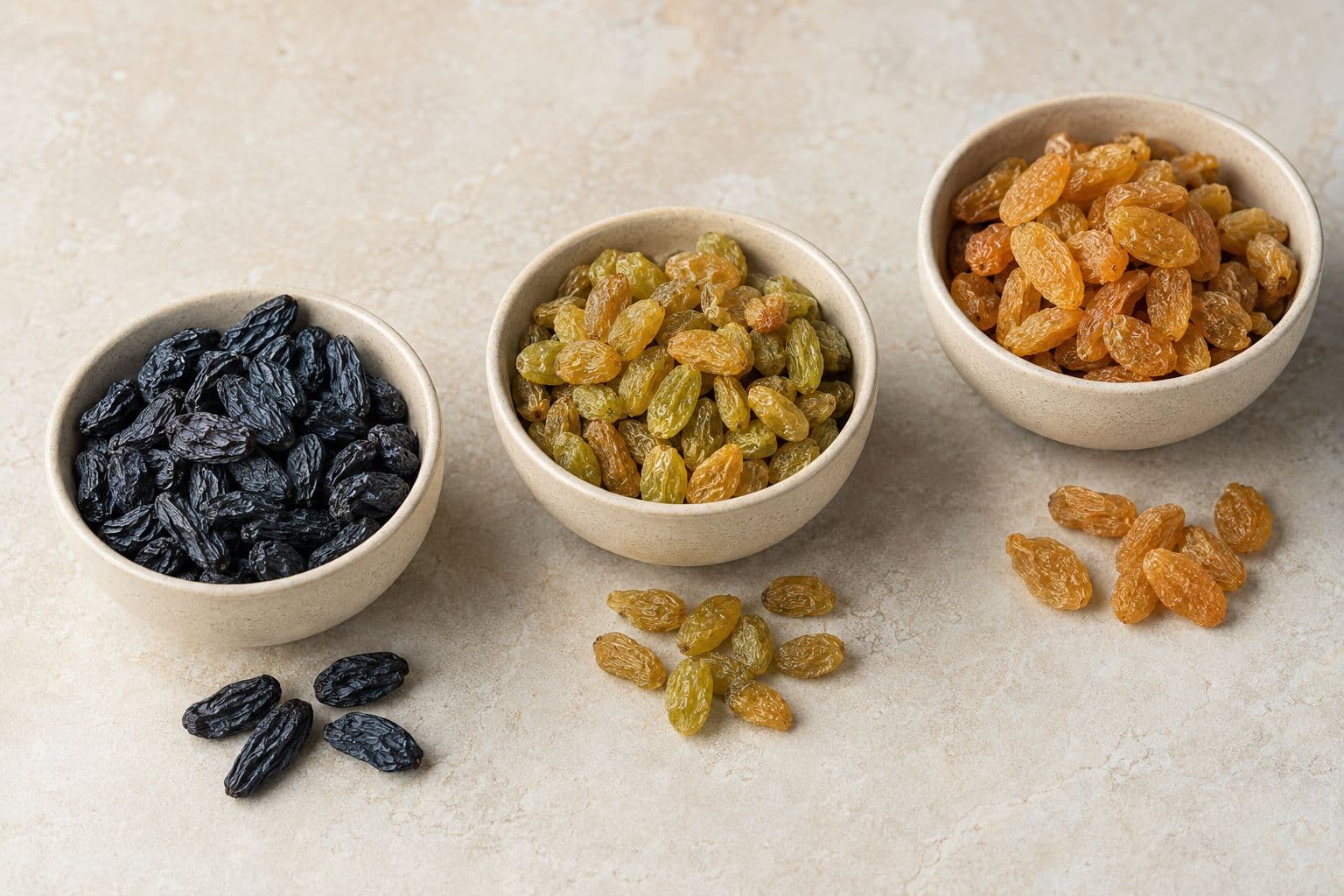
Black raisins vs green raisins is a drying question, not a grape question. Both are the same Thompson seedless grape. Green is dried under shade nets, so it stays pale, firm and slightly tart. Black is dried in open sun, which darkens the skin, softens it and concentrates the sugar. Cook with green when the raisin must stay whole. Eat black, or use it where it should melt in.
The short version
Same grape, two drying yards
Walk any drying yard around Tasgaon in the first week of March and you will see both being made within sight of each other. Same vineyards, same variety, often the same grower. The racks sitting under green shade net are becoming green raisins. The trays left out in open sun are becoming black.
Green goes on the racks after a food grade dip that breaks the waxy bloom on the skin so moisture can leave evenly. Under net, out of direct light, the fruit takes roughly 12 to 16 days and finishes pale, long and firm. Black skips the shade entirely. Ten to fourteen days of straight Deccan sun darkens the skin, pulls moisture out faster and leaves a smaller, softer, distinctly sweeter raisin.
Yield is about the same on paper, near enough four kilos of grapes to one kilo of raisins on either route. The economics are not. Shade drying holds rack space longer and throws out more fruit for colour patchiness, so a green lot costs a grower more to produce and that shows up on the shelf. The full sequence from harvest to sorting is written out in how raisins are made.
Weather decides how wide the quality spread gets in any given year. Sun lots are exposed, so an unseasonal shower in the second week of March sends growers running to pull trays in, and fruit that goes back out afterwards carries patchy colour for the rest of its life. Shade lots ride out the same shower with less damage. After a bad drying week the premium grades of both varieties thin out, the gap between grades widens, and every rate quoted in the market yard moves within days.
Neither route is more natural than the other. Both have been standard practice in this belt for decades, and a farmer will often run both at once to spread his risk across two markets.
How they taste, and how they bite
Put ten of each in front of somebody and the words come back almost identical every time. Green tastes clean, with a tart edge on the finish and a bite that pushes back against the teeth. Black tastes cooked: deeper, jammy, sweet at the front of the tongue, and it collapses the moment you press it.
Both varieties leave our packing bench at around 15% moisture. Black still eats softer because sun drying breaks the flesh down further and leaves more free sugar sitting at the surface. That surface sugar is also why an opened pack of black raisins welds itself into a brick during a Konkan monsoon while green stays loose.
Size is the other tell. Premium select green runs 18-22 mm and is visibly long. Grade A black sits nearer 12-16 mm and is rounder. Customers sometimes write in saying their black raisins look small next to the green ones they bought last month. They are not a poor lot. They are a different variety.
One more thing about black catches people out. It varies more from lot to lot than green does, because open sun is a far less controlled process than a shaded rack. Two grade A black lots bought off the same road in the same week can differ in how dark they run and how sticky they feel. We squeeze and taste every lot before we buy it, and we buy in short runs through the season rather than filling a godown once in April, which is the only way a pack in October resembles the pack somebody bought in June.
Green raisins and black raisins compared
What happens when you cook them
This is the difference that actually decides most kitchen purchases, and it is easy to test. Drop six green raisins and six black into simmering milk. After four minutes the green ones are plump and still separate. The black ones have gone soft at the edges and the milk has picked up a faint grey-brown tint.
So kheer, payasam, sheera, pulao, biryani garnish, poha and dry fruit mixes take green. The raisin stays whole, stays visible, and its slight tartness cuts a very sweet dish. Add them in the last three or four minutes rather than at the start, or they turn to mush and you lose the point of buying the long grade.
Laddoo, panjiri, halwa, chikki and most mithai take black. Here you want the raisin to soften into the mixture and carry sweetness through it, and the darker colour disappears into ghee-roasted flour anyway. Sweet makers ordering by the sack know this, which is why our black kismis packs move fastest in the weeks before Diwali.
For soaking, green wants 10 to 15 minutes in warm water and black about 5. Overnight soaking is a different practice with its own uses and it turns black raisins into something closer to a paste.
In the oven, both have a problem
Neither of these is the bakery default in India, and there is a reason for that. Green raisins have a firm skin that dries out under a 180C bake. Pieces sitting on an exposed crust go leathery, and the tart finish can read as plain sour against a light sponge. Green works best in a bake where it is buried in a wet batter or a filling.
Black raisins take heat better in terms of texture, but they darken further and any piece exposed on top of a bun or rusk looks burnt whether it is or not. In dark bakes, date cakes, spiced buns, brown breads, that is a non-issue and the lower cost per kilo helps a production line.
If colour on the finished product matters, most bakeries move to the amber grade instead, and accept a higher rate for it. The trade-off there, along with soaking times and how much fruit a batter will actually hold, is set out in what golden raisins do differently.
Price, and why grade moves it more than colour
Green sits a little above black at every pack size. That gap is the drying cost and the rack time, not a quality judgement. Across a 1kg pack it is fifty rupees.
Our current retail packs, all from this season, work out like this.
Retail pack prices, black and green
Grade beats variety, every time
Inside one variety the grade ladder is wide. Premium select green, standard green and commercial green are three genuinely different products sorted on length, colour uniformity and moisture, and the spread between the top and the bottom of that ladder is wider than the spread between green and black at the same grade.
This is why a rate quoted without a named grade tells you nothing. A trader can undercut anybody in Sangli by quoting commercial green against somebody else's premium select and never mentioning it. Retail packs on this site are premium select for green and grade A for black, and both grades are printed on the label.
Buying either one in bulk
Bulk behaves differently from retail. We quote against a named grade on the day, hold that rate for 48 hours and work to a 15kg minimum, because the Tasgaon market moves week to week and a rate carried for a month is a rate somebody is going to lose money on. Samples are 250g, charged at cost and adjusted against the first order.
Bakeries and sweet units usually order both: green for the visible applications and black for anything cooked down. Retail buyers can compare the packs and the per kilo maths on the kismis price page, and the long green seedless grade is listed there with its own size and moisture spec.
Storing each one at home
Same principles for both: airtight, out of sunlight, away from the stove and off the top of the fridge where the compressor keeps things warm. Where they differ is what goes wrong first.
Black clumps. All that surface sugar makes an open pack set into a solid block by July if it sits in a humid kitchen. Half an hour in the fridge and the block breaks apart cleanly with a spoon, and nothing is lost. Green does not clump much, but it hardens and drifts brown when it is left warm and lit. Browning is not spoilage. It does mean the pale colour you paid a premium for is gone.
White crystals on either variety are crystallised sugar, not mould. Mould announces itself by smell, sour and fermented, and a lot that smells like that goes in the bin rather than the pan. Full month-by-month guidance is in storing raisins through the monsoon.
What to check before you commit to either
Choosing the wrong variety is a minor annoyance. Buying a bad lot of the right one is the real problem, and it happens far more often. Squeeze a handful. A correctly dried lot compresses and then falls apart when you open your hand. If it stays in a ball, the moisture is high and that lot will ferment before the season is out.
Then look at colour spread across the pack rather than at individual pieces, check for stems and caps, and smell it. The trained version of this check, including what we reject at the sorting table and why, is in how we grade what goes into a pack. If you want the wider picture of what else sits on an Indian dry fruit counter, start from all the varieties Indian shops stock.
So which one should you buy
Most households that cook regularly end up keeping both, a 1kg of black for the jar and a 500g of green for the kitchen. If you are only buying one, buy black for eating and green for cooking, and decide which of those you actually do more of.
Then buy the pack size you will genuinely finish. A kilo opened in April in a coastal kitchen and left on the counter until August is a kilo that will disappoint you by June, and no grade survives that treatment. Two 500g packs bought two months apart beat one kilo bought in a hurry, unless you have the fridge space and you actually use the clip on the pack.
Pick by what you are making
Frequently asked
Neither, in general. Green is firmer, slightly tart and holds its shape when cooked, which makes it the better raisin for kheer, pulao and anything where it must stay visible. Black is softer and sweeter and is the better one to eat from the jar or cook into laddoo and halwa. Grade matters more than colour.
Grade A black and premium select green, 250g to 1kg, packed in short runs and dispatched from Tasgaon.
Shop black and green packs