
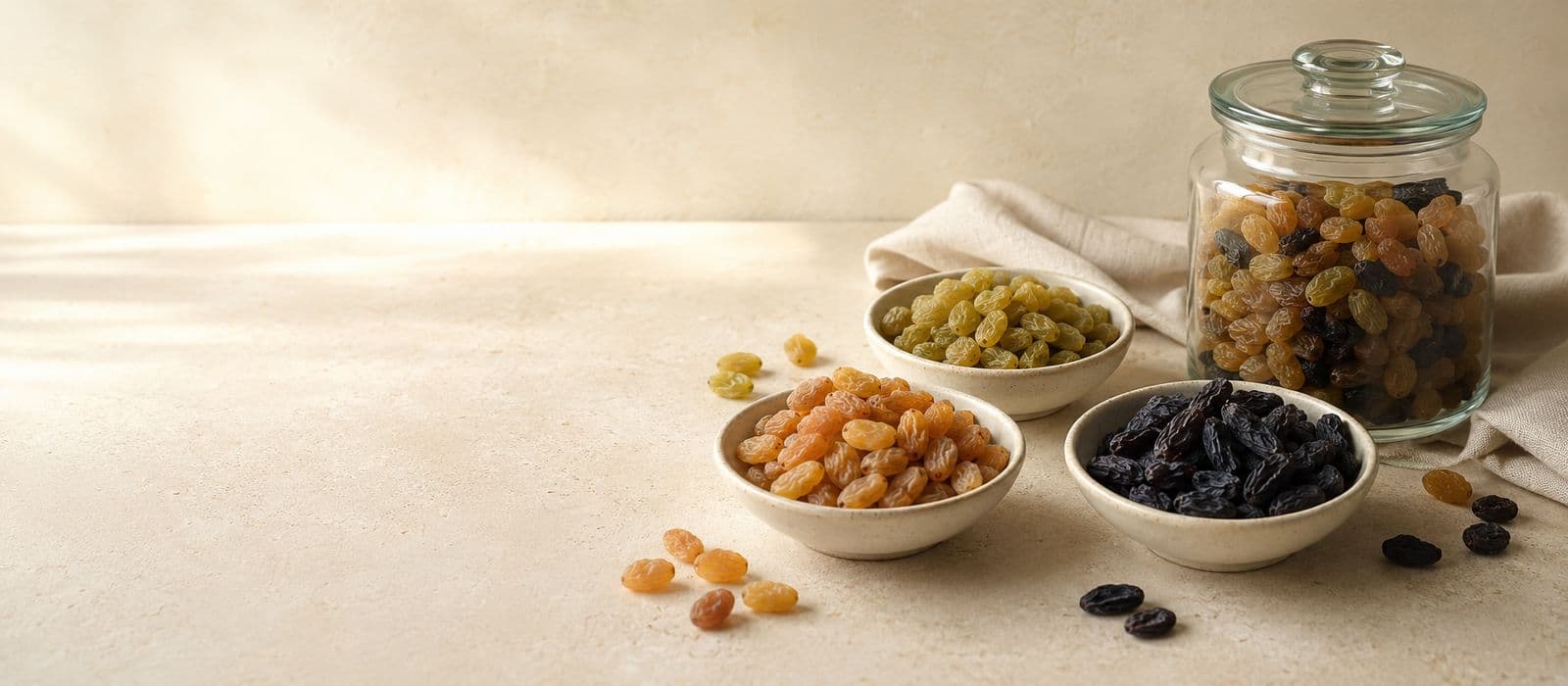
Yellow raisins and golden raisins are the same product under two names. Against green raisins they come from the same Thompson seedless grape, dried under the same shade nets, but from riper fruit on a slower schedule. Golden finishes amber, plump and mild. Green finishes pale, long, firm and slightly tart. Both hold their shape when cooked. Golden costs more per kilo.
The short version
Green raisins vs yellow raisins at a glance
Both varieties come off the same Thompson seedless vines around Tasgaon, and both dry under shade nets in the same kind of shed. Nobody plants a golden vine. What separates them is how ripe the bunch was when it was cut and how long it then sat on the rack, and those two decisions are taken weeks apart by the same grower.
The table below is the version we give buyers on the phone. Read the size row properly. A 20 mm green raisin is long and narrow, while a golden raisin of the same length is visibly wider and heavier, so length alone will mislead you when you compare two lots on paper.
Green and golden (yellow) raisins compared, Raisinly Farm grading.
One grape, two drying schedules
Green raisins are cut at a moderate sugar level, dipped in a food grade solution that breaks the waxy bloom on the skin so moisture can leave evenly, then laid on racks inside a shed with netted sides. Twelve to sixteen days later they come off pale, long and firm. Air moves through the shed constantly. Direct sun never touches the fruit.
Golden raisins start with bunches left on the vine longer. Higher sugar, softer skin, more weight in every berry. The lot is treated with sulphur dioxide before drying, which is what holds the amber instead of letting it brown, and it is declared as E220 on any honest label. Then it dries slowly, again in shade.
So the fair answer to which one is more natural is neither, and both. They are two routes through the same shed, a few kilometres apart, often in the same week. The full sequence from bunch to bag, including what that dipping solution actually does to the skin, is set out in the drying yard process.
Colour, size and what the grade names mean
Grade names differ between the two varieties, and that trips up buyers comparing quotes. Green is graded mainly on length and colour evenness, which is why the top green grade is called premium select and is sold at 18-22 mm. Golden is graded on berry size and plumpness, which is why the top golden grade is called jumbo. Both are the best of their type. The numbers behind them are not comparable to each other.
Colour drift is the defect we reject most often on both. On a green lot it shows as brown patching among the pale, usually from a rack that sat too close to an open side during a hot week. On a golden lot it shows as dull straw instead of amber, and a dull golden lot is very hard to place with a bakery no matter how it tastes.
Why the same grade name can mean two things
Jumbo is used loosely across the trade. Some traders use it for any large raisin regardless of colour, some use it only for golden. When a rate is quoted to you as jumbo, ask for the variety and the length band in the same sentence, otherwise you are comparing two different products.
The ladder we buy against, with the trade names each step goes by and what we reject at each one, is on raisin grades.
Taste and texture
Bite a green raisin and it resists for a moment. There is a small snap at the skin, then a tart edge that comes from picking earlier, and the sweetness arrives behind it. Clean flavour. People who prefer green kismis usually say it does not cloy after a handful.
A golden raisin gives way immediately. The sweetness is honeyed and rounded, with none of the tartness and none of the deep jammy note that sun drying puts into a black lot. If you have only eaten black kismis, golden will taste almost mild by comparison. That mildness is exactly why bakers want it. It adds fruit without taking over a plain crumb.
Neither is the sweetest of the three Indian varieties. Black is, by a distance. If the choice you are actually making is between dark and amber rather than pale and amber, black against golden covers that pair properly.
How each behaves in the pan and the oven
Both hold their shape in heat. That is the practical thing they share, and the thing that separates them from black raisins. Drop either into kheer four minutes before you take the pan off the flame and it will still be a whole raisin in the bowl.
Where they part company is colour on the finished dish and where the sweetness sits. Green goes into kheer, sheera, pulao, dry fruit mixes and most namkeen work, because the tartness balances a sugary preparation and pale fruit reads correctly against milk or rice. Golden goes into bread, tea cake, rusk, granola and gift boxes, because amber against a pale crumb looks like fruit while pale green looks like a mistake.
For baking, soak golden raisins in warm water for 15-20 minutes, drain them, pat them dry, then toss them in a spoon of the recipe flour before folding in. They stay suspended instead of sinking to the base of the tin. Green raisins need far less, five minutes at most, or they lose the bite you paid for.
Why golden costs more than green
Golden carries the highest retail price of the three varieties we pack and green sits in the middle. The reason is yield. Jumbo golden grade takes only the largest berries out of a lot, so a tonne of grapes gives you less of it, and the sulphur step plus the slower drying add handling on top. Roughly four kilos of grapes make a kilo of raisins before any grade sorting removes more.
Retail pack prices and effective rate per kilo, August 2026.
Does the gap matter
At the 1kg pack the difference is ₹150. Across a household year that is nothing worth thinking about. Across a bakery running 40 kg a month it is real money, which is why bakeries that do not need visible amber fruit switch to green or black for the interior of a product and keep golden for the top and the shop window.
Within either variety the grade moves the price further than the colour does. A commercial green lot and a premium select green lot sit further apart than green and golden do at the same grade. All current pack prices are listed on the kismis price page and we revise them when the market moves rather than on a schedule.
Telling them apart at the counter
Loose stock gets mixed up more often than you would think, especially at a dry fruit counter where two bins sit side by side and the same scoop serves both. Four checks settle it in under a minute.
Which one to buy
Most Indian kitchens should keep green as the default. It is the variety a recipe assumes when it says kismis, it costs less than golden, and its tartness does more work inside a sweet dish than people expect it to.
Buy golden when the raisin will be seen on the finished product, when you are cooking for someone else, or when you want fruit without extra sweetness. Both come in the same 250g, 500g and 1kg packs, on green raisins and on golden kismis.
If you are working from an imported recipe that asks for sultanas, golden is the correct substitute and the naming behind it is explained in raisins, sultanas and currants. For the whole Indian line-up, including munakka and seeded lots we do not stock, start at the variety pillar.
Buying either variety in bulk
Bulk buyers ask a different question: which one repeats across a season. Green is the easier answer. The grade bands are tighter and a good shed can turn out consistent premium select for months. Golden depends more on how the fruit ripened that year, and one poor drying week narrows the supply of true jumbo and widens the spread between jumbo and the grade below it.
Minimum bulk order is 15kg for either variety. Samples are 250g, charged at cost and adjusted against your first order. We quote the day's rate rather than publishing one, because green and golden both move with arrivals at the Tasgaon market yard, and a quote holds for 48 hours.
Frequently asked
Both come from the same seedless grape and both are shade dried. Yellow, or golden, raisins are made from riper fruit dried more slowly and usually treated with sulphur dioxide to hold their amber colour. They are plumper, milder and sweeter. Green raisins are longer, firmer and slightly tart.
Both varieties in 250g, 500g and 1kg, graded and packed in short runs at Tasgaon.
Compare green and golden packs