

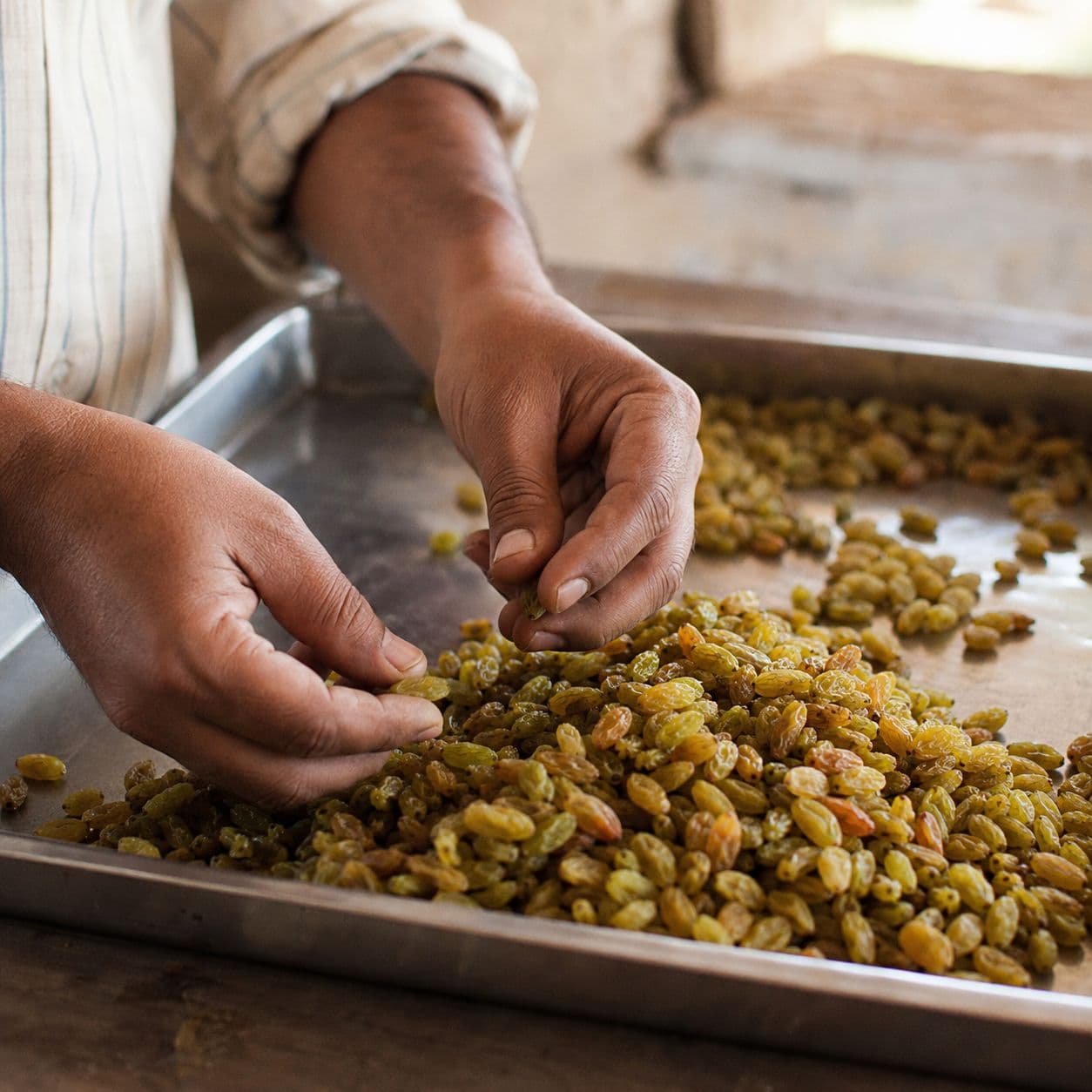
Nearly every raisin sold in India is seedless, and not because anyone removed a seed. The Thompson seedless grape grown across Sangli and Tasgaon never forms one. Seeded raisins are a separate product, dried from seed-bearing grape varieties, larger and chewier, bought for traditional preparations rather than snacking. We stock seedless lots only, in all three varieties.
The short version
Seedlessness comes from the grape, not the process
Ask this question in a Tasgaon drying shed and you will get a shrug. Nobody here takes seeds out of anything. The vineyards through this belt are planted almost entirely with Thompson seedless and its local clones, Sonaka, Manik Chaman, Tas-A-Ganesh, and those grapes do not set a hard seed at all. The flower sets, the berry swells, and whatever seed had started stops early. What is left is a soft trace you will never find with a tooth.
So a seedless raisin is not a seeded raisin that has been cleaned up. It is a different grape, already seedless when it was cut from the vine in February and carried to the racks. Everything that happens afterwards, the dip, the twelve to sixteen days under shade or in open sun, the sorting bench, is about colour, moisture and cleanliness. Nothing in what happens on the drying racks touches a seed, because there is none to touch.
That one fact settles most of the questions on this page.
It also explains why the word turns up constantly in search and almost never in trade. Growers here do not say seedless when they sell a lot, because there is nothing else on offer. They say premium select, or grade A, or a length in millimetres.
What seeded raisins actually are
Seeded raisins come from grape varieties that carry a proper hard seed, two or three to a berry. Dried, they finish bigger, denser and chewier than kismis, and they taste less like sugar and more like fruit that has been reduced. You do not eat them absent mindedly out of a bowl in front of the television. You pinch the seed out first, or you soak the fruit and use the flesh.
That is the whole reason both exist. A seedless raisin is built for convenience. A seeded one is bought for a preparation that wants density, and the seeds are tolerated because the flesh is worth the trouble.
Seedless and seeded dried grapes compared
Where the seeded fruit comes from
In Indian shops the seeded dried grape you will actually meet is munakka. It is not a grade of kismis, not a coarser black raisin and not a bigger version of anything we pack. It is priced separately, displayed separately and bought by people who came in for it specifically.
We have never seen a munakka lot come through the Tasgaon market yard. What trades there is seedless raisin, sold by grade in bags, with the buyers arguing about length and colour and moisture. Munakka reaches Indian counters through a different trade, a good part of it through import channels. Before you swap one for the other in a recipe or on an invoice, read how munakka differs from ordinary kismis.
What "seedless black raisins" means on a label
Buyers type this phrase at us constantly, on the phone and in the search box, and it describes exactly the same fruit as plain black raisins. Both are sun-dried Thompson. There is no seeded version of the same lot sitting next to it in the godown waiting to be sold to someone less careful. The word is on the pack because buyers ask for it.
The same holds for the other two. A pack of long green kismis is seedless. A jumbo amber lot is seedless. If a label makes a point of the word, read the line underneath it instead, because the grade is where the money actually is. Our black packs run grade A at roughly 12-16 mm, and where that sits against the rest of the range is set out in the full list of Indian raisin types.
If it is the product you want rather than the label, seedless black kismis is the page to open.
What the words on the pack are really telling you
"Black raisins with seeds": what people usually mean
Two kinds of buyer type this into a search box. The first wants munakka and is using the words they have. The second bit into something hard in a pack sold as seedless and wants to know whether that is normal.
It is not normal, and in our experience it is usually not a seed either. What people find is one of four things. A hardened stem cap still attached at the cap end. A piece of grit that came off a drying rack or a floor. An immature berry that dried down into a small stone instead of a raisin. Or, rarely, a berry from a seeded vine that got mixed in somewhere between the vineyard and the market yard. Only the last of those is a seed.
Mixing does happen. A grower with a small block of a seeded variety at the edge of the plot. A shared drying shed in a village where four families use the same racks. A lot that changed hands twice before it reached the yard. It is uncommon in a properly sorted lot, and it is exactly why we sort by hand instead of trusting a supplier's word about what is in a bag. Anything hard that gets past our bench is a failure on our side, not a variety you accidentally ordered.
How to check a pack before you commit to it
None of this needs equipment. Five minutes, a plate and decent light. It works on a retail pouch you have just opened and on a sample carton sitting on a buyer's desk, and it will tell you more than any label will.
What to do with a lot that fails
For a retail pouch, photograph it and claim. For a bulk carton, weigh out 100 grams, separate the defects onto a saucer and photograph that against the packing slip. A serious supplier will ask you for exactly that before discussing a replacement.
The wider checklist, including colour, the sulphur smell on a freshly opened carton and what a fermented lot smells like at the top of the bag, is in checking a lot before you pay for it.
Which one your kitchen actually wants
For anything eaten straight, stirred into kheer or sheera, rolled into laddoo or folded into a batter, buy seedless. That is practicality rather than preference. Nobody wants to warn guests about seeds in a dessert, and no bakery wants a customer finding one in a slice of fruit loaf.
Seeded fruit earns its place where the recipe was built around it. Soaked overnight and pressed. Dropped into a decoction. Used in winter preparations where the density is the point. Those recipes expect that texture and that slightly tart depth, and dropping sweet seedless black raisins in instead changes the dish rather than substituting for it.
Inside the seedless range the real decision is the drying method, not the seed. Shade-dried green holds its shape through a boiling kheer and keeps a firm, springy bite. Sun-dried black softens into halwa and carries the most sweetness of the three. Slow-dried golden jumbo packs stay amber against a pale crumb, which is the entire reason bakeries specify them by name.
What seed status does and does not do to the price
At retail, almost nothing, because there is no seeded line to compare against. Our black packs are ₹229 for 250g, ₹429 for 500g and ₹799 for 1kg. Green runs ₹249, ₹449 and ₹849. Golden runs ₹289, ₹539 and ₹999. The gap in price per kilo between the 250g pouch and the 1kg pouch is wider than anything seed status would ever create, and the whole working is on current pack rates.
Munakka is priced on its own market and usually sits above ordinary kismis per kilo. That gap is a large part of why the two names get swapped at a counter in the first place. A shopkeeper who sells you munakka as black kismis has made money on the exchange. One who sells you kismis for a preparation that wanted munakka has cost you the dish.
In bulk, seed status is not something we quote on at all. Grade, length, moisture and defect tolerance are. Rates are quoted on the day and hold for 48 hours, because Tasgaon moves and a stale number helps nobody. Minimum order is 15kg, samples are 250g charged at cost and adjusted against your first order. The ladder those rates hang off is on the grade ladder we quote against.
What we stock, plainly
Seedless only. Black, green and golden, all from the Sangli and Tasgaon belt, all hand sorted on our bench before anything goes into a pouch. We do not stock munakka. We do not stock seeded raisins. If you order kismis expecting munakka, we will tell you before we ship rather than after.
If a seeded lot is genuinely what you need, buy it from a house that trades it, and look at the goods instead of the label. Ask which grape. Ask where it dried and in what year. Ask what the moisture is. Those three questions separate a supplier who knows their stock from one who bought a carton and printed a sticker.
Frequently asked
Almost all raisins sold in India are seedless, because they are dried from the Thompson seedless grape and its local clones. No seed is ever removed at any stage. Products sold as seeded raisins come from different, seed-bearing grape varieties and are a separate item on the counter, priced and used differently.
Black, green and golden in 250g, 500g and 1kg. Every pack hand sorted, seedless, free of stems and stones.
Shop seedless packs