

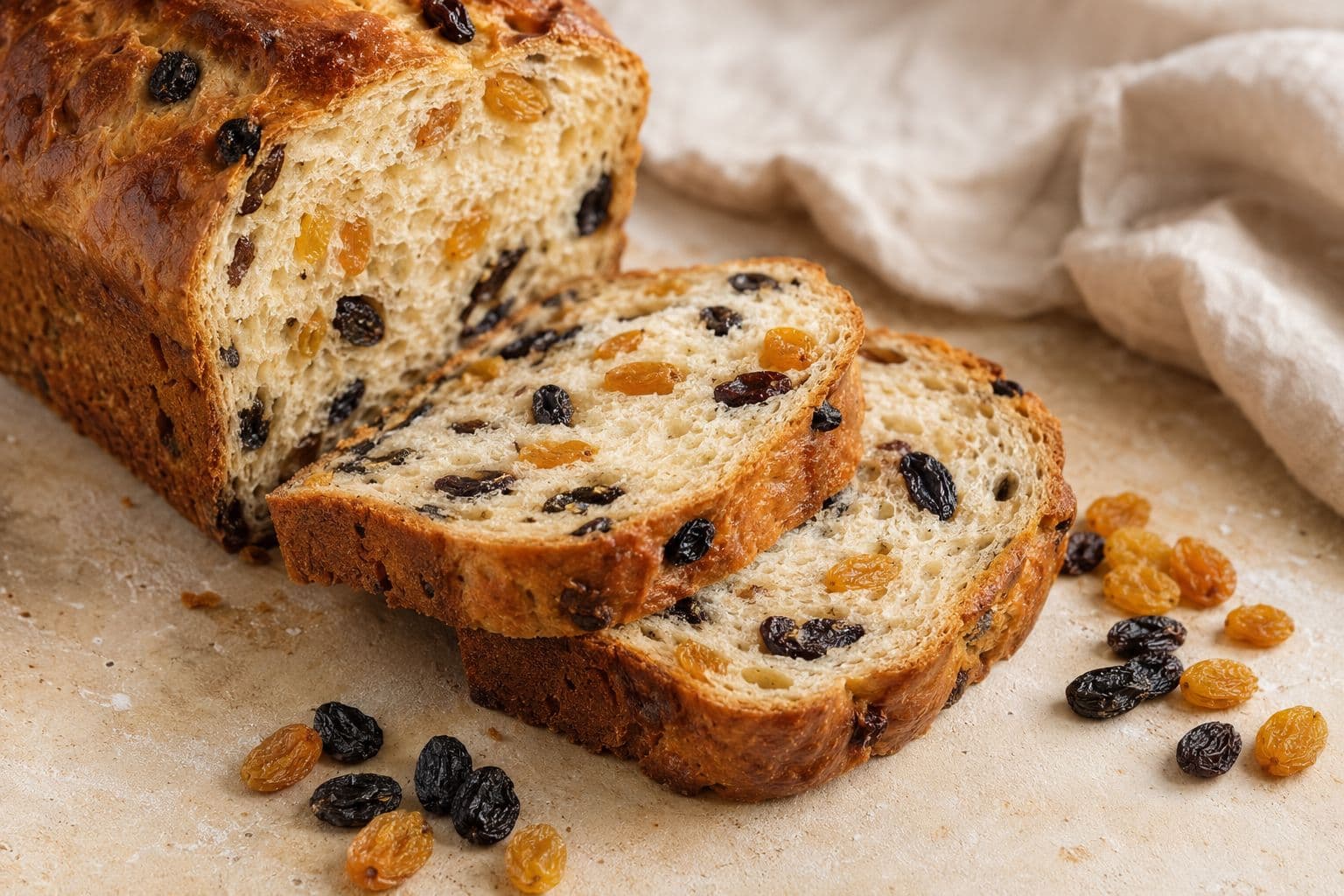
Use golden raisins for baking anything with a pale crumb, and black raisins for dark or spiced bakes. Soak 15 to 20 minutes, drain, pat dry, dust in flour, then fold in during the last minute of mixing at slow speed. Bread takes 15 to 20 percent of flour weight, cake up to 25 percent.
The short version
Choosing raisins for baking: which variety
Bakery is the one application where fruit is picked mostly on how it looks after forty minutes in a hot oven. Everything else, the sweetness, the size, the price per kilo, comes second to that.
Golden raisins are the default and have been for as long as we have been selling to bakeries. They hold their amber colour through a bake, they plump beautifully after a short soak, and their sweetness is mild and honeyed rather than concentrated, so it sits under the bake instead of arguing with it. Jumbo golden runs large and tender, which is what a fruit loaf wants. Grade A golden is smaller and more even, which is what a rusk line wants. If your recipe was written in Britain and asks for sultanas, this is the fruit it means, and where sultanas and raisins genuinely part ways covers the exceptions.
Black raisins belong in anything already dark. Date cake, spiced buns, chocolate loaf, jaggery cookies, dark fruit cake. In those the colour is doing no work and the lower cost per kilo starts to matter, particularly at volume. Drop black into a white sponge and it reads as a burnt speck to every customer who looks at the slice.
Green is rarely used in sweet baking. The tartness reads as out of place in a sugary crumb. It does turn up in savoury breads, olive and herb loaves, and some stuffed buns, at a much lower dosage. The full comparison of the two bakery varieties sits on black against golden.
The method, in five steps
Almost every complaint we hear from a home baker or a bakery is solved by these five steps in this order. Skipping step four is why raisins sink. Skipping step two is why they come out hard.
Soaking liquids and how long
The reason to soak at all is water balance. A raisin at roughly 15% moisture dropped into a lean bread dough will take water from the crumb around it, because that is what dry fruit does, and it comes out of the oven hard while the crumb around it comes out dry. Soaking pre loads the fruit so it stops stealing.
The reason not to over soak is the opposite failure. Fruit held in water for an hour is waterlogged, it bleeds colour and sugar into the batter, and the crumb around each piece bakes wet and grey. Twenty minutes is plenty for almost everything. Thirty is the ceiling, and the only exception is alcohol soaking for fruit cake, where you genuinely do want the fruit saturated and where the alcohol changes the arithmetic.
One case where soaking is wrong: rusk and hard biscuit. Both get a second bake or a long low bake that drives moisture off anyway, so soaked fruit just extends the bake and softens the finished product. Use those dry.
Soaking liquids, times and what each one suits
How much to add, as a percentage of flour weight
Weigh fruit against flour, not against the finished batter, and not in cups. Baker percentage is the only way this stays consistent between a two loaf test and a two hundred loaf run.
Fifteen to twenty percent of flour weight reads as generous in a bread without wrecking the gluten structure. Cakes take more, up to twenty five percent, because there is no gluten network to tear. Above those numbers a slice starts falling apart when you cut it. If a recipe genuinely needs more fruit than that, put it in as a swirl or a layer rather than dispersing it through the crumb.
Fruit cake is the exception that proves nothing. A plum cake or a Christmas cake is a fruit dish held together by a little batter, fruit routinely runs at or above the flour weight, and none of the structural rules above apply because structure is not what is holding it together.
Starting dosage by product, as a percentage of flour weight
Stopping raisins sinking in a cake
Fruit sinks because it is denser than the batter holding it and the batter is too loose to hold anything. Two fixes, and use both.
First, dust. Toss the drained, dried fruit in a spoonful of the recipe flour until every piece has a dull coating. That coating grips the batter instead of sliding through it. Take the spoonful out of the recipe weight rather than adding it on top, otherwise you have quietly changed the hydration.
Second, look at the batter. A batter that pours like cream will not hold fruit no matter what you dust it in. Hold back a little of the milk, or chill the batter for fifteen minutes before the fruit goes in, and the problem usually solves itself.
In stiff bread doughs none of this is necessary. The gluten network holds the fruit exactly where you put it, which is why a raisin loaf never has this problem and a raisin muffin always does. Wet fruit is the other cause worth naming, and it is why patting dry matters more than it sounds like it should.
Size, grade and whether to chop
For a fruit loaf or a tea cake, big fruit is the point. Jumbo golden runs large and plump and every slice shows it. For a rusk, a biscuit or a thin cookie, big fruit is a liability: it sits proud of the surface, it burns before the dough is done, and it makes the product hard to cut cleanly.
Chop when the product is thinner than the fruit. A rough chop, two or three cuts per piece, is enough. Chopped fruit also disperses more evenly through a low dosage bake, which matters when you are putting ten percent into a rusk and want every stick to look the same.
Grade drift is the thing that catches bakeries out. A grade A golden lot and a jumbo golden lot bake differently, take up soaking water differently, and look different in the slice. If you have calibrated a recipe against one grade, changing grade mid season is a recipe change, whatever the invoice says. Name the grade in your order and buy it again.
Moisture matters for the same reason. Fruit that has drifted wet during storage takes on less soaking water and can leave a soggy line around each piece. Storing bakery stock properly is covered in keeping raisins in condition, and it is worth reading before you buy a season's worth.
What went wrong and how to fix it
This is roughly the list we work through with a bakery when a batch does not come out right. Most of it is method rather than material, which is good news, because method is free to change.
Common raisin problems in a bake
Bakery raisins at production scale
Two things change when you move from a home oven to a plant. Neither of them is the recipe.
The first is consistency. A grade that varies between deliveries changes your soak time, your bake time and how the finished slice looks, and by the time anyone traces the complaint back to the fruit you have already run a fortnight of product. Put the specification in writing before the first carton moves: variety, grade name, size band in millimetres, moisture ceiling, tolerance for stems and damaged berries, whether sulphur dioxide has been used and will be declared, crop year and packing date.
The second is handling. Bulk fruit ships in 5kg, 10kg, 20kg and 25kg cartons with food grade liners. Cartons go on pallets, not on the floor, a hand span clear of external walls, rotated so the oldest packing date leaves first. A carton opened on Monday and left open until Friday is a different ingredient by Friday, particularly in a warm bakery in July.
Our practice with bakery buyers is a 250g sample from the actual lot on offer, charged at cost and adjusted against the first order. Minimum bulk order is 15kg. Rates are quoted on the day and hold for 48 hours, because the market in this belt moves and pretending otherwise helps nobody. Grades, packing options and buyer specifications for bakery accounts sit on bulk raisins for bakeries.
Buying for a home oven
If you bake once a fortnight, a 500g pack of golden and a 500g pack of black covers most of a year and both will still be in good condition when you get to the end of them. Golden 500g is ₹539 and black 500g is ₹429. If Christmas cake season is coming and you soak fruit in bulk, the kilo packs work out meaningfully cheaper per kilo, and the full working across all nine packs is on the retail price list.
Buy for the bake you actually do. A household that makes one plum cake a year and a lot of banana bread does not need jumbo golden, and a household that turns out tea cakes every weekend should not be buying 250g pouches. Baking is only one of the things raisins get used for, and most kitchens are buying for three or four uses at once.
One habit worth borrowing from the trade. Soak the fruit before you start weighing anything else. By the time the butter is creamed and the tins are lined, twenty minutes has gone and the fruit is ready. Nobody plans it that way the first time and everybody does after.
Frequently asked
Golden raisins. They keep an even amber colour against a pale crumb, plump well after a short soak, and their mild sweetness does not overpower the bake. Black raisins are the right choice for dark or spiced cakes, where colour is not a concern and the lower cost per kilo helps.
Jumbo golden and grade A black in 5kg to 25kg cartons. Samples at cost, 15kg minimum, rates quoted on the day.
Bulk rates for bakeries