

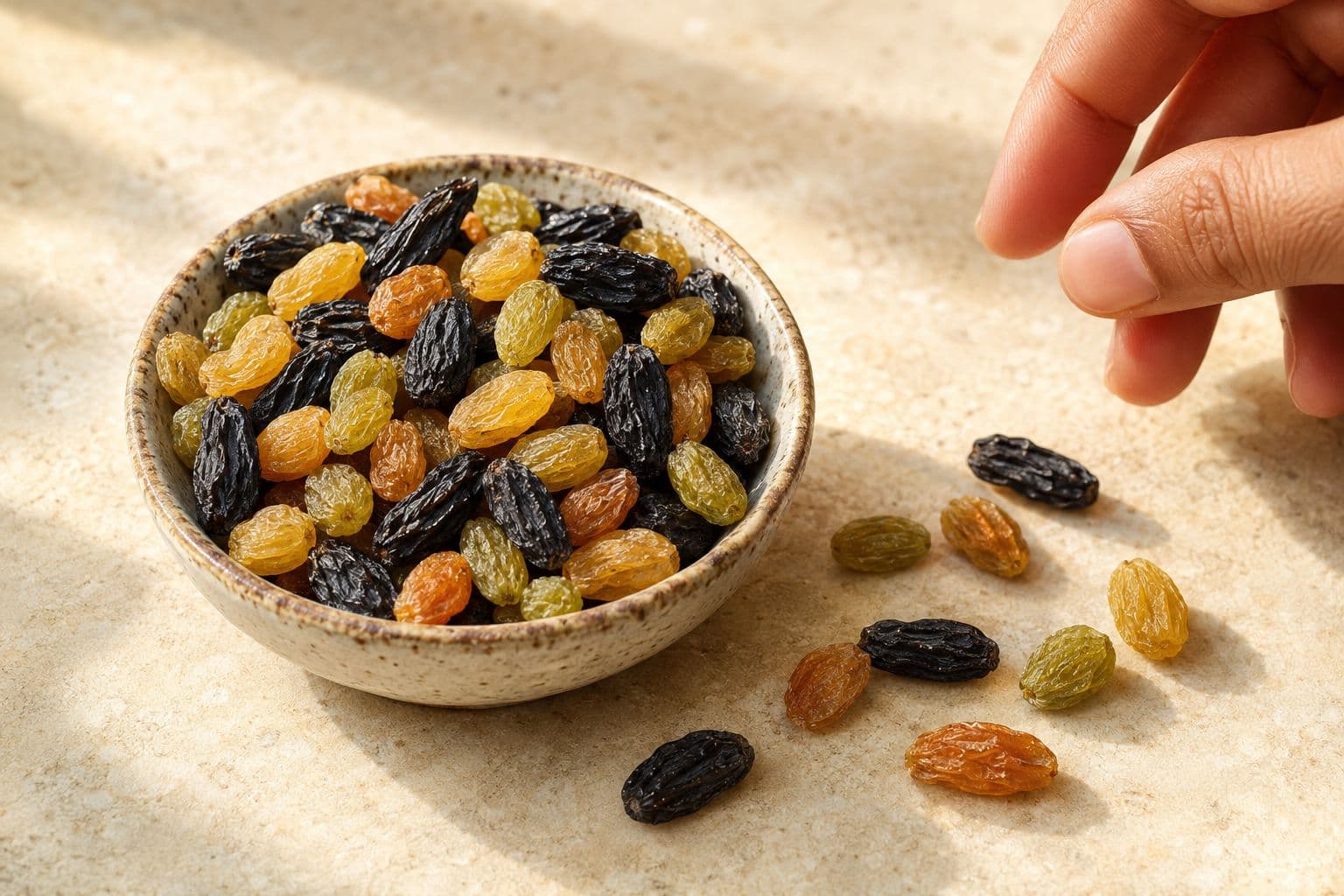
The uses of raisins in an Indian kitchen fall into six groups: snacking, breakfast, cooked dishes such as kheer and pulao, mithai, baking, and commercial food production. Variety decides which job a raisin does well. Black is the snacking and sweets raisin, green holds its shape in a hot pot, golden survives an oven with its colour intact. A normal portion is 15 to 20 raisins.
The short version
The six jobs raisins actually do
Ask ten people at our counter in Tasgaon what they do with a kilo of kismis and you get the same short list in a different order every time. Eat them. Put them in the kheer. Make laddoo at Diwali. Send them in the tiffin. Bake with them. The tenth person is the bakery two streets over, ordering twenty kilos at a time and not interested in any of the first five answers.
Those answers sort into six groups. The reason it is worth sorting them at all is that each group wants a different raisin, and not a different brand of raisin. A different variety, and inside that variety a different grade.
Everything below assumes the three types we pack: shade dried green, sun dried black, and slow dried amber golden. All three come off the same seedless Thompson grape grown across the Sangli belt, and the drying shed is what separates them. If that is new to you, start with the three raisin types sold in India and come back.
Snacking, and what counts as a portion
This is the largest single use and the one that drives repeat orders. A small handful, roughly 15 to 20 pieces, eaten straight from the jar or tossed with almond, cashew and walnut into a dry fruit mix.
Sun dried black kismis win here on taste. Sun drying concentrates the sugar, so grade A black is the sweetest and softest of the three and needs nothing done to it. Green is the second choice, usually chosen by people who find black cloying, because the tartness reads cleaner against a cup of tea. Golden gets bought for snacking too, mostly for guests and gift boxes, because a bowl of even amber fruit looks like something you paid money for.
Two things we tell customers at the counter. Buy the pack size you will actually finish. A 250g pouch emptied in three weeks stays in better condition than a kilo opened in April and still half full in July. And decant it. A pouch opened and rolled shut twenty times will clump long before an airtight steel dabba does, and clumping is the complaint we hear more than any other about snacking raisins.
Breakfast, curd and lunchboxes
Raisins go into oats, poha, upma, milk, curd, cornflakes and overnight oats with no preparation whatsoever. No soaking, no chopping, no frying. Drop them in.
Heat is the only variable worth thinking about. In hot poha or upma, green raisins hold a firm bite for the whole plate. Black raisins soften inside a minute and sweeten everything around them, which some people want and some people complain about. In cold curd or cold milk either works, and black is the usual pick because the sweetness stands up against the sourness.
Tiffin boxes are their own case. A mix of black raisins, cashew and roasted almond travels well, does not melt in an April classroom, and survives being sat on. Keep that mix in a small airtight box instead of a fold of foil. Raisins pull moisture out of the air faster than any nut sitting next to them, and by Thursday a foil packet is a sticky brick.
Indian cooking, dish by dish
Cooking is where variety choice stops being a preference and becomes a technique. A raisin going into a hot pot is doing one of two jobs. Either it stays whole and visible in the finished dish, or it gives way and disappears into it. Pick the wrong variety and you get the job you did not want.
Pale green seedless raisins do the first job. Shade dried flesh is firm enough to survive heat, so they plump instead of collapsing. That is why kheer, sheera, sweet pulao and biryani garnish in this part of the country all use green. Timing matters more than people expect. Add them in the last three or four minutes of a kheer. Leave them in for twenty and they surrender their sugar into the milk and turn slack and pale.
Pulao and biryani work differently. Heat ghee, drop in cashew, and the moment the cashew takes colour add the raisins. They swell in about ten seconds. Pull the pan off then. A raisin held in hot ghee goes hard and bitter, and one burnt raisin ruins a pot of rice far more thoroughly than one burnt cashew does.
Black takes over wherever the dish is already dark and sweet. Gajar halwa, lauki halwa, sooji halwa, sheera made with jaggery. They go in near the end and melt into the mass, and the deeper sweetness carries through a preparation that already has plenty of sugar in it.
One correction we make constantly. A recipe calling for soaked munakka is not asking for kismis. Munakka is a bigger seeded dried grape off a different vine, bought and priced as a separate product, and substituting one for the other changes what you cooked. Buy what the recipe names.
Which raisin for which dish, and when to add it
Mithai, laddoo and festival sweets
A large share of our black raisin volume in October and November goes to sweet units, and the logic is straightforward. A laddoo is already sweet. The raisin in it is not there to add sugar, it is there to break the texture, and a soft chewy pocket does that better than a firm one.
Besan laddoo, rava laddoo, dry fruit laddoo, panjiri, chikki, karanji filling, modak filling, dodha. Black, all of it. Sweet shops across Sangli and Kolhapur buy grade A black by the sack from Dussehra onwards, and the rate for that one grade tightens every year in the same fortnight because the whole district wants the same material in the same three weeks. Buyers who wait until the week before Diwali pay for waiting.
Where the raisin sits on top rather than inside, colour starts to matter and golden comes out. A garnish on kaju katli, a tray of barfi, a mithai box going out as a gift. The jumbo golden grade holds an even amber that does not bleed into the white of a katli and does not look like a burnt speck in a photograph.
There is a texture trick worth knowing for dry sweets. If a laddoo mix is stiff and the raisins are on the drier side, warm them for thirty seconds in the ghee you are already using before folding them in. They soften just enough to blend without turning the mix greasy.
What black raisins are used for
Black raisins uses come up often enough as a question on its own that it deserves a straight answer. Black is the general purpose Indian raisin. If a household keeps only one jar, this is almost always what is in it.
It is soft, it is the sweetest of the three, and it is the cheapest per kilo. On a 250g pouch that price gap is loose change. On five quintals for a sweet unit it decides where the order goes.
Where black is the wrong choice: anything that must stay pale on the plate, anything that has to survive twenty minutes of cooking with its shape intact, and light coloured bakes where the fruit darkens further against a white crumb and reads as scorched. In those three cases use green or golden and accept the extra rupees.
Baking, rusk and biscuit
Bakery is the one application where the raisin is chosen mostly on how it looks after forty minutes at 180 degrees. Golden is the default for that reason. It stays amber against a pale crumb, it plumps well when soaked, and its mild honeyed sweetness sits under the bake rather than fighting it.
Black works in anything already dark. Date cake, spiced buns, chocolate loaf, cookies with jaggery. Green is rarely used in sweet baking at all, because the tartness reads as out of place in a sugary crumb, though it turns up in savoury breads and stuffed buns now and then.
The technique is four steps and it solves most complaints. Soak for 15 to 20 minutes, drain properly, pat dry, then dust the fruit in a spoon of the recipe flour before folding it in at the end of mixing on slow speed. Dosage, soaking liquids and what to do when raisins sink to the bottom of a tin are all worked out on our baking guide.
Commercial uses of raisins in food production
At production scale the same six jobs exist, but almost everything about the buying changes. Nobody on a factory floor is choosing between varieties on flavour. They chose the variety two seasons ago and what they need now is the same material arriving again, at a moisture level that does not change their bake time and a size band that does not change how a slice looks.
That is the practical difference between a household buyer and a commercial one. A household buys a raisin. A business buys a specification: variety, grade name, size band in millimetres, moisture ceiling, tolerance for stems and damaged berries, whether sulphur dioxide has been used and will be declared, crop year and packing date.
Volumes move seasonally and the direction is predictable. Sweet units load up from September. Bakeries stay steady through the year and spike before Christmas. Dry fruit packers buy heaviest in the two months before Diwali. Namkeen units buy flat all year. A good drying season in February to April fills the belt with premium grades and softens the spread. A bad one, four cloudy days in the wrong week, thins the top grades and widens the gap between premium and commercial for months afterwards.
Our bulk minimum is 15kg, samples are 250g charged at cost and adjusted against the first order, and rates are quoted on the day and hold for 48 hours because the market genuinely moves that fast. Grades, packing options and buyer specifications sit on the wholesale supply page.
Who buys which variety in bulk, and what they actually care about
Soaking, and when it is worth doing
For ordinary Indian cooking, no. A raisin from a properly dried lot is soft enough to go straight into the pot, and soaking it first before adding it to kheer or pulao gives you a waterlogged raisin rather than a plump one. It also dilutes whatever it was soaked in back into your dish.
Soak when the recipe genuinely asks for it. Bakery is the main case, where a dry raisin in a lean dough pulls water out of the crumb and comes out of the oven like a pebble. Traditional preparations that specify munakka are the other, and those are a different product to begin with.
If your raisins have gone hard in the jar over a few months, warm water for ten minutes brings most of the texture back and they are fine for cooking afterwards, though not for a snack bowl. That hardening is a storage problem rather than a lot problem, and it is avoidable. Keeping an open pack in good condition is mostly two habits and a jar.
Choosing what to keep in your kitchen
Most households that cook regularly end up with two jars. Black for eating and for sweets, green for anything that goes in a pot. A third jar of golden appears in kitchens that bake, and in the weeks before a festival when boxes are being made up.
Pack size follows how fast you get through it. If a jar is emptying inside a month, buy the kilo, because the cost per kilo drops sharply as the pack gets bigger. If a 250g pouch lasts you from March to July, buy 250g and buy it more often. Our retail range runs from ₹229 for 250g of black up to ₹999 for a kilo of golden, and the full per kilo working across all nine packs sits on what a kilo actually costs.
One last thing, said plainly because customers ask. The kismis uses on this page do not change with the grade, but the eating experience does. A premium select green lot and a commercial green lot behave the same in a kheer. In a snack bowl, straight from the jar, the difference is obvious to everybody at the table.
Frequently asked
Six things, in rough order of volume. Snacking and dry fruit mixes. Breakfast dishes such as oats, poha, upma and curd. Cooked dishes like kheer, sheera, pulao and biryani. Mithai, laddoo and panjiri. Baking, from tea cakes to rusk. And commercial food production, where sweet units, bakeries and namkeen lines buy the same grades in cartons.
Black, green and golden in 250g, 500g and 1kg packs, dispatched from Tasgaon with the packing date on every pouch.
Shop all three varieties