
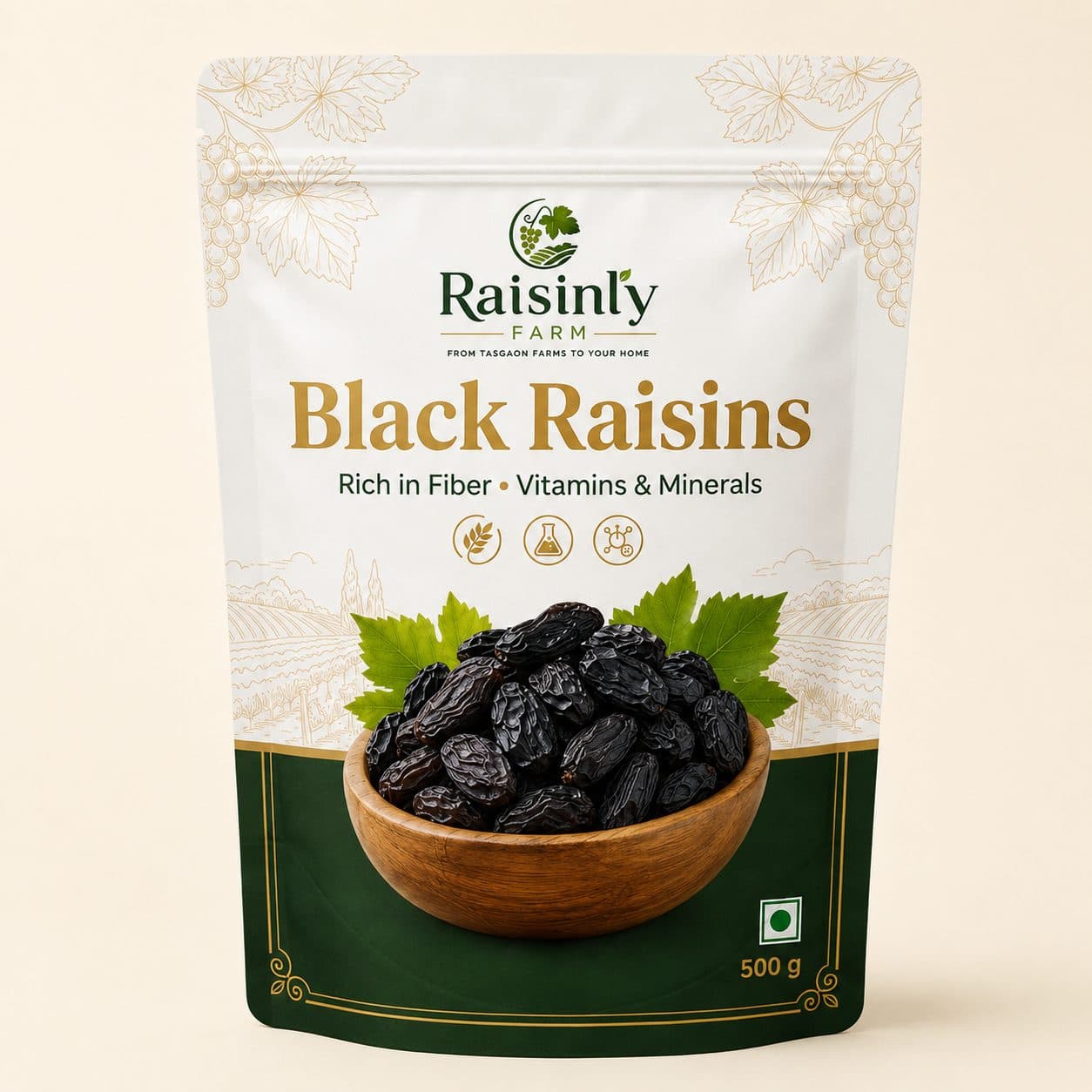
About black raisins
Black raisins, kali kismis on most shop boards between Sangli and Solapur, are Thompson seedless grapes dried in open sun until the skin runs from green through brown to something close to black. Same grape as the green kismis in the next jar. Different sun. Ten to fourteen days uncovered on the trays is the whole of the difference, and it is what makes black the sweetest, the softest and the cheapest of the three varieties we pack.
This pouch comes in 250g at ₹229, 500g at ₹429 and 1kg at ₹799. That is ₹916 a kilo on the small pack against ₹799 on the kilo, so the large pouch is where the price actually lands. Households buying black raisins online tend to order a 500g the first time and move to the kilo after that. The black raisins price for every pack size, set beside green and golden with the per kilo maths shown, is on our retail price page.
Seedless, all of it. No stones, no stems, nothing your teeth find halfway through a laddoo. Seeded black raisins are a genuine product in the north Indian trade, sold loose by weight and grown on a different grape altogether, and we do not carry them. If a shop hands you dark raisins with hard pips inside and calls them the same thing, it is not the same thing, and the price should not be the same either.
Taste is why people keep coming back to it. Open sun concentrates the sugar as the fruit shrinks, so dried black raisins land jammy and low on tartness, closer to a date than to a fresh grape. The chew is soft. A good lot gives under the tooth without being sticky on the fingers.
Colour on seedless black raisins runs deep brown to near black with some drift piece to piece across a handful. That drift is normal on sun dried fruit and it is not a fault. A lot that is uniformly jet black in every single piece is worth asking a question or two about, because nothing that spent two weeks on a tray in Tasgaon comes off it perfectly matched.
Use it where sweetness matters more than shape. Laddoo, panjiri, halwa, chikki, dry fruit barfi, milkshakes, and straight out of the jar at four in the afternoon. Black softens further in a pan and partly melts into whatever it is cooked with, which is exactly what you want inside a mithai mixture and exactly what you do not want in a kheer.
So if your recipe needs the fruit to stay whole and visible through a boil, the firmer long seedless green kismis is the one to buy. If you are baking and the raisin has to read light against a pale crumb, amber jumbo raisins keep their colour where black reads as scorched. All three sit side by side, with the seeded types and sultanas, in the guide to raisin varieties.
How these raisins are made
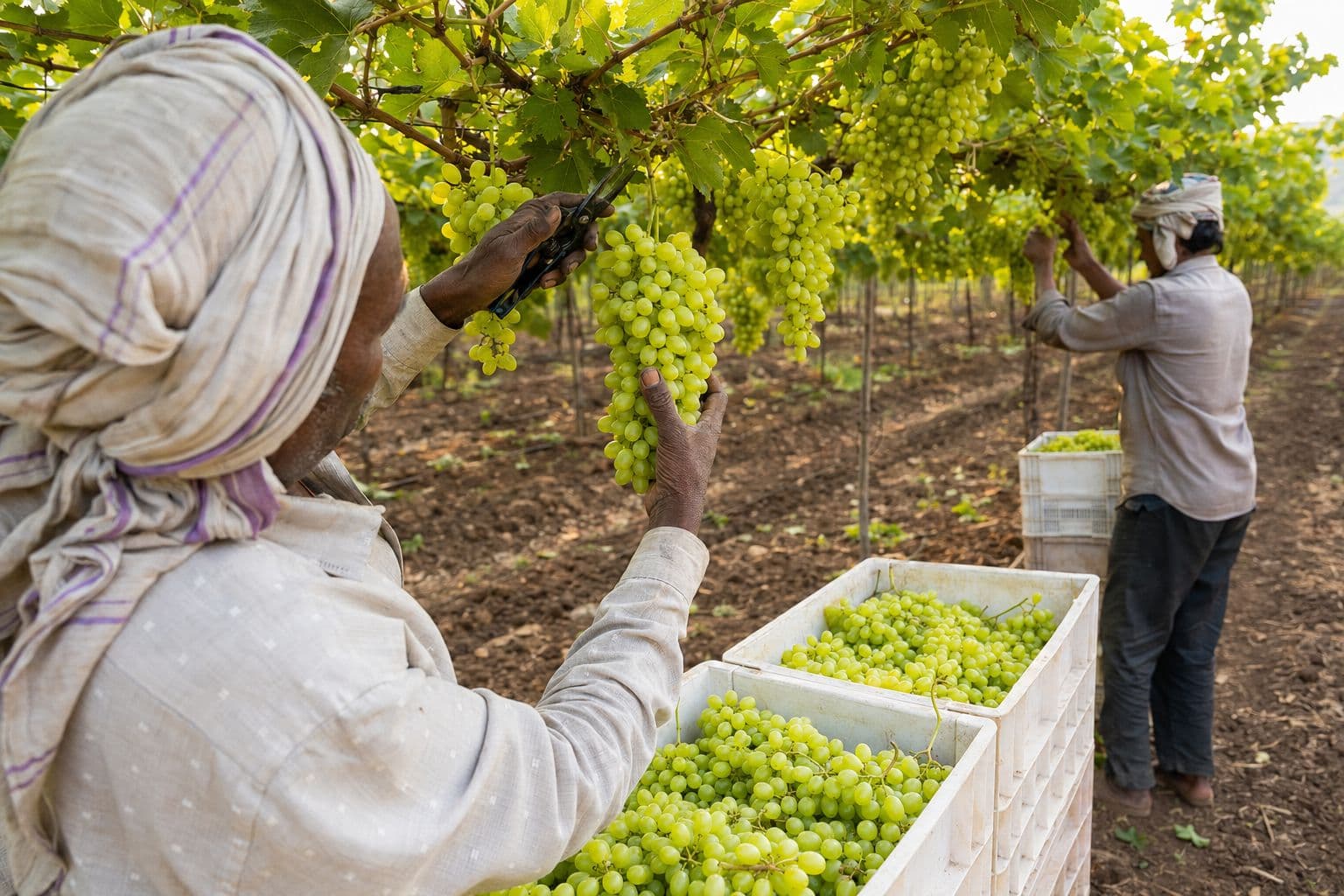
Harvest runs February to April across the Tasgaon belt, and black lots are made in the same weeks as green ones, often off the same grower's plot. The fruit goes straight onto trays in open sun. No shade net over it, no dip to hold a colour, nothing to stop the skin darkening, because darkening is the entire point of the exercise. Ten to fourteen days, turned by hand, and what comes off the tray is roughly a quarter of the weight that went on. Four kilos of grapes to a kilo of raisins is the rough figure everybody here works with.
Black carries no sulphur dioxide. E220 exists in this trade to hold a pale colour on green and golden lots, and there is no pale colour on a black raisin to hold, so the ingredient line on this pack reads dried grapes and stops there. No added sugar, no oil, no glazing agent, no colour. If you have been avoiding sulphites, black is the variety to buy, and we would rather tell you that outright than steer you into something with a higher rate on it.
We buy lot by lot through the season from growers and traders around Tasgaon, Palus, Khanapur and Miraj. Some of it comes off a rack we have stood next to. Some of it moves through the market yard, and some sits in cold storage before we take delivery. We are not going to print direct from farmers over stock that came through a trader. What we will say is that every lot is squeezed, tasted and metered at our own bench before it is graded, and the ones that read wet or smell fermented go back to where they came from. The belt, its season and how the yard actually behaves are described on our Sangli sourcing page.
Sorting is by hand: size, colour drift, stem and cap fragments, immature pieces. Moisture is held around 15%, and on black that number matters more than it does on green, because black carries more free sugar at the surface and a lot packed a point or two wet will set solid in a humid godown by the second week of July. Graded stock goes into cold storage so the moisture stays where we left it and a pouch bought in October eats like one bought in April.
A trade note worth having. Black is the workhorse variety, so it moves in bigger volumes and its rate is the one most exposed to a poor drying week. When the weather turns in March, the premium grades of every variety get scarce first, and the spread between grade A black and commercial black widens for months afterwards.
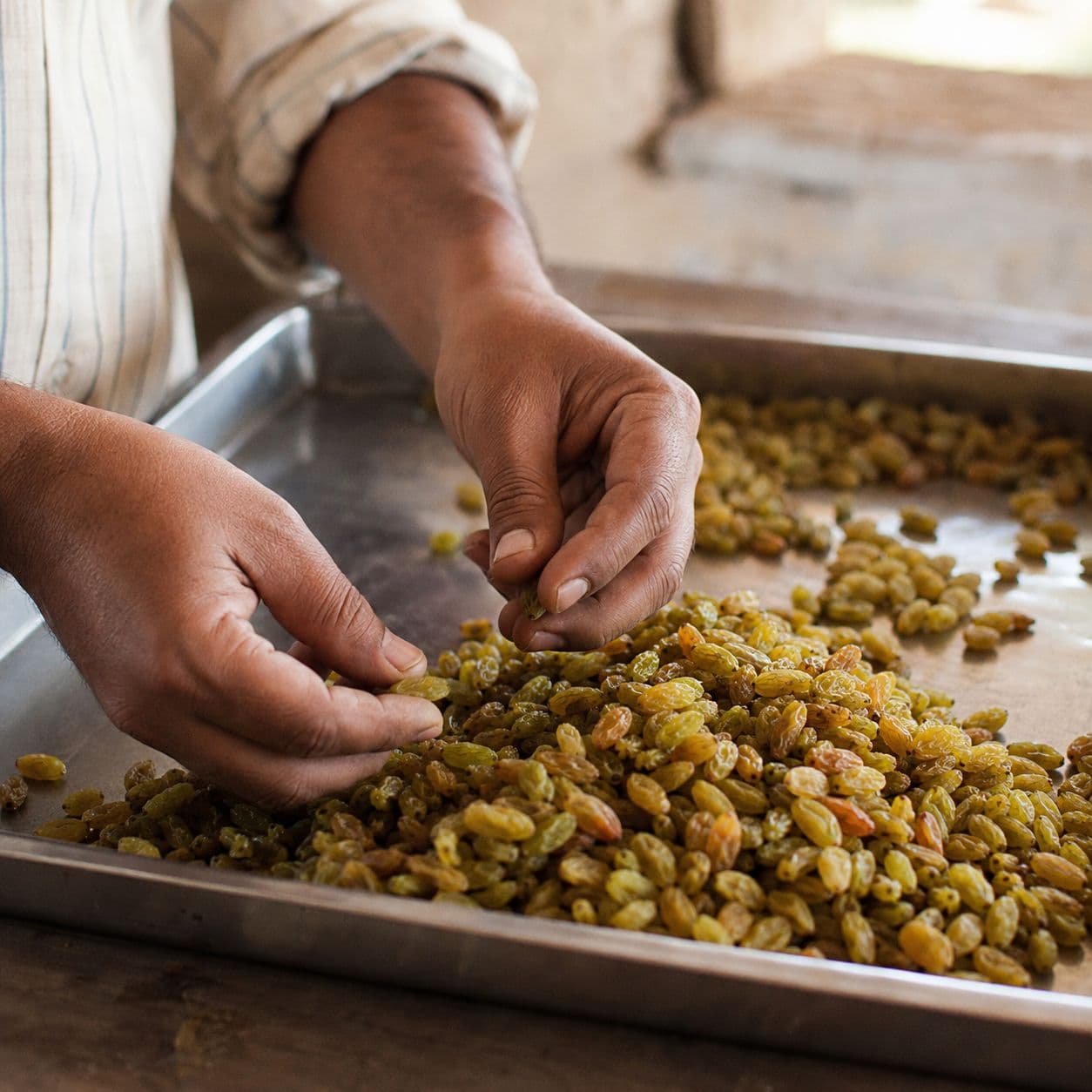
We pack in short runs rather than sitting on one large stock, so the pouch that reaches you is usually from the current season. We print a packing date on the pack. Most brands give you only a best before. Those are two different pieces of information, and the packing date is the one worth reading. Each pouch is nitrogen flushed and sealed at our bench in Tasgaon.
How to use black raisins
Black raisins carry their sweetness into whatever they are cooked with. They soften further in heat and partly break down, which is a virtue in a sweet mixture and a nuisance in a dish where the fruit is meant to stay whole and visible. No soaking is needed for most Indian recipes. Ten minutes in warm milk or water is plenty when you want them plumper for a blend or a batter.
Snacking
Straight from the jar, or into a dry fruit mix with almond and cashew. About 15 to 20 raisins is a portion. Reseal the pouch rather than leaving it open on a counter.
Laddoo and panjiri
Fold in whole at the end. Their sweetness carries the mixture, so most cooks find they can pull the added sugar back a little.
Halwa and sheera
Add in the last three or four minutes so they plump and release sweetness into the semolina without collapsing entirely.
Mithai and barfi
What sweet units buy black for. In dry fruit barfi and ghee based mixtures the raisin cooks down and its colour stops mattering.
Milkshakes and smoothies
Soak ten minutes in warm milk, then blend. Sweetens with body rather than thinness, and a decent mixer takes the skins out entirely.
Chikki and namkeen
Goes into jaggery chikki and sweet namkeen mixes. Use the smaller grade here; a plump grade A piece is wasted once it is coated.
Bakers reach past black for anything where the fruit shows on the finished crust, because dark raisins read as burnt against a pale crumb. Colour is the whole argument, and it is worked through properly in black raisins set against the amber grade, including how each one behaves after a soak.
How to store them
Keep the pouch closed and press the air out before you reseal it. An airtight glass or steel jar in a dark cupboard is better still. Away from sunlight, away from the stove, away from anything strongly scented, because raisins take on the smell of a shelf faster than most dry goods do. Stored that way they stay good for nine months from the packing date printed on the pack.
Black clumps sooner than green. More sugar at the surface, and Indian humidity does the rest. This is not spoilage and it is not evidence that the lot was poor. It is sugar softening and the pieces sticking to one another, and it happens to good stock in a bad cupboard.
The label carries what the rules require and what you would want to check anyway: net quantity, the ingredient line, packing date, best before, batch code, our FSSAI licence number and the green vegetarian mark. Ingredients on black read dried grapes, and nothing follows. No preservative is declared because none is used on this variety. Country of origin is India and the sourcing region is the Sangli and Tasgaon belt in Maharashtra. Nutrition per 100g is printed on the back of the pouch and repeated further down this page.
For longer keeping, the fridge is enough. Raisins do not need a freezer and freezing only makes them awkward to portion. If you buy a kilo in April and expect it to see you through the monsoon, decant a week's worth into a small jar and keep the rest sealed and cold rather than opening the same pouch twenty times.
White crystals on the surface are crystallised natural sugar. They show up on black more than on the other two varieties, simply because black is the sweetest, and they dissolve the moment the fruit meets heat. Mould is a different thing entirely: fuzzy, greyish, sour smelling before you can even see it. If a pack ever arrives like that, photograph it and send it to us. We replace it without argument and we pull the rest of that batch.
Grades explained
Grade moves the price of black raisins more than the variety does. Three things set it: size, how far colour drifts across a handful, and moisture. Grade names here are convention rather than law, so two suppliers can both write grade A on a bill and ship visibly different fruit. This retail pouch is grade A seedless. One thing to expect if you have been buying green all year: grade A black measures smaller, because open sun shrinks the fruit further than a shaded rack does. That is the variety behaving normally, not an undersized lot.
Green vs black vs golden
Most kitchens end up keeping a jar of each rather than choosing once. Where the two varieties genuinely differ, in drying method, taste, cooked behaviour and rate, is set out in green kismis compared with black. If you are buying 15kg or more for a sweet unit, a namkeen line or a trade counter, the grade ladder, tolerances, carton formats and quotation basis are on bulk black kismis. Rates there are quoted on the day of enquiry, ex-Tasgaon, and held for 48 hours.
Product information
Nutrition per 100 g
Indicative values for dried seedless black raisins. Actual values vary by lot and season.
Questions buyers ask
Questions about orders, delivery, returns or wholesale rates are answered on the full FAQ page.