

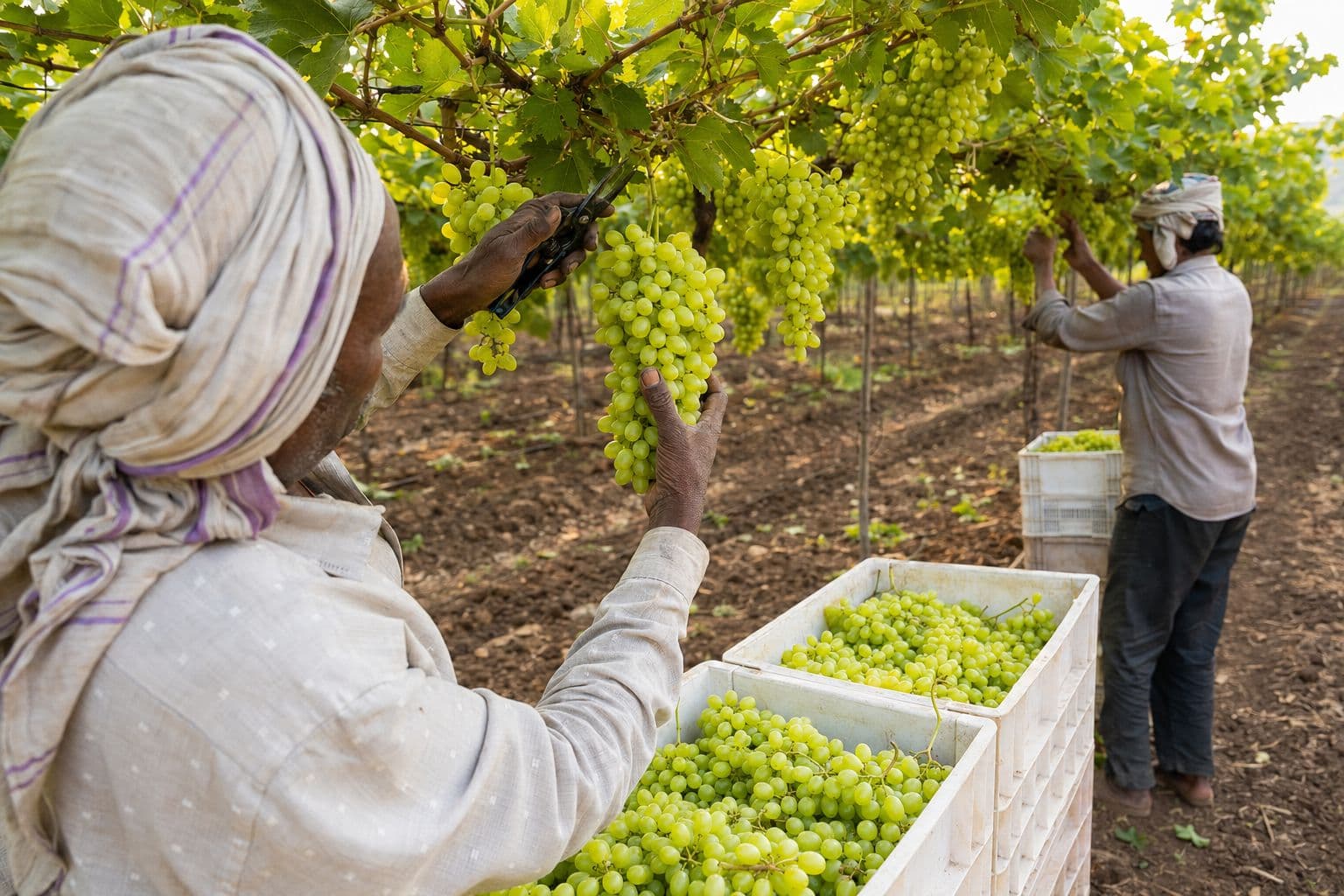
Raisin production in India runs on a single annual cycle. Grapes are picked from February to April, dried over the following two to three weeks, then graded and moved into cold storage to be sold across the rest of the year. Maharashtra accounts for the overwhelming majority of output, centred on Sangli district. Once the racks are cleared in April, national supply is fixed until the next crop.
The short version
The production calendar
It is a short window followed by a long tail. Harvest for raisin grapes opens in the second half of February and runs into April, moving a week or two either way depending on pruning dates and how the season has behaved. Each batch then spends 10 to 18 days on the racks. Stripping, cleaning, hand sorting and grading follow within days, because a graded lot can move and an ungraded one just sits.
By the end of April the sheds are empty. Everything the country will sell for the next ten months already exists, in bags, in a cold store. That single fact governs the rest of this page.
The raisin year in the Sangli-Tasgaon belt
What the peak weeks actually look like
In the third week of March a shed in Tasgaon is working two shifts. Bunches come in on trolleys through the afternoon, get dipped, and go up on the tiered racks the same evening. Somebody walks the rows every morning turning bunches and pulling the ones that have run ahead of the rest. Meanwhile the lots that finished last week are being stripped and sorted on the floor below, and a buyer is standing in the doorway asking what is coming off next. Nothing about the peak is leisurely. It is six weeks of work that decides twelve months of trade.
How much grape it takes
Roughly four kilos of fresh grapes make one kilo of raisins. That ratio is why raisin output tracks the grape crop so tightly, and why a rate quoted in March can look like a different commodity by October.
It also explains why growers weigh the fork so carefully. A tonne of table grapes is paid for on the day it leaves the vineyard. A tonne sent to the racks becomes about 250kg of raisin that still has to be dried without rain, stripped, sorted, graded, stored and only then sold. More work, more risk, and a better return in a year that behaves.
The drying is where the value is made or lost, and it is set out day by day in how raisins are made. Two weeks of decisions on a rack decide whether a lot sells as premium or as cooking grade.
Raisin production in Maharashtra
Maharashtra makes the large majority of India's raisins. Within the state, Sangli district is the centre, and within Sangli, Tasgaon is where drying, grading, storing and trading concentrate. Solapur, Satara and parts of Pune district contribute volume. Across the boundary, Vijayapura and Bagalkot in northern Karnataka feed both fruit and finished lots into the same trading ecosystem.
Nashik has more vineyard than Sangli. It is a table grape and export district first, and its fruit is grown for cartons rather than racks. When export bookings soften mid season, some Nashik fruit does get diverted to drying, and it shows up as extra supply at the tail of the season.
We do not publish national tonnage figures. The numbers in circulation vary widely between sources and most get repeated without a base. For official estimates, APEDA and the Maharashtra state horticulture department are the places to look. What we can tell you first hand is what a shed holds, how long a lot takes, and what three wet days do to a grade spread. Region detail sits on the Sangli belt page, and the wider country picture in our overview of Indian raisins.
What moves raisin production in India from year to year
Four things, in roughly this order of impact.
Rain is the one that keeps people awake. A batch that gets wet halfway through drying does not simply take longer. It darkens, it dries unevenly, it can ferment in the bag, and the lot drops two grades or stops being sellable as green at all. Three bad days in the wrong week can pull a visible share of the season's premium grades out of the market, and the price gap between grade A and grade B widens the same fortnight.
The table grape fork is quieter but just as real. If export bookings look strong in January, more bunches go into cartons and fewer reach the racks. The raisin supply for the entire year is smaller before a single grape has been dipped.
Labour belongs on the list too. Drying, stripping and hand sorting are all labour operations working against a hard deadline, and a season that runs late competes with everything else the district needs hands for at the same time.
Why supply is fixed after April
There is no second crop. No import stream fills the gap either, because what India imports is mostly sultanas and currants, which are different products answering different recipes. From May the national position is simply a closing stock number, drawn down month by month.
That is why rates behave the way they do. They are usually softest in March and April, when new lots are landing and sellers want cash. They firm through the monsoon. They climb hardest from Ganesh Chaturthi into Diwali, when sweet manufacturers, dry fruit wholesalers and gifting demand all arrive in the same eight weeks. By January the market is trading on what is left against what the new crop is expected to bring.
Buyers who can commit early almost always buy better than buyers who arrive in October. How we form a view on where rates are heading, and what the market is actually reacting to, is set out in the market price guide.
The fixed supply also changes what a shortage looks like. In most commodities a shortage is met by more production. Here it is met by grade substitution: buyers who wanted premium select take grade A, buyers who wanted grade A take grade B, and the whole ladder shifts up in price at once. That is why a wet fortnight in March is still being felt at a mithai counter in Chennai in November, and why the spread between grades tells you more about the season than the headline rate does.
Cold storage is the second half of production
Drying makes the raisin. Cold storage decides whether it is still worth eating in November. Graded lots go into chambers at the end of the season, which holds moisture stable, keeps the surface sugar from softening and stops the colour drifting through the hot months.
A green lot that went in at the right moisture comes out in October looking close to how it went in. A lot that went in wet comes out clumped, darker at the edges and worth two grades less than the sheet said. Moisture is the line item bulk buyers argue over hardest for exactly this reason, and the handling discipline described in godown handling and shelf life matters as much to a distributor as the original grade did.
Chamber capacity is a constraint on the trade itself. A district can only hold what its chambers hold, so in a heavy crop year some stock moves out early simply because there is nowhere to keep it. That is one of the few times a buyer sees genuinely soft rates in June.
Raisin production by country
India is one of several large producers, and the products differ more than the volumes suggest. Turkey is the sultana country. California dries Thompson seedless on trays laid between the vine rows. Iran and Afghanistan make long green raisins in ventilated drying houses. Greece makes currants from the Corinth grape. Chinese production centres on Xinjiang, using open sided drying houses that work on the same principle as an Afghan kishmish khana.
We are not going to print a country tonnage table. Those figures move every year and the published estimates disagree with one another. The USDA Foreign Agricultural Service and the International Nut and Dried Fruit Council both publish country level estimates on an annual cycle, and either is a better source than a number copied onto a supplier website.
Major producing countries and what they actually make
What that means for an Indian buyer
Narrower than it looks. On the three types India makes, domestic lots win on landed cost and are competitive on quality, so importing them makes little sense. On sultanas and currants there is no domestic option, so the recipe decides and freight is part of the price.
What the cycle means if you are buying
For a household it is background noise. Buy the grade you like, check the packing date, buy again when the jar empties. If you are still choosing between green, black and golden, the variety guide is the faster read.
For anyone buying by the sack the cycle is the whole game. Grade availability is at its widest from March to June and at its thinnest in November. Moisture and packing matter more the later in the year you buy. And a supplier who cannot tell you which season a lot came from has told you something useful about the lot.
We buy lot by lot through the season rather than in one block, keep lots separate instead of blending them, and quote against a named grade rather than a brand. Bulk terms are a 15kg minimum, a 250g sample charged at cost and adjusted against the first order, and a rate held for 48 hours. What the grade terms actually mean is set out in the grade ladder, and current availability sits with our bulk raisin desk.
Frequently asked
Grapes for raisins are harvested from the second half of February into April, and each batch dries for 10 to 18 days after that. Grading and packing follow immediately. From about May onwards every kilo sold in the country is coming out of cold storage rather than off a rack.
Quoted on the day for the grade you name, held 48 hours, 15kg minimum, dispatched from Tasgaon.
Ask for today's bulk rate