

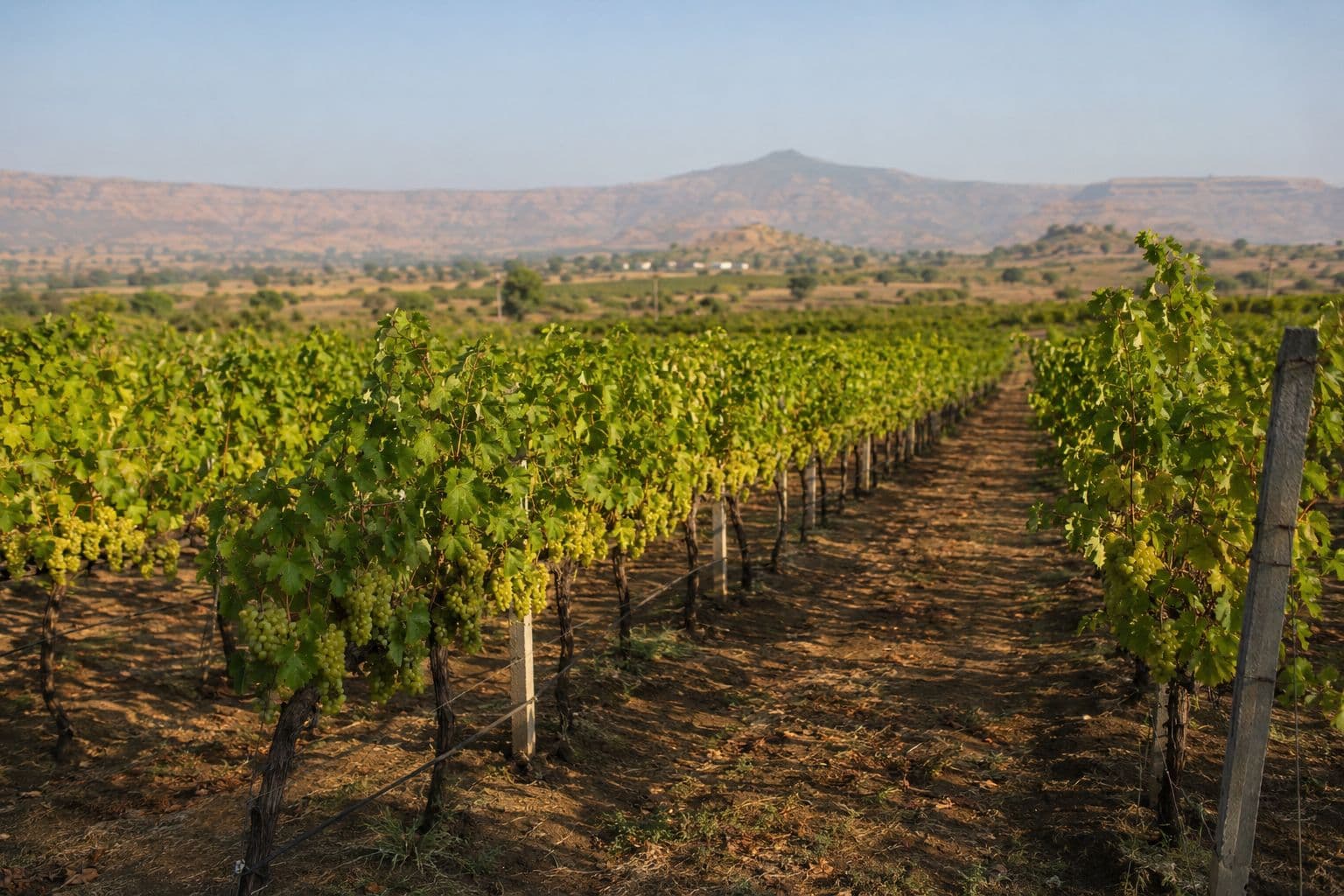
Indian raisins come almost entirely from Maharashtra, and within Maharashtra from Sangli district, with Tasgaon as the trading centre. India makes green, black and golden seedless raisins from Thompson seedless grapes and their local clones, dried between February and April. Sultanas and currants are not produced here at any scale. Munakka is a separate seed-bearing trade with its own supply.
The short version
Where raisins are grown in India
The map is smaller than most people expect. Raisin making in India sits in western Maharashtra, concentrated in Sangli district, running into parts of Solapur and Satara, with a further pocket across the state boundary in Vijayapura and Bagalkot in northern Karnataka. Nashik grows more grapes than any of them. Very little of the Nashik crop is dried, because those bunches earn more as table fruit and export cartons.
Within Sangli the trade sits around Tasgaon, Palus, Miraj and Kavathe Mahankal. Tasgaon is the middle of it. Drying sheds, sorting halls, cold storages and the market yard are close enough that a lot can come off the racks in the morning and be graded, weighed and sold before the shed cools in the evening. Our buying desk works out of that cluster, and the season, the market pattern and our sourcing model are set out on our page on the Sangli belt.
Andhra Pradesh, Telangana and parts of Tamil Nadu grow grapes as well. Almost none of it becomes raisin. The district by district picture, and why the drying map is so much narrower than the grape map, is in raisin production in India.
The concentration is not an accident of soil. Raisin quality is decided in the two weeks after picking, not in the vineyard alone, and a district that already owns the racks, the net sheds, the trained sorting labour and the cold storage bays turns out steadier lots than one that has to truck fruit somewhere else to dry it. The infrastructure is the advantage, and it took a long time to build.
Why Sangli and Tasgaon hold the trade
Three things have to line up before a place can make raisins at scale, and they line up here.
The trade itself runs through the market yard on the auction pattern most Indian agricultural commodities use. Growers or their agents bring lots in, buyers walk the rows and sample by hand, and rates settle per quintal against the grade sitting in front of them. Nobody quotes one price for raisins, because there is no such thing as one raisin. There is a lot, in a bag, with a length, a colour and a moisture level.
Being inside the belt is what lets us buy the way we do, lot by lot as stock comes off the racks, rather than committing to one large purchase in March and living with it until January. Some of our stock comes from growers we deal with directly and some comes through cold storages. We would rather say that plainly than print a farm-to-door claim we cannot stand behind.
Types of raisins in India
India makes three retail types and they are all the same grape. What separates them is how the fruit was dried. That one fact explains most of the confusion in this category, and if you buy raisins regularly it is worth reading the full variety guide once and then never worrying about it again.
What India makes and what it does not
Green, the volume variety
Long, pale green, firm, tart underneath the sweetness. This is what most Indian households mean when they say kismis, and it is the grade ladder buyers argue over most, because length is visible and easy to price. Premium select runs 18-22 mm. Shorter grades go to sweet shops and mixes where the raisin gets chopped or soaked anyway.
Black, the sun dried one
The same Thompson fruit, dried in open sun instead of under nets, so the skin darkens and the sugar concentrates. Smaller, softer, sweeter. It goes into kheer, sheera, panjiri and everyday snacking, and it is the variety most Indian kitchens keep as the default jar. If you want to see how one grape ends up two colours, the drying process sets it out day by day.
Golden, the shade dried premium
Riper fruit, a slower shade schedule, amber colour, plump and mild. Bakeries and mithai kitchens ask for it when the raisin has to be visible in the finished product rather than disappearing into it. Golden lots carry a permitted preservative, sulphur dioxide (E220), to hold the pale colour, and it is declared on the pack.
Munakka, which is not a grade of kismis
Munakka is a larger dried grape that keeps its seeds and trades on its own supply and its own price. Asking a shopkeeper for raisins and getting munakka, or the reverse, is a common and annoying mistake. The difference between kismis and munakka takes two minutes to read and saves a wasted purchase if a recipe names one of them specifically.
The grape behind Indian raisins
Nearly all of it is Thompson seedless, grown here as a family of local clones rather than one uniform vine. Tas-A-Ganesh, Sonaka and Manik Chaman are the names you hear in the belt. They differ mostly in berry length and in how the bunch fills out, and berry length is exactly what a raisin buyer pays for.
Sonaka runs longer in the berry, so Sonaka lots tend to give the long green raisin that sits at the top of the retail ladder. Tas-A-Ganesh is the workhorse. A grower with either can send the crop two ways, and the decision usually gets taken around January on the price of fresh grapes against the expected raisin rate.
That fork matters more than buyers realise. In a season when export bookings for fresh table grapes are strong, less fruit reaches the drying racks, and the raisins that do get made carry the cost of that competition all year.
How Indian raisins are graded and named
There is no national grade standard that every trader follows. What exists instead is a working vocabulary the market yard, the cold storages and the packers all understand well enough to trade on: premium select, grade A, grade B, and for golden, jumbo.
Three things decide where a lot lands. Length, colour uniformity and moisture. Green raisins come off the racks at roughly 15% moisture, and anything wetter will clump in the bag by August. Colour is judged across a handful, never on a single piece, because a few darker raisins in a pale lot are normal and mean nothing.
The grade vocabulary you will actually hear
Checking a lot yourself
You do not need equipment. Pour a handful, look at the spread of sizes, look at the colour across the whole handful, squeeze and release to see whether the pieces separate, and bite two or three pieces from different parts of the pack. The five checks that separate a good lot from an average one are set out in our quality checklist, and they work equally well in a shop or on a godown floor.
Indian raisins compared with imported ones
Most of what India imports is a type India does not make. Sultanas come mainly from Turkey. Currants, the tiny dark ones in Christmas baking, come from Greece. Long green raisins arrive from Iran and Afghanistan, dried in ventilated brick drying houses rather than under nets, which gives them a different surface and a chewier bite.
For an Indian kitchen the substitutions are simple. Golden raisins stand in for sultanas in almost every recipe, and the few places where the two genuinely part ways are worth knowing before you shop an imported recipe. Currants have no local equivalent at all, so a recipe that needs them needs the imported product.
Imported types and their domestic equivalents
On price and on consistency
Domestic lots win on landed cost almost every time, because there is no freight, no import duty and no six week transit sitting on top. On quality, a good Indian lot matches anything imported. The honest catch is that Indian retail packs vary far more than imported ones, since a large share of the stock in the market changes hands unbranded and ungraded, and whoever packs it last decides what to call it.
The season, and why a packing date beats a brand name
Everything India makes is made between February and April. There is no second crop, no autumn harvest, no way to add supply once the racks are cleared. From roughly May the whole country is selling out of cold storage, where a lot that went in at the right moisture will keep well for a year.
So the useful question on a retail pack is not which brand, but which season and how long since packing. A March lot packed in June is a different product from the same grade packed in January and then sitting in a warm shop through the monsoon.
We pack in short runs and print the packing date on every pouch, because when the underlying stock comes from the same few market yards, grade and freshness are the facts that actually differ between suppliers.
What this means when you buy Indian raisins
Origin is not the differentiator most packs pretend it is. If the label says Indian, it is very probably Sangli, whoever printed it. What varies is the grade, the season and the handling, in that order.
At retail that comes down to three decisions: which variety suits the use, which grade you are willing to pay for, and how fresh the pack is. Our black packs are ₹229, ₹429 and ₹799 for 250g, 500g and 1kg. Green raisin packs run ₹249, ₹449 and ₹849, and golden sits at ₹289, ₹539 and ₹999. The full ladder with the per kilo arithmetic is on the kismis price page.
Buying by the sack changes the questions entirely. Then it is grade specification, moisture, packing format, a sample before the first order and a rate quoted on the day. Minimum order is 15kg, samples are 250g charged at cost and adjusted against your first invoice, and a quoted rate holds for 48 hours.
Frequently asked
Mostly in western Maharashtra, concentrated in Sangli district and above all around Tasgaon, with smaller volumes from Solapur, Satara and from Vijayapura and Bagalkot in northern Karnataka. Nashik has more vineyard area but sends most of its crop out as fresh table grapes rather than drying it.
Bought lot by lot in Tasgaon, packed in short runs, packing date printed on every pouch.
See this season's packs